GST • Income Tax • Registration • Payroll • Advisory • FSSAI • Virtual CFO

12A & 80G Registration for NGOs in India

Obtain 12A & 80G Registration to help your NGO avail income tax exemptions and enable donors to claim tax deductions on eligible donations. Cotaxo’s experts manage the complete registration process with accurate documentation, regulatory guidance, and end-to-end support to help your organization build long-term credibility and financial sustainability.

Enter Your Details to Receive a Full Quote and Consultation

What Sets Cotaxo Apart

Dedicated Expert Assistance

Transparent Pricing

End-to-End Compliance Support

Pan-India Service Coverage

What is 12A and 80G Registration?

For any non-profit organization in India, obtaining 12A and 80G Registration is an important step toward financial sustainability and legal recognition. Whether your organization is established as a Trust, Society, or Section 8 Company, these registrations help reduce the tax burden and improve fundraising opportunities.

Registration under Section 12A allows eligible charitable or religious organizations to claim exemption on their income, while Section 80G enables donors to claim tax deductions on eligible contributions made to the organization. Together, these registrations strengthen the credibility of an NGO and make it more attractive to donors, CSR contributors, and grant providers.

Section 12A Registration under the Income Tax Act, 1961

Section 12A provides eligible charitable and religious organizations with exemption from income tax on income applied towards their approved objectives. Without this registration, the income earned by an NGO, including voluntary donations and grants, may become taxable under the applicable provisions of the Income Tax Act.

Obtaining registration under Section 12A confirms that the organization operates for genuine charitable or religious purposes and complies with the prescribed legal requirements.

Section 12AB Registration

The registration framework introduced under Section 12AB has replaced the earlier registration process under Section 12A. NGOs are now granted registration and renewals under Section 12AB in accordance with the revised provisions of the Income Tax Act.

Although the registration process is now governed by Section 12AB, the term 12A Registration continues to be widely used because it represents the tax exemption available to eligible charitable organizations.

Section 80G Registration under the Income Tax Act, 1961

Section 80G allows donors to claim deductions on eligible donations made to approved charitable institutions. Once an NGO receives 80G registration, eligible individuals, companies, and other taxpayers can claim tax benefits on their contributions, subject to the conditions prescribed under the Income Tax Act.

The availability of tax deductions encourages charitable giving and helps NGOs attract greater financial support from individuals, corporate donors, and CSR initiatives.


Difference Between 12A and 80G Registration

Although both registrations are issued under the Income Tax Act, they serve different purposes. The following comparison explains their roles:

Particulars Section 12A Registration Section 80G Registration
Primary Benefit Exempts the NGO's eligible income from income tax Allows eligible donors to claim tax deductions on donations
Beneficiary The NGO or charitable organization The donor making the contribution
Purpose Provides tax exemption on income used for charitable purposes Encourages charitable donations by offering tax benefits
Eligibility Available to eligible Trusts, Societies, and Section 8 Companies Generally granted to organizations holding valid 12AB registration
Importance Essential for obtaining income tax exemption Helps improve fundraising and donor confidence

Why Your NGO Should Obtain Both 12A and 80G Registration

Registering under both Section 12A and Section 80G provides significant advantages for charitable organizations. While 12A registration helps reduce the organization’s tax liability, 80G registration encourages more individuals and businesses to contribute by offering tax benefits on eligible donations.

Having both registrations also enhances the credibility of your NGO and improves eligibility for various government schemes, CSR funding opportunities, institutional grants, and philanthropic partnerships. For many funding programs, valid 12AB and 80G registrations are considered essential compliance requirements.

With Cotaxo, you receive end-to-end assistance for obtaining both registrations, ensuring your application is prepared accurately and submitted in accordance with the latest regulatory requirements.

Benefits of 12A and 80G Registration

Obtaining both 12A and 80G Registration provides important legal, financial, and fundraising advantages for charitable organizations. These registrations not only reduce the tax burden on the NGO but also improve its credibility among donors, corporate partners, and government authorities.

1. Income Tax Exemption for the Organization

Registration under Section 12A enables eligible NGOs to claim exemption on income applied towards charitable or religious purposes. This allows the organization to utilize a larger share of its funds for its core objectives instead of paying income tax.

2. Better Fundraising and Donor Confidence

An NGO registered under Section 80G allows eligible donors to claim tax deductions on their contributions. This encourages individuals and businesses to contribute more confidently while strengthening the organization’s credibility and public trust.

3. Access to Government Grants and Funding Opportunities

Many government departments, public welfare schemes, and funding agencies prefer or require NGOs to hold valid 12A and 80G registrations before extending financial assistance. These registrations demonstrate that the organization meets the prescribed legal and regulatory requirements.

4. Eligibility for CSR Funding

Companies undertaking Corporate Social Responsibility (CSR) initiatives generally prefer to collaborate with compliant and registered NGOs. Holding 12A and 80G registrations improves an organization’s eligibility for CSR partnerships and enhances its ability to attract corporate funding.

5. Stronger Institutional Credibility

Having both registrations reflects that the NGO operates within the legal framework of the Income Tax Act. This enhances its reputation among donors, financial institutions, government bodies, and philanthropic organizations.

6. Long-Term Financial Sustainability

Tax exemptions for the organization and tax benefits for donors create a stronger financial foundation. This helps NGOs attract consistent funding, expand their charitable activities, and achieve long-term operational sustainability.

Eligibility Criteria for 12A & 80G Registration

To obtain registration under Sections 12A and 80G of the Income Tax Act, an organization must satisfy the eligibility conditions prescribed by the Income Tax Department. These requirements ensure that only genuine charitable and non-profit organizations receive tax benefits and recognition.

General Eligibility for NGOs

Regardless of whether the organization is established as a Trust, Society, or Section 8 Company, the following conditions generally apply:

  • The organization must be formed exclusively for charitable or religious purposes as defined under the Income Tax Act. Eligible objectives include education, medical relief, relief of the poor, environmental protection, preservation of monuments, yoga, and other activities that serve the public interest.
  • The organization must function on a genuine non-profit basis. Its income, assets, and resources should be used only to achieve its stated charitable objectives and should not provide personal financial benefits to founders, trustees, members, or directors.
  • Proper books of accounts, financial records, and supporting documents must be maintained to demonstrate transparency and accountability.
  • If the organization carries out any business or commercial activity, it must remain incidental to its primary charitable purpose, and separate books of accounts should be maintained wherever required.
  • The NGO must be legally registered under the applicable law as a Public Charitable Trust, Registered Society, or Section 8 Company before applying for tax registrations.
  • The activities of the organization should benefit the general public and must not be established solely for the benefit of any particular religious community or caste, except where specifically permitted under applicable law.

Eligibility for Public Charitable Trusts

A Public Charitable Trust can apply for 12A and 80G registration if it meets the following conditions:

  • The trust is legally constituted under the applicable Trust Act or relevant state legislation.
  • The Trust Deed clearly defines its charitable objectives and governing provisions.
  • The trust carries out activities that are consistent with its stated charitable purposes.

Eligibility for Registered Societies

A society seeking registration should fulfil the following requirements:

  • It must be registered under the Societies Registration Act, 1860 or the relevant state legislation.
  • Its Memorandum of Association and Rules & Regulations should clearly specify charitable objectives.
  • The society should actively work towards public welfare without distributing profits among its members.

Eligibility for Section 8 Companies

A Section 8 Company is eligible to apply if it satisfies the following conditions:

  • It is incorporated under Section 8 of the Companies Act, 2013.
  • The company’s primary objective is to promote charitable activities such as education, healthcare, social welfare, research, environmental conservation, art, culture, science, sports, or other recognised public welfare activities.
  • Any income or surplus generated by the company is reinvested solely for achieving its objectives.
  • The company does not declare or distribute dividends or profits to its members or shareholders.
  • It complies with the statutory provisions applicable to Section 8 Companies and maintains proper governance and financial records.

Cotaxo assists Trusts, Societies, and Section 8 Companies in assessing eligibility, reviewing documentation, and completing the 12A and 80G registration process with complete professional support and compliance guidance.

Provisional and Permanent Registration under Sections 12A & 80G

The registration framework for NGOs was revised through the Finance Act, 2020 to improve transparency and ensure periodic review of charitable organizations. As a result, all new applicants now receive provisional registration before becoming eligible for regular registration.

Provisional Registration

Newly established Trusts, Societies, and Section 8 Companies are initially granted provisional registration under Sections 12A and 80G. This registration is generally valid for three years and allows the organization to begin its charitable activities while remaining eligible for applicable tax benefits.

Permanent Registration

After receiving provisional registration, the organization must apply for regular (permanent) registration:

  • At least six months before the expiry of the provisional registration, or
  • Within six months from the date of commencement of its charitable activities,

whichever is earlier.

Once approved, the registration is generally valid for five years, after which it must be renewed within the prescribed timeline to continue enjoying tax exemptions and donor-related benefits.

Renewal of Registration

NGOs are required to renew their registration before its validity expires. Under the current provisions, regular registration is generally renewed for a five-year period. In certain cases, eligible smaller charitable trusts may receive a ten-year validity in accordance with the applicable provisions of the Income Tax Act and related government notifications.

Cotaxo assists NGOs throughout the entire registration lifecycle, from provisional registration to permanent registration and timely renewals, helping ensure continuous compliance with the applicable legal requirements.

Documents Required for 12A & 80G Registration

Preparing the required documents in advance helps ensure a smooth and hassle free registration process. The Income Tax Department may request additional information depending on the nature and activities of the organization.

Common Documents Required

The following documents are generally required for all NGOs, irrespective of whether they are registered as a Trust, Society, or Section 8 Company.

Document Purpose
NGO PAN Card Self attested copy of the PAN card issued in the name of the organization.
Registration Certificate Certificate of registration or incorporation issued by the relevant authority.
Constitutional Documents Trust Deed, Memorandum of Association (MoA), Articles of Association (AoA), or Bye Laws, as applicable.
Registered Office Proof Recent electricity bill, water bill, property tax receipt, or rent agreement along with the owner's No Objection Certificate (NOC), wherever applicable.
Financial Statements Audited Balance Sheet, Income & Expenditure Account, Audit Report, and other financial records for the previous three financial years or from the date of incorporation if the organization is newly established.
Bank Statements Bank account statements for the applicable financial period.
Activity Report Brief note describing the charitable activities, projects, and achievements of the organization along with supporting documents, if available.
Governing Body Details List of trustees, directors, or governing body members along with their PAN, address, and contact details.
Donor Information Details of donors, if applicable, particularly where donations have already been received.
Declaration or Affidavit Declaration confirming that the organization carries out genuine charitable activities and complies with the applicable legal provisions.
Existing Registration Certificates Copies of any existing registrations under Sections 12A, 12AA, 12AB, or 80G, if previously granted.
FCRA Registration Certificate Required only if the organization has obtained registration under the Foreign Contribution (Regulation) Act.
NITI Aayog NGO DARPAN Registration Registration details or Unique ID, wherever applicable.

Additional Documents for Trusts

Public Charitable Trusts may also be required to produce:

  • Original Trust Deed for verification, if requested by the authorities.
  • Any supplementary trust deeds or amendment documents, where applicable.

Additional Documents for Registered Societies

Registered Societies should keep the following documents ready:

  • Original Society Registration Certificate.
  • Original Memorandum of Association and Rules & Regulations or Bye Laws for verification, if required.

Additional Documents for Section 8 Companies

Section 8 Companies are generally required to provide:

  • Original Certificate of Incorporation issued by the Ministry of Corporate Affairs.
  • Original Memorandum of Association (MoA) and Articles of Association (AoA), if verification is requested.
  • Details of directors and statutory registrations, wherever applicable.

Cotaxo assists in preparing, reviewing, and verifying all documentation before submission, helping reduce errors and improving the chances of timely approval for both 12A and 80G registration.

How to Apply for 12A & 80G Registration

The application for 12A and 80G registration is completed online through the Income Tax Department’s e-Filing portal. Below is the standard registration process:

  1. Prepare the Required Documents
    Collect all supporting documents required for the application, including registration certificates, constitutional documents, financial records, and identity proofs.
  2. Access the Income Tax e-Filing Portal
    Log in to the official Income Tax e-Filing portal using the organization’s registered credentials.
  3. Select the Appropriate Application Form
    Choose Form 10A for fresh or provisional registration, or Form 10AB for regular registration, renewal, or other applicable cases.
  4. Complete the Online Application
    Enter all required details relating to the organization, its objectives, registration details, and charitable activities.
  5. Upload Supporting Documents
    Attach self attested scanned copies of all required documents in the prescribed format.
  6. Verify and Submit the Application
    Submit the application using a valid Digital Signature Certificate (DSC) or Electronic Verification Code (EVC), as applicable.
  7. Receive the Acknowledgement
    After successful submission, an acknowledgement number is generated, which can be used to track the application status.
  8. Application Review by the Income Tax Department
    The Commissioner of Income Tax (Exemptions) examines the application and supporting documents. Additional information may be requested if required.
  9. Respond to Queries, if Any
    If the department seeks clarification or raises any objections, the applicant must submit the necessary explanation or documents within the prescribed time.
  10. Issue of Registration Certificate
    Once the application is approved, the Income Tax Department issues the registration order granting registration under Section 12A, Section 80G, or both, as applicable.

Forms Used for 12A & 80G Registration

Application Purpose Form When to Apply Registration Validity Department Processing Time
Fresh Provisional Registration Form 10A Before commencing the relevant assessment year 3 Years Generally within 1 month from the end of the month in which the application is received
Migration from Existing 12A/12AA Registration Form 10A As prescribed by the Income Tax Department 5 Years Generally within 3 months from the end of the month in which the application is received
Conversion from Provisional to Regular Registration Form 10AB At least 6 months before provisional registration expires or within 6 months from commencement of activities, whichever is earlier 5 Years Generally within 6 months from the end of the month in which the application is received
Renewal of Existing Registration Form 10AB At least 6 months before expiry of the existing registration 5 Years* Generally within 6 months from the end of the month in which the application is received
Modification of Charitable Objects Form 10AB Within 30 days of adopting or modifying the objects As applicable Generally within 6 months from the end of the month in which the application is received

Note: In certain cases, eligible charitable organizations with lower annual income may receive a longer renewal validity as permitted under the applicable provisions of the Income Tax Act and related government notifications.

12A & 80G Registration Fees

The overall cost of obtaining 12A and 80G registration depends on the services required, the complexity of the application, and the documentation involved. The expenses are generally divided into the following categories.

Government Fees

At present, the Income Tax Department does not levy any government filing fee for submitting Form 10A or Form 10AB through the Income Tax e-Filing portal.

Professional Fees

Many NGOs choose to work with experienced professionals to ensure accurate documentation and timely filing. Professional charges may vary depending on:

  • The complexity of the organization’s structure and activities.
  • The scope of services included, such as document drafting, application filing, compliance review, and departmental assistance.
  • The experience and expertise of the consultant handling the registration.

Estimated Professional Fees: ₹8,000 to ₹30,000 or more, depending on the requirements.

Other Associated Costs

Particulars Estimated Cost
Digital Signature Certificate (DSC) ₹500 to ₹2,000
Notarisation of Documents ₹50 to ₹500 per document
Courier or Documentation Charges (if applicable) As per actual expenses

At Cotaxo, we provide end to end assistance for 12A and 80G registration with transparent pricing, expert documentation support, and complete guidance throughout the registration process.

Renewal of 12A & 80G Registration

Renewal of 12A and 80G registration is a mandatory compliance requirement for eligible charitable organizations. NGOs must renew their registration within the prescribed timeline to continue enjoying tax exemptions and donor-related tax benefits under the Income Tax Act.

Why is Renewal Required?

The Finance Act, 2020 introduced a revised registration framework under which 12A and 80G registrations are no longer granted permanently. Instead, organizations are required to renew their registrations at regular intervals to ensure they continue to satisfy the prescribed eligibility and compliance requirements.

In general, regular registrations remain valid for five years. Certain eligible charitable trusts may qualify for a longer validity period in accordance with the applicable provisions of the Income Tax Act and related government notifications.

Renewal Process

The renewal procedure is carried out online through the Income Tax e-Filing portal and generally involves the following steps:

  1. File Form 10AB through the Income Tax e-Filing portal within the prescribed timeline.
  2. Upload the required documents, including updated financial statements, activity reports, registration certificates, and other supporting records.
  3. Departmental Verification is carried out by the Income Tax Department to review the organization’s activities, compliance history, and submitted documents. Additional information may be requested if necessary.
  4. Issue of Renewal Order is granted once the authorities are satisfied that the organization continues to meet the applicable legal requirements. The renewed registration is generally valid for the prescribed period.

When Should You Apply for Renewal?

Organizations should submit Form 10AB at least six months before the expiry of their existing registration to avoid any interruption in tax exemption benefits.

It is advisable to begin preparing the required documents well in advance so that the renewal application can be filed within the prescribed time.

Compliance Requirements After 12A & 80G Registration

Obtaining registration under Sections 12A and 80G is only the first step. To continue enjoying tax exemptions and donor-related benefits, NGOs must comply with the ongoing requirements prescribed under the Income Tax Act and related rules.

Key Compliance Requirements

  1. Maintain Proper Books of Accounts

Maintain accurate books of accounts, donation registers, receipts, bank records, and other financial documents. Proper accounting records should be preserved in accordance with the applicable provisions of the Income Tax Act and Income Tax Rules.

  1. File Annual Income Tax Return

Every NGO registered under Section 12A is required to file its annual Income Tax Return using the applicable ITR form, generally ITR-7, within the prescribed due date, irrespective of whether tax is payable.

  1. Issue Donation Receipts and Form 10BE

NGOs registered under Section 80G should issue valid donation receipts to donors containing the prescribed details. They are also required to provide Form 10BE, enabling donors to claim the applicable tax deduction.

  1. File Form 10BD

Organizations registered under Section 80G must submit Form 10BD, the annual statement of donations received, within the prescribed due date each financial year.

Consequences of Non-Compliance

Failure to comply with the statutory requirements may result in financial penalties, cancellation of tax benefits, and other legal consequences.

  1. Late Filing Fees and Interest

Delayed filing of applicable returns may attract late fees, interest, and other charges as prescribed under the Income Tax Act.

  1. Withdrawal of Tax Exemption

Non-compliance with the prescribed conditions may result in withdrawal of the tax exemption available under Section 12A, making the organization’s income taxable.

  1. Cancellation of Registration

The Income Tax Department may cancel or revoke the organization’s registration if it finds misuse of funds, violation of charitable objectives, or repeated failure to comply with statutory requirements.

  1. Legal Action

In cases involving serious violations, fraudulent activities, or deliberate non-compliance, the authorities may initiate legal proceedings, including penalties and prosecution, wherever applicable under the law.

Cotaxo helps NGOs stay compliant by providing timely filing support, documentation assistance, and ongoing advisory services to ensure uninterrupted tax benefits and regulatory compliance.

Common Reasons for Rejection of 12A & 80G Registration

The approval of a 12A and 80G application depends on accurate documentation, proper compliance, and meeting the eligibility requirements prescribed under the Income Tax Act. The following are some of the most common reasons why applications are rejected.

1. Incorrect or Incomplete Application

Errors in Form 10A or Form 10AB, missing information, incorrect details, or incomplete submissions can delay the application or lead to rejection. It is important to ensure that all mandatory fields are accurately completed before filing.

2. Inconsistency Between Objectives and Activities

The charitable objectives mentioned in the Trust Deed, Memorandum of Association (MoA), or Articles of Association (AoA) should be consistent with the actual activities carried out by the organization. Any mismatch or objectives that do not qualify as charitable under the Income Tax Act may result in rejection.

3. Inadequate Financial Records

Failure to maintain proper books of accounts, audited financial statements, supporting documents, or clear records showing the utilization of funds for charitable purposes may adversely affect the application.

4. Failure to Meet Eligibility Requirements

Applications may also be rejected if the organization does not satisfy the prescribed eligibility conditions, such as having an invalid legal structure, missing PAN, incomplete registration under the applicable law, or failing to meet other statutory requirements.

Cotaxo carefully reviews your eligibility, documentation, and application before submission to minimize the chances of rejection and help ensure a smooth registration process.

12A & 80G Registration Certificate

After successful approval of your application, the Income Tax Department issues the registration certificates under Section 12A and Section 80G. These certificates serve as official proof that your organization is eligible for the applicable tax benefits under the Income Tax Act.

The 12A Registration Certificate enables the organization to claim income tax exemption on eligible income, while the 80G Registration Certificate allows eligible donors to claim tax deductions on their donations, subject to the applicable provisions of the Act.

The certificates generally contain important details such as the organization’s name, PAN, registration number, date of registration, and the applicable validity period.

Importance of the 12A & 80G Certificate

A valid registration certificate helps your organization:

  • Avail income tax exemption on eligible income.
  • Enable donors to claim tax deductions on eligible donations.
  • Apply for government grants, CSR funding, and other financial assistance.
  • Enhance credibility among donors, funding agencies, and regulatory authorities.
  • Demonstrate compliance during audits, statutory filings, and due diligence.

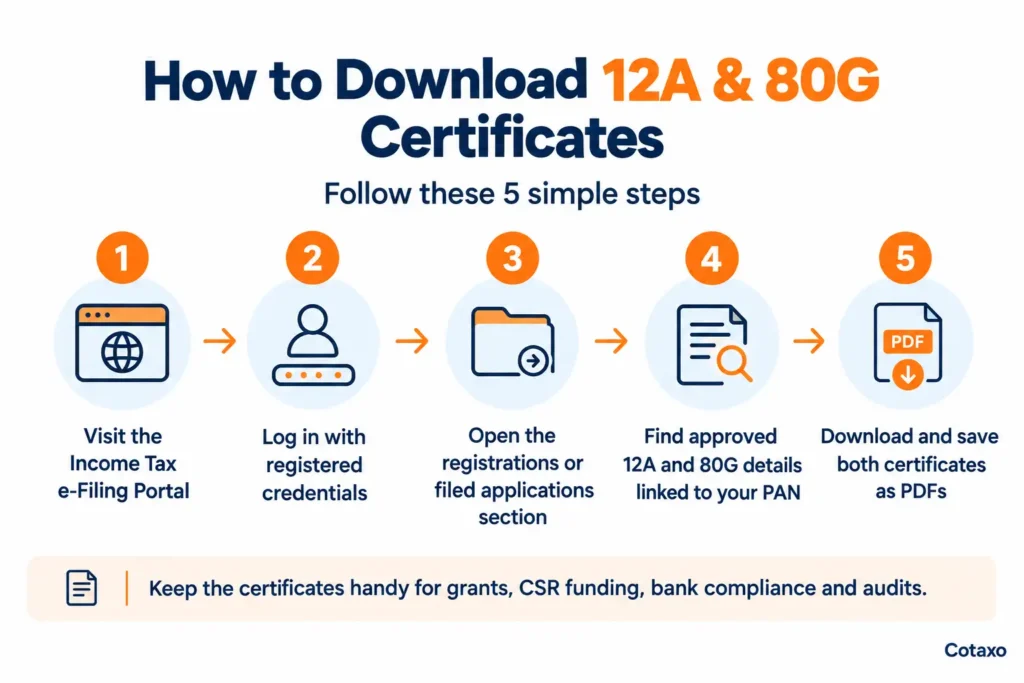
How to Download the 12A & 80G Registration Certificate

Follow these steps to access your registration certificates online:

  1. Visit the official Income Tax e-Filing Portal.
  2. Log in using the organization’s registered credentials.
  3. Navigate to the relevant section for registrations or filed applications.
  4. Locate the approved 12A and 80G registration details linked to the organization’s PAN.
  5. Download the certificates in PDF format and save them for future reference.

These certificates are frequently required while applying for grants, CSR funding, opening bank accounts for compliance purposes, statutory audits, and various regulatory submissions. Cotaxo also assists clients in obtaining and maintaining copies of their registration certificates whenever required.

Talk To Our Experts

Frequently Asked Questions (FAQs)

Can I apply for 12A and 80G registration together?

Yes. Eligible NGOs can apply for both 12A and 80G registration through the same application process. Depending on the type of application, the registration is filed using Form 10A or Form 10AB on the Income Tax e-Filing portal, allowing both requests to be processed simultaneously.

The processing time depends on the completeness of the application, supporting documents, and verification by the Income Tax Department. In most cases, applications are processed within a few weeks to a few months.

Yes. The Income Tax Department may cancel or revoke the registration if the organization violates the prescribed conditions, carries out activities that are not charitable in nature, misuses funds, or fails to comply with the applicable legal requirements.

The percentage of tax deduction available to a donor depends on the category of the approved charitable institution and the provisions applicable to that donation. Some donations qualify for a 100% deduction, while others are eligible for a 50% deduction, subject to the conditions prescribed under the Income Tax Act.

Yes. Donations made in cash beyond the limit prescribed under the Income Tax Act are not eligible for tax deduction under Section 80G. Donations through banking channels or digital payment methods are generally preferred for claiming tax benefits.

A Unique Registration Number (URN) is the identification number allotted by the Income Tax Department after approval of registration under Sections 12A or 80G. It serves as the official reference for the organization’s registration.

Yes. Under the current registration framework, 12A registration is generally granted for a specified validity period and must be renewed within the prescribed timeline to continue receiving tax exemption benefits.

Trusts, Societies, and Section 8 Companies established for eligible charitable purposes and complying with the conditions prescribed under the Income Tax Act can apply for 80G registration.

A 12A Registration Certificate is an official approval issued by the Income Tax Department that allows an eligible charitable organization to claim exemption on its income, subject to compliance with the applicable provisions of the Income Tax Act.

An 80G Registration Certificate authorizes eligible donors to claim tax deductions on donations made to the registered charitable organization, subject to the provisions and limits specified under the Income Tax Act.

Why Choose Cotaxo for 12A & 80G Registration?

Setting up tax exemptions for your NGO requires accurate documentation, compliance with Income Tax provisions, and timely filing. At Cotaxo, we simplify the entire registration process by providing expert guidance from eligibility assessment to certificate approval, helping your organization focus on creating social impact.

What We Offer

Whether you are establishing a new charitable organization or renewing your existing registration, Cotaxo helps Trusts, Societies, and Section 8 Companies complete the process with confidence and professional support.

Let our specialists handle your 12A & 80G registration process

Ready to Register Your NGO Under 12A & 80G?

Obtaining 12A and 80G registration is an important step towards securing tax exemptions, improving donor confidence, and strengthening your organization’s credibility. Whether you are a newly established NGO or need assistance with registration, renewal, or compliance, Cotaxo’s experts are here to help.