GST • Income Tax • Registration • Payroll • Advisory • FSSAI • Virtual CFO

Trademark Opposition in India

Protect your brand from conflicting trademark registrations with Cotaxo’s professional Trademark Opposition services. If a trademark published in the Trade Marks Journal is identical or deceptively similar to your existing brand, our experts help you file a well-supported opposition, prepare legal documents, respond to counter-statements, and represent your interests throughout the opposition proceedings under the Trade Marks Act, 1999.

Enter Your Details to Receive a Full Quote and Consultation

What Sets Cotaxo Apart

Dedicated Expert Assistance

Transparent Pricing

End-to-End Compliance Support

Pan-India Service Coverage

What is Trademark Opposition?

Trademark Opposition is a legal remedy that allows any person or business to object to the registration of a trademark after it has been published in the Trade Marks Journal. If a published trademark is identical or deceptively similar to your existing trademark, is likely to create confusion among consumers, or does not meet the legal requirements under the Trade Marks Act, 1999, you can file a Notice of Opposition before the prescribed deadline.

After the opposition is filed, the trademark application is marked as “Opposed” by the Trade Marks Registry, and the matter proceeds through a legal adjudication process before the Registrar.

The opposition process generally includes the following stages:

  1. Filing of the Notice of Opposition by the opposing party.
  2. Submission of a Counter-Statement by the trademark applicant.
  3. Filing of evidence by both parties in support of their claims.
  4. Hearing before the Registrar of Trade Marks.
  5. Final order allowing or refusing the trademark registration.

Why is Trademark Opposition Important?

Trademark opposition is an effective legal mechanism that helps businesses safeguard their brand identity before a conflicting trademark is registered. Taking timely action can prevent future disputes and protect the distinctiveness of your brand.

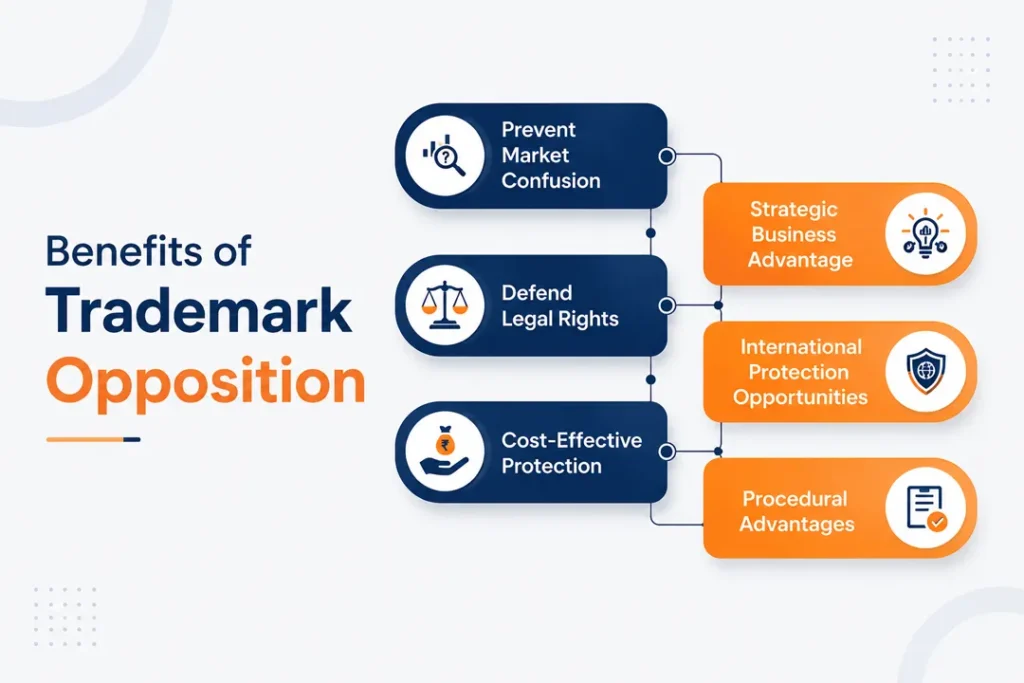
Benefits of Trademark Opposition

  • Protects your existing trademark rights from conflicting registrations.
  • Prevents customer confusion caused by similar or misleading trademarks.
  • Helps maintain the uniqueness and value of your brand identity.
  • Stops the registration of trademarks that may infringe your legal rights.
  • Promotes fair competition by preventing deceptive or dishonest trademark registrations.
  • Reduces the risk of costly legal disputes after trademark registration.
Benefits of Trademark Opposition

Who Can File a Trademark Opposition in India?

Under Section 21 of the Trade Marks Act, 1999, any person has the legal right to oppose the registration of a trademark published in the Trade Marks Journal. The law does not restrict this right only to registered trademark owners. If you believe that a published trademark may affect your rights, create confusion in the market, or does not satisfy the legal requirements for registration, you can file a Notice of Opposition within the prescribed time.

The Registrar examines the legal grounds and supporting evidence presented by the parties before deciding whether the trademark should proceed to registration.

Who Can File a Trademark Opposition?

The following individuals and entities can file a trademark opposition:

  1. Any Individual or Legal Entity

Any person, company, LLP, partnership firm, trust, society, or other legal entity can oppose a trademark application if valid legal grounds exist.

  1. Prior Users of a Trademark

Businesses or individuals who have been using a similar trademark before the applicant may oppose the registration based on prior usage rights.

  1. Registered Trademark Owners

Owners of existing registered trademarks can object to a new application that is identical or deceptively similar to their registered mark.

  1. Businesses Operating in the Same Industry

Competitors may file an opposition where the proposed trademark is likely to create confusion or dilute the identity of an existing brand.

  1. Members of the Public

Any person can oppose a trademark that is misleading, deceptive, descriptive, prohibited under law, or otherwise unsuitable for registration.

  1. Industry Associations or Trade Bodies

Associations working to protect industry interests or intellectual property rights may also initiate opposition proceedings where appropriate.

Note: More than one opponent can jointly file a single Notice of Opposition if the opposition is based on common facts and legal grounds.

When Should You File a Trademark Opposition?

Trademark opposition can only be initiated after the trademark application has been accepted by the Trade Marks Registry and published in the Trade Marks Journal. Missing the statutory deadline may result in the trademark proceeding to registration without objection.

Important Timelines

  1. File Within Four Months

The Notice of Opposition must be filed within four months from the date of publication of the trademark in the Trade Marks Journal. This time limit cannot be extended.

  1. Opposition Begins Only After Publication

A trademark application cannot be opposed while it is under examination. The right to oppose arises only after its publication in the Journal.

  1. Monitor the Trade Marks Journal Regularly

Since the Trade Marks Journal is published every week, businesses should regularly monitor newly published applications to identify trademarks that may conflict with their existing rights and take timely action.

Grounds for Trademark Opposition in India

A trademark opposition must be supported by valid legal grounds under the Trade Marks Act, 1999. The Registrar considers these grounds while deciding whether a trademark application should proceed to registration or be refused. Depending on the circumstances, an opposition may be based on one or more of the following reasons.

1. Absolute Grounds for Refusal (Section 9)

A trademark may be opposed if it fails to satisfy the essential conditions required for registration. These objections relate to the nature of the trademark itself rather than any existing rights.

Common grounds include:

  • Lack of Distinctiveness: The trademark is too generic or common to distinguish one business from another.
  • Merely Descriptive: The mark simply describes the quality, nature, purpose, or characteristics of the goods or services.
  • Customary Trade Expression: The proposed trademark consists of words or expressions commonly used in the relevant trade or industry.
  • Deceptive or Misleading: The trademark is likely to mislead consumers regarding the origin, quality, composition, or nature of the products or services.
  • Filed in Bad Faith: The application has been made dishonestly to copy another brand, exploit goodwill, or prevent another business from securing registration.
  • Prohibited Under Law: The trademark contains restricted names, national emblems, offensive matter, or any content prohibited under applicable laws.

Example: Applying to register “Fresh Milk” for milk products may be opposed because the mark merely describes the goods and does not possess sufficient distinctiveness.

2. Relative Grounds for Refusal (Section 11)

An opposition may also be filed where the proposed trademark conflicts with an existing trademark or infringes the rights of another party.

The common grounds are:

  • The proposed trademark is identical or deceptively similar to an earlier registered or pending trademark.
  • Registration of the trademark is likely to create confusion or deception among consumers.
  • The trademark conflicts with a well-known trademark, even if it relates to different goods or services.
  • Registration may result in passing off or infringe rights protected under other intellectual property laws.

3. Prior Use of a Trademark

Indian trademark law gives significant importance to prior commercial use. Even without registration, a business that has been using a trademark earlier may oppose a later application.

An opposition may be based on:

  • Earlier and continuous commercial use of the trademark.
  • Established reputation and goodwill in the market.
  • Likelihood of passing off due to the use of a similar trademark by another business.

Example: If a business has been using the trademark “Urban Wear” for clothing since 2018 without registration, it can oppose a later application for an identical or confusingly similar trademark based on its prior user rights.

4. Bad Faith Trademark Application

A trademark application can also be challenged if it has been filed with dishonest intentions or for an unfair commercial advantage.

Typical situations include:

  • Attempting to copy an established brand.
  • Filing a trademark solely to block another business from registering it.
  • Misappropriating the goodwill and reputation of an existing business.
  • Filing the application without any genuine intention to use the trademark.

Example: If an individual applies for a trademark identical to a reputed brand without any legitimate business connection, the rightful brand owner can oppose the application on the ground of bad faith.

5. Statutory and Legal Restrictions

Certain trademarks cannot be registered because they violate legal provisions or public policy. Such applications can also be opposed.

These include trademarks that:

  • Use protected national symbols, official emblems, or government insignia without authorization.
  • Contain content that is unlawful, offensive, or contrary to public morality.
  • Conflict with rights protected under other laws, including copyright, geographical indications, or statutory restrictions.
  • Include words or expressions whose use is prohibited under applicable legislation.

Example: A trademark containing a protected national emblem or other restricted government symbol may be opposed because its use is prohibited under Indian law.

Grounds for Trademark Opposition in India

Filing a trademark opposition requires submitting the prescribed forms along with supporting documents to the Trade Marks Registry. Providing complete and accurate documentation helps ensure that your opposition is processed without unnecessary delays.
The following documents are generally required:

Document Purpose
Notice of Opposition (Form TM-O) The primary application used to initiate trademark opposition. It includes the trademark application details, grounds of opposition, and information about both the opponent and the applicant.
Power of Attorney (Form TM-48) Required when the opposition is filed through a trademark attorney or authorised representative. It may be submitted subsequently within the time permitted by the Registrar.
Government Filing Fee The prescribed fee must be paid while filing Form TM-O. The applicable fee depends on the mode of filing and the number of trademark classes involved.
Supporting Evidence Documents supporting the grounds of opposition, such as trademark registration certificates, invoices, advertisements, promotional materials, sales records, website screenshots, or any other evidence establishing prior use or legal rights.
Affidavit (If Applicable) An affidavit may be filed along with supporting evidence to establish prior use, goodwill, reputation, or other facts relied upon during the opposition proceedings.

Important Note

After the applicant files the Counter-Statement, the opponent is generally required to submit supporting evidence within the prescribed timeline under the Trade Marks Rules. Alternatively, the opponent may choose to rely solely on the grounds stated in the Notice of Opposition by informing both the Registrar and the applicant within the prescribed period. Failure to comply with the applicable timeline may result in the opposition being treated as abandoned.

At Cotaxo, our trademark experts assist you in preparing the complete documentation, drafting strong legal grounds, and ensuring every filing is completed accurately and within the statutory deadlines.

Mode of Filing a Trademark Opposition Application

A Notice of Opposition (Form TM-O) must be filed within four months from the date the trademark application is published in the Trade Marks Journal. The application can be submitted either online through the IP India portal or by filing a physical application with the Trade Marks Registry.

1. Online Filing (E-Filing)

Online filing is the most convenient and preferred method for submitting a trademark opposition.

  • File Form TM-O along with the required supporting documents through the official IP India portal.
  • A registered user account and a valid Class 3 Digital Signature Certificate (DSC) are required for e-filing.
  • The prescribed government fee is ₹2,700 per class.
  • An electronic acknowledgement is generated immediately after successful submission.

2. Offline Filing (Physical Submission)

Applicants may also file a trademark opposition by submitting physical documents at the appropriate Trade Marks Registry office.

  • Submit the completed Form TM-O together with the supporting documents.
  • The prescribed government fee is ₹3,000 per class.
  • Physical acknowledgements are issued after the documents are processed by the Registry.

Which Filing Method Should You Choose?

Although both methods are legally valid, online filing is generally recommended because it is quicker, more economical, and offers faster acknowledgement and tracking of the application. The government fee is payable per trademark class, and once paid, it is non-refundable, irrespective of the outcome of the opposition proceedings.

Trademark Opposition Procedure in India

Trademark opposition is a structured legal process governed by the Trade Marks Act, 1999 and the Trade Marks Rules, 2017. Once a trademark application is published in the Trade Marks Journal, any eligible person may challenge its registration by following the prescribed procedure.

Step 1: Filing the Notice of Opposition

The opposition process begins by filing Form TM-O within four months from the date the trademark is published in the Trade Marks Journal.

The Notice of Opposition should clearly include:

  • Details of the opposed trademark application.
  • Information about the opponent.
  • The legal grounds for opposition.
  • The prescribed government filing fee.

After the application is accepted, the Trade Marks Registry serves a copy of the Notice of Opposition to the trademark applicant.

Step 2: Filing the Counter-Statement

After receiving the Notice of Opposition, the applicant must submit a Counter-Statement within two months.

The Counter-Statement should respond to each ground raised in the opposition. Once received, the Registry forwards a copy to the opponent.

Important: If the applicant fails to file the Counter-Statement within the prescribed period, the trademark application is deemed abandoned and does not proceed for registration.

Step 3: Evidence in Support of Opposition

After receiving the Counter-Statement, the opponent is required to submit evidence supporting the opposition within two months.

Supporting evidence may include:

  • Trademark registration certificates.
  • Sales invoices.
  • Advertisements and promotional materials.
  • Business records.
  •  
  • Any other documents establishing prior rights.

Instead of filing additional evidence, the opponent may choose to rely solely on the Notice of Opposition by informing both the Registrar and the applicant within the prescribed timeline.

Failure to submit evidence or the required intimation within the specified period may result in the opposition being treated as abandoned.

Step 4: Evidence in Support of the Application

After receiving the opponent’s evidence, the applicant gets two months to file evidence supporting the trademark application.

The applicant may either:

  • Submit documentary evidence supporting the application, or
  • Choose to rely entirely on the Counter-Statement already filed.

If neither evidence nor an intimation is submitted within the prescribed time, the trademark application may be treated as abandoned.

Step 5: Reply Evidence by the Opponent

The opponent may submit reply evidence within one month after receiving the applicant’s evidence.

This stage is optional and is intended only to address new facts or arguments introduced by the applicant. It cannot be used to introduce entirely new grounds that were not raised earlier.

Step 6: Hearing Before the Registrar

After completion of the evidence stage, the Trade Marks Registry schedules a hearing and issues a notice to both parties in advance.

During the hearing:

  • Both parties are given an opportunity to present their arguments.
  • An adjournment may be requested by filing Form TM-M, subject to the applicable rules and prescribed fee.
  • If a party fails to appear, the Registrar may decide the matter based on the available records or proceed in accordance with the applicable legal provisions.

Step 7: Final Decision

After considering the pleadings, documentary evidence, and submissions made during the hearing, the Registrar passes a reasoned order.

Depending on the merits of the case, the Registrar may:

  • Allow the trademark to proceed for registration.
  • Refuse the trademark application.
  • Allow registration subject to specific conditions or limitations, where applicable.

The final decision is communicated in writing to both the opponent and the applicant.

Timeline of Trademark Opposition in India

Trademark opposition proceedings follow specific timelines prescribed under the Trade Marks Act, 1999 and the Trade Marks Rules, 2017. Adhering to these deadlines is essential, as failure to act within the prescribed period may result in the opposition or trademark application being treated as abandoned.

Stage Prescribed Timeline
Publication in the Trade Marks Journal The opposition period begins once the trademark application is published in the Trade Marks Journal.
Filing the Notice of Opposition (Form TM-O) Within 4 months from the date of publication.
Counter-Statement by the Applicant Within 2 months from the date of receipt of the Notice of Opposition.
Evidence by the Opponent Within 2 months after receiving the Counter-Statement.
Evidence by the Applicant Within 2 months after receiving the opponent's evidence or intimation.
Reply Evidence by the Opponent (Optional) Within 1 month after receipt of the applicant's evidence.
Hearing Before the Registrar Scheduled by the Trade Marks Registry after completion of the evidence stage.
Final Order Issued by the Registrar after considering the evidence, submissions, and hearing. There is no fixed statutory timeline for the final decision.

Note: Missing any statutory deadline may adversely affect your rights. Filing documents within the prescribed timelines is essential for the smooth progression of trademark opposition proceedings.

Forms Used in Trademark Opposition Proceedings

Trademark opposition proceedings involve several prescribed forms under the Trade Marks Act, 1999 and the Trade Marks Rules, 2017. Each form serves a specific purpose during different stages of the opposition process.

Form Purpose Applicable Fee Key Information
Form TM-O Used for filing the Notice of Opposition as well as the Counter-Statement by the applicant. ₹2,700 per class (e-filing)₹3,000 per class (physical filing) Filed under Section 21 of the Trade Marks Act, 1999. The Notice of Opposition must be filed within 4 months from publication in the Trade Marks Journal, while the Counter-Statement must be filed within 2 months from receipt of the opposition notice.
Form TM-48 Authorises a trademark attorney or authorised representative to act on behalf of the applicant or opponent. No separate government fee Required when the proceedings are handled through an authorised representative. It may be submitted subsequently within the time permitted by the Trade Marks Registry.
Form TM-M Used for miscellaneous requests such as adjournments, corrections, amendments, or other procedural applications permitted under the Rules. ₹900 per request Hearing adjournments should generally be requested before the scheduled hearing. The Trade Marks Registry may allow a maximum of two adjournments, subject to the prescribed conditions.

Costs Involved in Trademark Opposition Proceedings

The overall cost of a trademark opposition depends on the stage of the proceedings, the number of trademark classes involved, and the complexity of the dispute. Generally, the expenses include government filing fees, professional service charges, and other case-related costs.

1. Government Fees

The Trade Marks Rules, 2017 prescribe official fees for filing applications during the opposition process.

Particulars Government Fee Remarks
Notice of Opposition (Form TM-O) ₹2,700 per class (e-filing)₹3,000 per class (physical filing) Payable while filing the opposition.
Counter-Statement (Form TM-O) ₹2,700 per class (e-filing)₹3,000 per class (physical filing) Applicable when filing the applicant's Counter-Statement.
Evidence by Affidavit No government fee Evidence is submitted during the prescribed stage of the proceedings.
Form TM-M (If Applicable) ₹900 per application Applicable for procedural requests such as adjournments or miscellaneous applications.

Note: Government fees are charged per trademark class and are non-refundable, irrespective of the outcome of the proceedings.

2. Professional Fees

Professional charges depend on the complexity of the opposition, the legal grounds involved, the volume of evidence, and the level of representation required.

Service Estimated Professional Charges
Trademark Opposition Drafting and Filing ₹5,000 to ₹20,000
Complete Opposition Proceedings with Hearing Support ₹20,000 to ₹50,000 or more, depending on the complexity of the matter

3. Other Related Expenses

Certain cases may involve additional expenses based on the facts and procedural requirements.

Expense Estimated Cost
Evidence Collection and Documentation ₹5,000 to ₹50,000+
Affidavit Drafting and Notarisation ₹1,000 to ₹5,000 per affidavit
Expert Opinion or Technical Reports (If Required) ₹10,000 to ₹1,00,000+
Hearing Representation and Legal Documentation ₹15,000 to ₹1,00,000+
Administrative and Document Service Charges ₹1,000 to ₹5,000

The final cost of a trademark opposition depends on factors such as the number of hearings, documentary evidence, legal complexity, and the duration of the proceedings. At Cotaxo, we provide transparent pricing and professional guidance throughout every stage of the trademark opposition process, helping you protect your brand efficiently and in compliance with applicable laws.

How to Defend Against a Trademark Opposition?

Receiving a trademark opposition does not automatically mean your application will be rejected. If someone opposes your trademark, you have the legal right to defend your application before the Registrar of Trade Marks under the Trade Marks Act, 1999. A well-prepared response, supported by relevant evidence and filed within the prescribed timelines, can significantly improve the chances of securing your trademark registration.

The objective is to demonstrate that your trademark is distinctive, legally adopted, and does not infringe upon the rights of any existing trademark owner.

Steps to Defend a Trademark Opposition

1. Review the Notice of Opposition

Carefully examine the Notice of Opposition to understand the exact legal grounds raised by the opponent. Common objections include similarity with an earlier trademark, prior user claims, lack of distinctiveness, or other statutory grounds under the Trade Marks Act.

2. File a Counter Statement

Submit a Counter Statement within 2 months from the date of receiving the opposition notice. Failure to respond within the prescribed period results in the trademark application being treated as abandoned.

3. Submit Supporting Evidence

Strengthen your case by filing supporting documents that establish ownership and genuine use of the trademark. Depending on your case, this may include:

  • Sales invoices
  • Marketing and advertising materials
  • Product packaging
  • Website or social media records
  • Business documents showing continuous trademark use

4. Attend the Hearing

If the matter proceeds to a hearing, both parties are given an opportunity to present their arguments before the Registrar. After examining the documents, evidence, and legal submissions, the Registrar passes a final order.

5. Explore Settlement Options

In suitable cases, both parties may resolve the dispute through mutual settlement before the final decision. This may involve withdrawal of the opposition, a coexistence agreement, or other mutually accepted terms.

6. Appeal Against the Decision

If you are dissatisfied with the Registrar’s order, you may challenge the decision before the appropriate High Court in accordance with the applicable legal provisions.

Timely action, accurate documentation, and a well-prepared legal strategy are essential for successfully defending a trademark opposition. At Cotaxo, our trademark professionals assist you throughout the process, from preparing the counter statement and evidence to representing your interests during the proceedings.

What Happens After the Registrar's Decision in Trademark Opposition?

After examining the submissions, evidence, and arguments presented by both parties, the Registrar of Trade Marks issues a final written order. This decision determines whether the opposed trademark application will move forward for registration or be rejected.

The possible outcomes include:

1. Opposition Dismissed

If the Registrar rejects the opposition, the trademark application proceeds further, and the applicant is granted registration for the trademark. A Registration Certificate is issued after completion of the required formalities.

2. Opposition Allowed

If the opposition is accepted, the trademark application is refused either completely or for specific goods or services covered under the application.

3. Partial Acceptance

In certain cases, the Registrar may allow registration for only specific goods or services while refusing protection for others, depending on the evidence submitted and the scope of the opposition.

4. Right to Appeal

If either party is dissatisfied with the Registrar’s order, they may challenge the decision before the appropriate High Court by presenting valid legal or factual grounds.

Trademark Opposition vs Trademark Objection vs Trademark Rectification

Trademark Opposition, Trademark Objection, and Trademark Rectification are three different legal procedures under the Trade Marks Act, 1999. Although all three processes relate to trademark protection, they apply at different stages and address different legal issues.

Understanding the difference helps businesses take the right action at the appropriate stage of the trademark lifecycle.

Feature Trademark Objection Trademark Opposition Trademark Rectification
Stage Raised during the examination process of a trademark application Filed after publication of the trademark in the Trade Marks Journal and before registration Initiated after the trademark has already been registered
Initiated By Trademark Examiner or Registrar of Trade Marks Any individual, business, or legal entity with valid grounds Trademark owner or any aggrieved person
Purpose To determine whether the trademark application meets the legal requirements for registration To prevent the registration of a trademark that may conflict with existing rights or legal provisions To correct, modify, or remove a registered trademark from the Trademark Register
Common Grounds Lack of distinctiveness, similarity with existing trademarks, descriptive nature, deceptive marks, or legal restrictions Prior trademark rights, likelihood of confusion, bad faith filing, similarity with existing marks, or violation of trademark laws Non-use of trademark, incorrect registration, fraudulent registration, improper entries, or legal defects
Process Filing a reply to the Examination Report and attending a hearing, if required Filing Form TM-O, submitting evidence, responding to counter-statements, and attending hearings Filing a rectification application, presenting evidence, and attending proceedings, if required
Possible Outcome Trademark application may proceed towards registration or may be refused Trademark may either be registered or rejected based on the opposition proceedings Trademark registration may be amended, cancelled, or removed from the register
Legal Provision Sections 9 and 11 of the Trade Marks Act, 1999 Section 21 of the Trade Marks Act, 1999 Sections 47 and 57 of the Trade Marks Act, 1999

Choosing the correct legal procedure is important to protect your trademark rights effectively. At Cotaxo, our trademark professionals help businesses understand the appropriate course of action and provide complete support throughout the trademark process.

Landmark Trademark Opposition Cases in India

Over the years, several landmark judgments have played an important role in shaping trademark opposition law in India. These decisions have established key principles for evaluating deceptive similarity, prior rights, consumer confusion, and protection of established trademarks.

1. Amritdhara Pharmacy v. Satya Deo Gupta (1963)

In this landmark case, the Supreme Court established the principle for determining deceptive similarity between trademarks. The Court observed that trademarks should be evaluated from the viewpoint of an average consumer with imperfect memory.

The judgment highlighted that even minor similarities in sound, appearance, or overall impression can create confusion among consumers and become valid grounds for trademark opposition.

2. Corn Products Refining Co. v. Shangrila Food Products Ltd. (1960)

The Supreme Court held that trademark similarity must be assessed by considering the overall impression created by the marks rather than comparing individual elements separately.

The decision emphasized that phonetic similarity, visual appearance, and the likelihood of confusion among consumers are important factors while deciding trademark disputes and opposition matters.

3. Nandhini Deluxe v. Karnataka Cooperative Milk Producers Federation Ltd. (2018)

In this case, the Supreme Court clarified that identical or similar trademarks may coexist if they are used for different goods or services and there is no reasonable possibility of consumer confusion.

The judgment highlighted that trademark disputes must be examined in their commercial context, including the nature of goods, target customers, and market conditions.

Talk To Our Experts

Frequently Asked Questions (FAQs)

What happens if the applicant does not file a counterstatement?

If the trademark applicant does not submit a counterstatement within the prescribed period after receiving the opposition notice, the Registrar may treat the trademark application as abandoned under Section 21(2) of the Trade Marks Act, 1999. In such cases, the application will not proceed further, and the applicant may lose the opportunity to obtain registration for the trademark.

Yes, a trademark opposition can be filed even if your trademark is not registered. A person can oppose a trademark application based on prior use, reputation, similarity with an existing mark, or other legal grounds recognised under the Trade Marks Act, 1999. Registration of the opposing party’s trademark is not always mandatory to initiate opposition proceedings.

The duration of a trademark opposition proceeding depends on factors such as submission of evidence, responses from both parties, hearings, and the workload of the Trademark Registry. Generally, the process may take several months to a few years before reaching a final decision.

A relying letter is a document submitted during trademark opposition proceedings to inform the Trademark Registry about the documents, evidence, or earlier records that a party intends to rely upon during the proceedings. It helps establish the basis of the party’s claims before the Registrar.

Yes, parties involved in a trademark opposition may mutually settle the dispute through an agreement. If both parties reach a settlement, appropriate documents may be submitted before the Trademark Registry to request withdrawal or appropriate action regarding the opposition proceedings.

To defend a trademark opposition, the applicant must file a proper counterstatement addressing the allegations mentioned in the opposition notice. The defence may include evidence of prior use, distinctiveness of the mark, differences between trademarks, and other supporting legal arguments.

The defence process generally involves:

  • Reviewing the grounds mentioned in the opposition notice.
  • Preparing and filing a counterstatement.
  • Submitting supporting evidence.
  • Attending hearings, if required.
  • Presenting legal arguments before the Registrar.

A trademark opposition notice should be answered by filing a counterstatement within the prescribed timeline. The response should address each allegation raised by the opponent and explain why the trademark application should be allowed to proceed.

Although trademark opposition cannot be completely eliminated, businesses can reduce the chances of opposition by:

  • Conducting a detailed trademark search before filing.
  • Selecting a distinctive and unique trademark.
  • Choosing the correct trademark class.
  • Avoiding marks that are identical or confusingly similar to existing trademarks.
  • Maintaining proper documentation of trademark usage.

A copy of the trademark opposition notice can be obtained from the Trademark Registry records. Applicants may access the opposition details through the official trademark records or obtain assistance from a trademark professional to review the filed documents.

Trademark opposition can be settled through mutual discussion between the parties. The settlement may involve withdrawal of opposition, consent arrangements, trademark limitations, or other mutually agreed terms. The settlement documents must be properly submitted before the Trademark Registry.

Yes, trademark classification plays an important role in opposition proceedings. A trademark can only be protected within the relevant classes of goods or services. The opposition should clearly mention the applicable trademark class and explain how the disputed application affects the opponent’s rights.

A counterstatement is the applicant’s formal response to a trademark opposition. It generally includes:

  • Details of the trademark application.
  • Response to the grounds raised by the opponent.
  • Reasons supporting registration of the trademark.
  • Legal arguments and supporting facts.
  • Any other relevant information required for defence.

Trademark opposition details can be accessed through the records maintained by the Trademark Registry. The information generally includes opposition number, parties involved, trademark details, status, and related documents.

Trademarks are published in the Trademark Journal after examination and acceptance to provide an opportunity for third parties to raise objections. This process helps prevent registration of trademarks that may conflict with existing rights or create confusion among consumers.

After filing a trademark opposition, the Trademark Registry serves a notice to the trademark applicant. The applicant must file a counterstatement within the prescribed period. After that, both parties may submit evidence and arguments before the Registrar makes a final decision.

The government fee for filing a trademark opposition depends on the applicable rules and filing method. Professional charges may vary depending on the complexity of the opposition matter, documentation, and legal assistance required.

Yes, a trademark opposition can be withdrawn by the opponent by submitting an appropriate request before the Trademark Registry. The withdrawal process must follow the applicable trademark procedures.

Documents required for trademark opposition may vary depending on the case. Commonly required documents include:

  • Trademark application details being opposed.
  • Details of the opponent’s trademark or prior use.
  • Proof supporting ownership or usage of the mark.
  • Evidence of reputation or market presence, if applicable.
  • Supporting documents and legal grounds for opposition.

Trademark objection and trademark opposition occur at different stages of the registration process.

Trademark Objection Trademark Opposition
Raised by the Trademark Examiner during examination. Filed by a third party after trademark publication.
Occurs before acceptance and journal publication. Occurs after publication in the Trademark Journal.
Applicant responds through a reply to examination report. Applicant responds by filing a counterstatement.

If no opposition is filed within the prescribed opposition period after publication in the Trademark Journal, the trademark application proceeds further towards registration, subject to completion of other formalities.

Yes, both the opponent and the trademark applicant have opportunities to submit evidence supporting their respective claims. The Registrar considers the pleadings, evidence, and arguments from both parties before passing a final order.

Why Choose Cotaxo for Trademark Opposition Services?

Trademark opposition proceedings require careful legal analysis, proper documentation, and timely responses to protect your intellectual property rights. At Cotaxo, we provide professional trademark opposition support through expert consultants who understand the legal framework under the Trade Marks Act, 1999.

Our approach focuses on understanding the facts of your case, preparing appropriate documentation, and guiding you throughout the opposition process with clear communication and professional assistance.

Here's Why Businesses Choose Cotaxo

  • Expert Legal Guidance: Get assistance from professionals who understand trademark laws, opposition procedures, and filing requirements.
  • Complete Opposition Support: From reviewing opposition notices to preparing responses, evidence, and legal documentation, Cotaxo assists you through every important stage.
  • Case-Specific Strategy: Every trademark dispute is different. We analyse your situation and provide guidance based on the facts, trademark history, and legal position.
  • Proper Documentation Assistance: Ensure that your counterstatement, evidence, and supporting documents are prepared in a structured and legally appropriate manner.
  • Transparent Communication: Receive clear updates and guidance through direct communication with expert consultants via WhatsApp, Email, and Phone.
  • Business-Focused Approach: Our objective is to help businesses, startups, and entrepreneurs protect their brand identity while managing trademark disputes effectively.
Why Cotaxo
Get expert guidance for your trademark opposition requirements

Protect Your Trademark Rights

A trademark opposition can impact your brand registration process and future business growth. Whether you need to oppose a conflicting trademark application or defend your own trademark against opposition, Cotaxo provides professional assistance to help you navigate the legal process with confidence.