GST • Income Tax • Registration • Payroll • Advisory • FSSAI • Virtual CFO

Copyright Registration Online in India

Protect your original creative work with professional copyright registration support from Cotaxo. Whether you have created a literary work, software application, music composition, artwork, website content, or any other eligible intellectual property, copyright registration helps establish legal ownership and provides stronger protection against unauthorised use.

Cotaxo provides online managed copyright registration services handled by expert consultants, assisting creators, businesses, startups, and professionals throughout the registration process with proper documentation and compliance support under the Copyright Act, 1957.

Enter Your Details to Receive a Full Quote and Consultation

What Sets Cotaxo Apart

Dedicated Expert Assistance

Transparent Pricing

End-to-End Compliance Support

Pan-India Service Coverage

What is Copyright Registration?

Copyright Registration is the legal process of recording ownership of an original creative work with the Copyright Office under the provisions of the Copyright Act, 1957 and the Copyright Rules, 2013. It provides creators and businesses with official recognition of their intellectual property rights and creates a formal record of ownership.

Copyright protection in India automatically applies to original works once they are created and expressed in a tangible form. However, obtaining copyright registration provides additional legal value by creating a publicly recorded claim of ownership. The copyright registration certificate issued by the Copyright Office acts as prima facie evidence of ownership in legal proceedings.

In simple terms, copyright registration creates an official record that establishes who owns a creative work and provides stronger support in case of unauthorised use, disputes, or infringement.

Purpose of Copyright Registration

Copyright registration helps creators and businesses protect their original work and manage their intellectual property rights effectively.

The key purposes include:

Establishing Legal Ownership

Registration creates an official record of ownership, making it easier to prove your rights over a creative work during legal disputes.

Protecting Against Unauthorised Use

A registered copyright provides stronger legal support to take action against individuals or organisations that reproduce, distribute, or use your work without permission.

Supporting Commercial Opportunities

Copyright registration helps creators safely license, assign, or commercially use their work by providing documented proof of ownership.

Maintaining Control Over Creative Assets

Registration allows copyright owners to exercise control over how their work is reproduced, distributed, adapted, or communicated to the public.

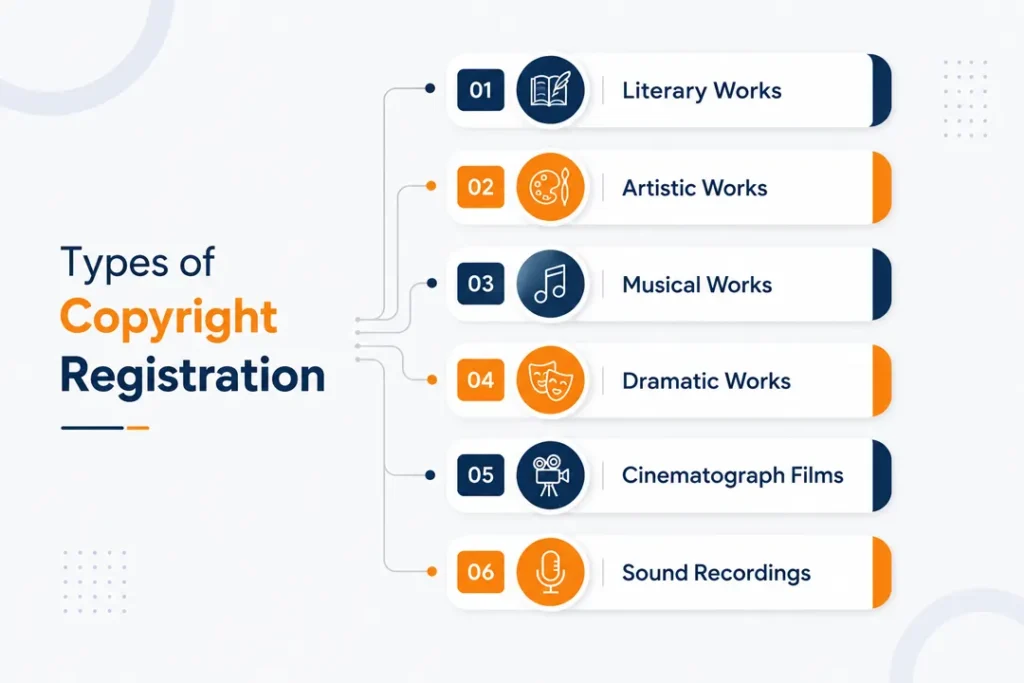
Types of Creative Works Protected Under Copyright Registration

The Copyright Act, 1957 provides protection to various categories of original creative works. Copyright registration can be obtained for the following types of works:

Types of Creative Works Protected Under Copyright Registration

Literary Works

Literary works cover written and textual creations, including both traditional and digital content.

Examples include:

  • Books and novels
  • Articles and research papers
  • Poems and manuscripts
  • Blogs and website content
  • Educational materials
  • Computer programs, source code, object code, and databases

Artistic Works

Artistic works protect original visual and graphical creations.

Examples include:

  • Paintings and drawings
  • Illustrations and designs
  • Photographs
  • Maps and technical drawings
  • Sculptures
  • Architectural works
  • Artistic elements of logos

It is important to understand that copyright protection for a logo covers its artistic expression, while trademark registration protects the logo as a brand identity.

Musical Works

Musical works protect the original composition and creative arrangement of music.

Examples include:

  • Musical compositions
  • Melodies
  • Musical scores
  • Original arrangements

Sound Recordings

Sound recording protection applies to the recorded version of a sound creation, separate from the underlying musical or literary work.

Examples include:

  • Song recordings
  • Podcast recordings
  • Speeches
  • Audio productions

Cinematograph Films

Cinematograph film protection applies to visual recordings and audiovisual creations.

Examples include:

  • Feature films
  • Short films
  • Documentaries
  • Animation content
  • Video productions

Dramatic Works

Dramatic works cover creations intended for performance or presentation.

Examples include:

  • Plays
  • Screenplays
  • Scripts
  • Choreography
  • Pantomime performances

Software and Computer Programs

Copyright protection applies to the expression of software, including its source code and object code.

Examples include:

  • Computer programs
  • Software code
  • Applications
  • Databases

Copyright protects the written expression of software but does not protect ideas, concepts, algorithms, or functionality behind the software.

Derivative Works

Derivative works are creative works developed by modifying, adapting, or transforming an existing copyrighted work.

Examples include:

  • A screenplay adapted from a novel
  • Translation of a literary work
  • Music remixes
  • Adapted stories
  • Creative works based on existing content

Registration of derivative works may require permission from the original copyright owner unless the underlying work is no longer protected.

Legal Rights of a Copyright Owner

Copyright ownership provides creators with exclusive rights to control the use and commercial exploitation of their work.

These rights are divided into economic rights and moral rights.

Economic Rights Under Copyright

Economic rights allow copyright owners to use, license, and commercially benefit from their creations.

Right to Reproduce

The copyright owner has the exclusive right to create copies of the work in physical or digital formats.

Right to Distribute

The owner can control the sale, transfer, rental, or distribution of copies of the copyrighted work.

Right to Public Performance

For literary, dramatic, musical, and cinematographic works, the owner has the right to perform or communicate the work publicly.

Right to Create Adaptations and Recordings

The owner has the authority to create adaptations, films, sound recordings, translations, or other forms based on the original work.

Right to Translate or Modify

Copyright owners can authorise translation, adaptation, or transformation of their creative work.

Right to Communicate the Work to Public

The owner can control broadcasting, streaming, online sharing, or other forms of public communication.

Right of Commercial Rental

For specific categories such as software, films, and sound recordings, copyright owners may control commercial rental rights.

Moral Rights of Authors

Under Section 57 of the Copyright Act, 1957, authors have certain special rights that remain connected with their creative identity.

Right of Attribution

The creator has the right to claim recognition and be identified as the author of the work.

Right Against Distortion

The author can object to any modification, distortion, or misuse of their work that may negatively affect their reputation.

Moral rights generally continue even when economic rights are transferred or assigned to another party.

Laws Governing Copyright Registration in India

Copyright registration in India operates under a structured legal framework that protects creators and defines their rights.

The primary laws include:

Law / Regulation Purpose
Copyright Act, 1957 Main legislation governing copyright protection and enforcement in India
Copyright Rules, 2013 Defines procedures and requirements for copyright registration
International Copyright Order, 1999 Provides protection for certain foreign works in India

International Protection of Copyright

India follows several international agreements that support copyright protection across different countries.

Berne Convention

The Berne Convention provides international copyright protection by ensuring that member countries recognise the rights of creators from other member nations.

Universal Copyright Convention (UCC)

The UCC provides an additional framework for international copyright recognition and protection.

TRIPS Agreement

The TRIPS Agreement establishes minimum standards for intellectual property protection among World Trade Organization member countries.

WIPO Copyright Treaty (WCT)

The WIPO Copyright Treaty provides additional protection for digital works and online content in the modern technological environment.

Authorities Responsible for Copyright Registration in India

The following authorities play important roles in copyright administration and enforcement:

Copyright Office

The Copyright Office manages copyright applications, maintains the Register of Copyrights, and processes registration-related matters.

Courts

Commercial Courts, District Courts, and High Courts handle copyright disputes, infringement matters, appeals, and licensing-related issues.

Department for Promotion of Industry and Internal Trade (DPIIT)

DPIIT works under the Ministry of Commerce and Industry and oversees intellectual property policies and development initiatives in India.

Copyright Symbol

The copyright symbol © is a globally recognised symbol used to indicate that a creative work is protected under copyright law.

Although using the copyright symbol is not mandatory in India for obtaining copyright protection, it is considered a recommended practice. It provides public notice that the work is protected and identifies the ownership of the copyrighted material.

A copyright notice generally includes:

  • The copyright symbol ©
  • The year of first publication
  • The name of the copyright owner

No separate registration is required to use the copyright symbol. The right to use ©, the term “Copyright”, or the abbreviation “Copr.” comes from ownership of the copyrighted work. These may be displayed along with the year of first publication and the name or recognised abbreviation of the copyright owner.

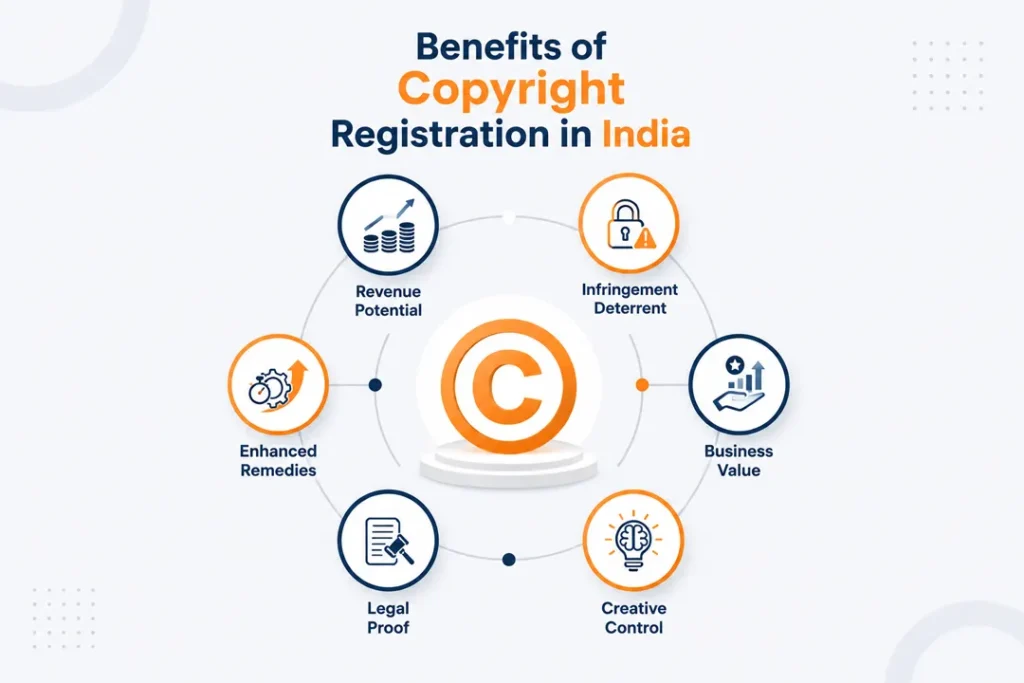
Benefits of Copyright Registration in India

Registering your creative work provides legal recognition and helps protect your intellectual property rights. Some key benefits of copyright registration include:

Legal Proof of Ownership

A copyright registration certificate serves as official evidence of ownership and can provide stronger legal support in case of copyright disputes or infringement matters.

Monetisation Opportunities

Registration makes it easier to license, assign, or commercially use your copyrighted work. It also helps creators establish greater value for their intellectual property when working with publishers, producers, or businesses.

Protection Against Unauthorised Use

A registered copyright creates public awareness of ownership and can strengthen your position while taking action against unauthorised copying, distribution, or online misuse of your work.

Maintains Creative Control

Copyright registration allows owners to control how their work is reproduced, adapted, distributed, or modified, helping protect the original creative vision.

Benefits of Copyright Registration

Disadvantages of Copyright Registration

While copyright registration offers several advantages, there are certain limitations that creators should consider:

Time, Cost, and Documentation Requirements

The registration process may take time depending on the application and verification process. It also involves government fees and may require professional assistance for complex matters.

Owner’s Responsibility for Enforcement

The Copyright Office maintains registration records but does not actively monitor or prevent infringement. Copyright owners are responsible for identifying unauthorised use and taking appropriate legal action when required.

Eligibility Criteria for Copyright Registration

To obtain Copyright Registration in India, the creative work must meet certain eligibility requirements under the Copyright Act, 1957. The work should:

  • Be original and contain a minimum level of creativity.
  • Be expressed and recorded in a tangible form.
  • Fall under one of the categories of works protected under copyright law.
  • Not be limited to an idea, concept, procedure, process, system, method, principle, or discovery.
  • Not already be available in the public domain.

Eligible Applicants for Copyright Registration

The following persons or entities can apply for copyright registration:

  • The original author or creator of the work.
  • A legal owner who has obtained copyright rights through assignment or transfer.
  • Organisations or employers for works created by employees during employment.
  • Legal heirs or authorised representatives of a deceased author.

Documents Required for Copyright Registration

Submitting complete and accurate documents is important for a smooth copyright registration process. The required documents may vary depending on the type of creative work being registered.

Basic Documents Required for All Applications

Common documents required for copyright registration include:

  • Completed Form XIV (Copyright Application Form)
  • Power of Attorney, if the application is filed through an authorised agent
  • Demand Draft (DD), Indian Postal Order (IPO), or online payment receipt for the application fee
  • Statement of Particulars and Statement of Further Particulars
  • Applicant’s identity proof such as Aadhaar Card, PAN Card, or Passport
  • Address proof of the applicant
  • Declaration of ownership and originality of the work

Documents Required for Literary Works

For literary works such as books, articles, software documentation, and written content, the required documents may include:

  • Two copies of the manuscript or published work
  • Synopsis or extract of the work, if the complete work is lengthy
  • No Objection Certificate (NOC) from the publisher, if applicable
  • NOC from co-authors or contributors, if the work has multiple creators
  • Assignment deed, if the applicant is not the original author
  • Proof of first publication, for published works
  • Translation permission, if the work is a translated version

Documents Required for Artistic Works

For artistic works such as drawings, paintings, photographs, and designs, documents may include:

  • Photographs or digital copies of the artwork
  • Description of the artwork, including dimensions and materials used
  • Exhibition records, if applicable
  • Portfolio or catalogue containing details of the work
  • Certificate of authenticity, if available
  • Commission agreement, if the work was created on request
  • NOC from the client or employer, where applicable

Documents Required for Musical Works

For musical compositions and related works, documents may include:

  • Musical notation or composition details
  • Audio recording, if available
  • Lyrics, where applicable
  • Collaboration agreements for jointly created works
  • Permissions from performers, if required
  • Publishing contracts, if the work has been commercially released

Documents Required for Cinematograph Films

For films and audiovisual works, the required documents may include:

  • DVD or digital copy of the film
  • Synopsis and details of credits
  • Chain of title documents
  • Agreements with performers, artists, and technicians
  • Distribution agreements, if applicable
  • Censorship certificate, where applicable

Documents Required for Sound Recordings

For sound recordings, applicants may need to submit:

  • CD or digital copy of the recording
  • Details of performers and recording process
  • Agreements with performers
  • Studio recording documents
  • Mixing and mastering details
  • Composer or lyricist NOC or agreements, if third-party content is used
  • Release details, if commercially available

Additional Documents for Specific Cases

Depending on the nature and ownership of the work, additional documents may include:

Case Additional Documents Required
Software Registration Relevant portions of source code and object code
Foreign Works Proof of first publication
Posthumous Works Author’s death certificate and legal heir documents
Joint Authorship NOC from all co-authors
Work Created During Employment Employment agreement or employer NOC
Work Made for Hire Agreement specifying copyright ownership

How to Register Copyright in India: Step-by-Step Process

The copyright registration process in India involves preparing the required documents, submitting an application with the Copyright Office, and completing the examination process. The steps involved are:

Step 1: Identify and Prepare Your Work

The first step is to identify the category of your creative work and ensure that it qualifies for copyright protection.

You need to:

  • Confirm that the work is original and eligible for registration.
  • Collect necessary documents such as identity proof, work copies, and ownership details.
  • Complete Form XIV with accurate information.
  • Prepare the applicable registration fee.

Step 2: Prepare the Copyright Application

The application can be prepared for online filing through the Copyright Office e-filing system or through physical submission as per applicable procedures.

The applicant should:

  • Complete the required application forms correctly.
  • Arrange supporting documents in the prescribed format.
  • Provide complete details of the applicant, author, and copyrighted work.

Step 3: Submit the Application

Once the application is prepared, it can be submitted to the Copyright Office.

The process includes:

  • Filing the copyright application along with required documents.
  • Paying the applicable government fee.
  • Receiving the acknowledgement receipt and diary number for future reference.

Step 4: Application Examination

After submission, the Copyright Office reviews the application to verify compliance with applicable copyright rules.

During this stage:

  • The application is examined for completeness and accuracy.
  • The applicant may need to respond to objections or clarification requests.
  • Application status can be checked using the assigned diary number.

Step 5: Objection Period

After filing and generation of the diary number, the Copyright Office provides a prescribed period for receiving objections from interested parties.

This process is different from trademark opposition proceedings and does not involve publication in the Trademark Journal.

If objections are received, the applicant may need to provide explanations, supporting documents, or additional information as required.

Step 6: Issuance of Copyright Registration Certificate

After successful examination and completion of the objection period, the Copyright Office proceeds with registration.

The registered copyright details are entered into the Register of Copyrights, and the registration certificate is issued as official proof of ownership.

Copyright Registration Fees and Legal Consequences

Understanding the applicable government fees and the legal implications of copyright infringement helps creators make informed decisions about protecting their intellectual property. Copyright registration provides an official record of ownership and strengthens your legal position in the event of unauthorized use.

Government Fee Structure

The Copyright Office prescribes statutory filing fees based on the category of creative work. These government fees are payable separately during the registration process and do not include professional consultancy or documentation charges.

Type of Work Government Fee (Per Application)
Literary, Dramatic, Musical or Artistic Work Rs. 500
Computer Software (Registered as a Literary Work) Rs. 500
Artistic Work Used in Relation to Goods or Products Rs. 2,000
Sound Recording Rs. 2,000
Cinematograph Film Rs. 5,000

Note: Professional service charges for application preparation, documentation, legal review, and filing assistance are separate from the statutory government fee.

Legal Consequences of Copyright Infringement

Using, reproducing, distributing, publishing, or commercially exploiting a copyrighted work without the owner’s authorization may constitute copyright infringement under the Copyright Act, 1957. Depending on the nature of the violation, the copyright owner may pursue civil remedies as well as criminal action.

Civil Remedies

A copyright owner may seek legal relief through the appropriate court, which may include:

  • Court orders restraining further unauthorized use of the copyrighted work.
  • Compensation for financial losses suffered due to infringement.
  • Recovery of profits earned by the infringing party through unauthorized exploitation of the work.
  • Seizure or destruction of infringing copies, where permitted under applicable law.

Criminal Penalties

Under Section 63 of the Copyright Act, 1957, knowing infringement of copyright is a criminal offence. Upon conviction, the penalties may include:

Penalty Applicable Provision
Imprisonment Six months to three years
Fine Rs. 50,000 to Rs. 2,00,000

The actual punishment depends on the facts of the case and the decision of the competent court.

Copyright Registration Timeline and Validity

Copyright registration is a one-time legal process that establishes an official record of ownership for an original creative work. While the registration procedure involves statutory examination by the Copyright Office, the protection granted under the Copyright Act, 1957 extends for several decades, depending on the nature of the work.

Estimated Registration Timeline

The time required for Copyright Registration varies based on the completeness of the application and whether any objections are raised during the examination process. In a straightforward case, registration generally takes between 8 to 12 months from the date of filing.

The process typically includes:

  1. Submission of the copyright application with the prescribed documents and government fee.
  2. A mandatory 30-day waiting period during which third parties may file objections.
  3. Examination of the application by the Copyright Office.
  4. Resolution of any objections or discrepancies, if applicable.
  5. Issuance of the Copyright Registration Certificate upon successful approval.

Note: If an objection is received or additional clarification is requested by the Registrar, the registration process may take longer depending on the complexity of the matter.

Validity of Copyright Registration

The duration of copyright protection depends on the category of the work as prescribed under the Copyright Act, 1957.

Type of Work Period of Copyright Protection
Literary, Dramatic, Musical and Artistic Works, including Photographs Lifetime of the author plus 60 years after the author's death
Cinematograph Films 60 years from the beginning of the calendar year following the year of first publication
Sound Recordings 60 years from the beginning of the calendar year following the year of first publication
Government Works 60 years from the beginning of the calendar year following the year of first publication

Copyright Protection for Photographs

Following the Copyright (Amendment) Act, 2012, photographs are no longer treated separately for determining the term of copyright. They are now classified as artistic works and receive protection for the lifetime of the photographer plus an additional 60 years after their death, in accordance with Section 22 of the Copyright Act, 1957.

Since copyright protection lasts for an extended period and no periodic renewal is required, registration serves as a valuable legal record that can help establish ownership and support enforcement of rights whenever disputes arise.

Copyright Registration Renewal and Cancellation

Copyright registration is a one-time legal registration that remains effective for the entire statutory period prescribed under the Copyright Act, 1957. Unlike several other intellectual property rights, copyright does not require periodic renewal to maintain its legal protection.

Renewal of Copyright Registration

Once a copyright is registered, there is no requirement to renew the registration during its period of protection. The rights continue automatically for the applicable term based on the nature of the work.

Key points include:

  • No periodic renewal or annual filing is required.
  • Copyright protection remains valid for the entire statutory term provided under the Copyright Act, 1957.
  • The registered owner continues to enjoy exclusive rights over the work during the applicable protection period, subject to the provisions of the law.

Cancellation or Rectification of Copyright Registration

Although copyright registration is intended to establish ownership of an original work, the registration may be challenged or corrected under specific legal circumstances. Appropriate authorities or competent courts may order rectification or cancellation where justified under the applicable legal provisions.

A copyright registration may be questioned in situations such as:

  • The registration was obtained by fraud, concealment of material facts, or misrepresentation.
  • The applicant was not the lawful owner or rightful claimant of the copyrighted work.
  • Incorrect or misleading information was entered in the Register of Copyrights.
  • Rectification of the Register of Copyrights becomes necessary to reflect the correct legal position.
  • The registration is found to be inconsistent with the applicable provisions of law or is otherwise liable to be set aside through competent legal proceedings.

If the ownership or validity of a registered copyright is disputed, the matter may require examination by the appropriate authority or adjudication before a competent court, depending on the nature of the dispute.

Copyright Infringement and Legal Remedies

Copyright grants creators the exclusive legal right to reproduce, publish, distribute, adapt, communicate, and commercially exploit their original work. When these rights are violated without authorization, it may amount to copyright infringement under the Copyright Act, 1957. Taking timely legal action can help protect ownership, prevent further misuse, and preserve the commercial value of the work.

What Constitutes Copyright Infringement?

Under Section 51 of the Copyright Act, 1957, copyright infringement generally occurs when a person exercises any exclusive right of the copyright owner without obtaining the necessary permission or licence.

Common instances of infringement include:

  • Reproducing a copyrighted work without authorization.
  • Publishing or distributing copyrighted material without the owner’s consent.
  • Selling, importing, or dealing in pirated copies of protected works.
  • Publicly displaying or communicating copyrighted content without permission.
  • Copying software, books, music, films, photographs, artwork, or other protected works for commercial purposes.

Permitted Uses Under the Copyright Act

The Copyright Act also recognizes certain situations where copyrighted material may be used without obtaining prior permission. These statutory exceptions, commonly referred to as fair dealing provisions under Section 52, are intended to balance the rights of creators with public interest.

Permitted uses may include:

  • Private or personal use, including research and self-study.
  • Criticism, commentary, or review of a copyrighted work.
  • Reporting current events and news.
  • Educational use by teachers, students, and educational institutions, subject to applicable legal conditions.
  • Use during judicial proceedings or for providing legal advice.
  • Limited use by libraries and archives for preservation, research, or educational purposes.

Whether a particular use qualifies under these exceptions depends on the facts of each case and the applicable legal provisions.

Impact of Copyright Infringement

Unauthorized use of copyrighted material can result in significant legal and commercial consequences. Infringement may:

  • Cause financial loss to the copyright owner.
  • Reduce the commercial value of the original work.
  • Harm the creator’s reputation and moral rights.
  • Discourage creativity, innovation, and investment in original content.
  • Lead to legal disputes, financial liability, and criminal prosecution.

Civil Remedies Available to Copyright Owners

Under Section 55 of the Copyright Act, 1957, a copyright owner may initiate civil proceedings against an infringer to protect their rights.

The court may grant remedies such as:

  • An injunction restraining further unauthorized use of the copyrighted work.
  • Monetary compensation for losses suffered due to infringement.
  • Recovery of profits earned through unauthorized exploitation of the copyrighted work.
  • Other reliefs that may be considered appropriate under the applicable law.

Criminal Liability for Copyright Infringement

In serious cases involving deliberate infringement, criminal action may also be initiated under the Copyright Act, 1957.

Applicable provisions include:

Legal Provision Purpose
Section 63 Prescribes criminal punishment for knowing copyright infringement, including imprisonment and fines.
Section 65A Provides penalties for unlawful circumvention of technological protection measures used to safeguard digital works.
Section 65B Protects rights management information and penalizes unauthorized removal or alteration of such information.

The nature of the punishment depends on the facts of the case and the decision of the competent court.

Importance of Copyright Registration

Although copyright generally exists from the moment an original work is created, registration serves as valuable legal evidence of ownership. A registered copyright can strengthen the owner’s position during disputes, licensing arrangements, enforcement proceedings, and infringement claims.

Why Timely Legal Action Matters

When infringement is suspected, acting promptly can help reduce further unauthorized use and preserve legal remedies. Early legal intervention may assist in:

  • Protecting ownership rights over the original work.
  • Preventing continued copying, publication, or distribution.
  • Preserving commercial value and licensing opportunities.
  • Supporting claims for compensation and other legal relief.
  • Strengthening enforcement through documentary evidence and statutory remedies.

Cotaxo assists creators, businesses, software developers, authors, artists, and other intellectual property owners with professionally managed Copyright Registration services and guidance on protecting their rights under the Copyright Act, 1957.

Difference Between Copyright, Trademark, and Patent

Copyright, trademark, and patent are the three primary forms of intellectual property protection available in India. Although they are often confused with one another, each protects a different type of intellectual asset and is governed by separate legislation. Choosing the appropriate form of protection depends on the nature of your creation, brand, or invention.

Feature Copyright Trademark Patent
Protects Original literary, artistic, musical, dramatic works, software, films, photographs, sound recordings, and other creative works Brand names, logos, symbols, slogans, taglines, and other distinctive brand identifiers New inventions, products, processes, and technological innovations
Primary Objective Protects the original expression of creative ideas from unauthorized copying or use Protects the identity of a brand and distinguishes its goods or services from others Protects the technical and functional aspects of an invention by granting exclusive rights
Common Symbol © ™ for an unregistered trademark, ® for a registered trademark No prescribed statutory symbol. Businesses commonly use the term "Patented" where applicable.
Governing Law Copyright Act, 1957 Trade Marks Act, 1999 Patents Act, 1970
Duration of Protection Generally, the lifetime of the author plus 60 years, subject to the nature of the work 10 years per registration with the option of renewal for successive periods of 10 years 20 years from the filing date, subject to statutory conditions and maintenance requirements

Which Intellectual Property Protection Is Right for You?

The appropriate form of intellectual property protection depends on what you want to safeguard.

  • Choose Copyright to protect original creative works such as books, software, music, artwork, photographs, films, and other creative content.
  • Choose Trademark to secure your business name, logo, brand identity, product name, or slogan.
  • Choose Patent to protect a novel invention, innovative product, or industrial process that satisfies the legal requirements for patentability.

If your business owns multiple intellectual assets, more than one form of protection may be appropriate. For example, a software company may protect its source code through copyright, its brand name through trademark registration, and a patented technology through patent registration, where eligible.

How to Check the Status of Your Copyright Application?

You can check the progress of your Copyright Registration application online by following these simple steps:

  1. Visit the official Copyright Office website.
  2. Open the Status of Application
  3. Enter the Diary Number received at the time of filing.

View the current status of your Copyright Registration application.

What is a Copyright Registration Certificate?

A Copyright Registration Certificate is the official document issued by the Copyright Office after successful registration of your work. It serves as legal evidence of registration and recognizes your ownership under the Copyright Act, 1957. The certificate strengthens your rights to reproduce, publish, distribute, license, and protect your original work against unauthorized use. It also supports licensing, commercial transactions, and enforcement of your intellectual property rights.

How to Download the Copyright Registration Certificate?

You can download your Copyright Registration Certificate by following these steps:

  1. Visit the official Copyright Office website.
  2. Log in using your registered credentials.
  3. Open the Application Status or Registered Works
  4. Select your registered copyright application.
  5. Download and save the Copyright Registration Certificate for your records.

If you experience any difficulty accessing the certificate, you may contact the Copyright Office or seek assistance from a professional consultant.

Talk To Our Experts

Frequently Asked Questions (FAQs)

Can AI-generated content be copyrighted in India?

Indian copyright law generally recognizes human authorship as a key requirement for copyright protection. Purely AI-generated content without meaningful human creative input may not qualify for copyright, while AI-assisted works involving substantial human creativity, editing, or arrangement may be eligible depending on the facts of each case.

Yes. Copyright can be jointly owned when two or more individuals contribute to creating a work. Each joint owner has rights in accordance with the Copyright Act, 1957 and any agreement between the parties.

Yes. Copyright is an intellectual property right that can be assigned, transferred, licensed, or inherited, subject to the applicable legal provisions and written agreements.

Yes. Copyright Registration in India can be completed online by filing an application with the Copyright Office along with the prescribed documents and government fee.

Yes. Copyright generally exists from the time an original work is created. However, registration serves as valuable legal evidence of ownership and can strengthen your position during legal proceedings.

The process involves preparing the required documents, filing the prescribed application with the Copyright Office, paying the applicable government fee, and completing the statutory examination process.

You can search available records through the official Copyright Office portal using the relevant search facilities provided on the website.

No. Registration is not mandatory, but it provides an official record of ownership and offers stronger evidentiary support in the event of disputes.

Yes. Copyright protection generally arises automatically upon the creation of an original work, provided it satisfies the requirements of the Copyright Act, 1957.

A consultant can assist with document preparation, application filing, legal review, responding to objections if any, and ensuring compliance throughout the registration process.

A registration may be challenged or rectified through the appropriate legal process if it was obtained through fraud, misrepresentation, incorrect ownership, or other legally recognized grounds.

The government fee depends on the category of the work being registered. Different fee structures apply to literary works, artistic works, software, sound recordings, and cinematograph films.

For most literary, artistic, musical, and dramatic works, copyright generally lasts for the lifetime of the author plus 60 years. Different terms apply to certain other categories of works.

The required documents generally include the application, copies of the work, identity and address proof of the applicant, author details, and supporting declarations or authorizations, where applicable.

An original logo may be registered as an artistic work under the Copyright Act, 1957, provided it meets the requirements for copyright protection.

Generally, individual names, short phrases, and titles do not qualify for copyright protection. In appropriate cases, they may be protected under trademark law.

Yes. The Copyright Office prescribes different application categories based on the nature of the work, such as literary works, artistic works, software, films, or sound recordings.

Copyright registration is available for literary, artistic, musical, dramatic works, computer software, cinematograph films, sound recordings, photographs, and certain other original works recognized under the law.

Yes. The copyright symbol may be used for original works even if they are not registered. However, registration provides stronger documentary evidence of ownership.

A No Objection Certificate may be required in specific situations, such as when the applicant is different from the author or where supporting permissions are necessary.

Indian registration does not create a worldwide copyright registration. However, copyright protection may be available in other countries under applicable international treaties and the laws of those jurisdictions.

Why Choose Cotaxo for Copyright Registration?

Copyright registration requires accurate documentation, proper classification of the work, and compliance with the Copyright Act, 1957. Cotaxo provides professionally managed online copyright registration services, helping creators, businesses, startups, software developers, artists, authors, and content creators complete the registration process with confidence.

Our consultants assist you throughout the process, from preparing the application and reviewing documents to filing with the Copyright Office and providing guidance until the registration process is completed.

Why Choose Cotaxo?

  • Expert assistance from intellectual property consultants
  • End-to-end online registration support
  • Accurate documentation and application review
  • Guidance on selecting the appropriate category of work
  • Assistance in responding to examination queries, where applicable
  • Transparent process with dedicated communication
  • Support for individuals, startups, businesses, and creative professionals
  • Legally compliant filing under the Copyright Act, 1957
Why Cotaxo
Choose the right approach for securing your intellectual property rights

Get Started with Copyright Registration

Protect your original work with professionally managed Copyright Registration services from Cotaxo. Whether you are registering a book, software, music, artwork, photograph, film, or any other original creation, our experts are ready to guide you through every stage of the registration process.