Copyright Registration is the legal process of recording ownership of an original creative work with the Copyright Office under the provisions of the Copyright Act, 1957 and the Copyright Rules, 2013. It provides creators and businesses with official recognition of their intellectual property rights and creates a formal record of ownership.
Copyright protection in India automatically applies to original works once they are created and expressed in a tangible form. However, obtaining copyright registration provides additional legal value by creating a publicly recorded claim of ownership. The copyright registration certificate issued by the Copyright Office acts as prima facie evidence of ownership in legal proceedings.
In simple terms, copyright registration creates an official record that establishes who owns a creative work and provides stronger support in case of unauthorised use, disputes, or infringement.
Purpose of Copyright Registration
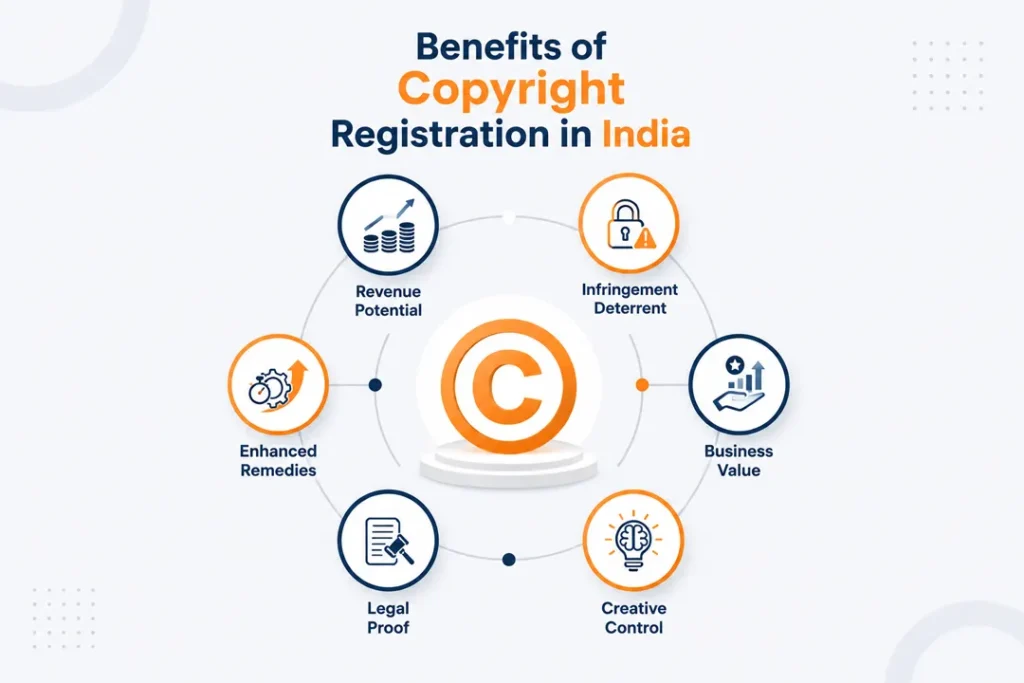
Copyright registration helps creators and businesses protect their original work and manage their intellectual property rights effectively.
The key purposes include:
Establishing Legal Ownership
Registration creates an official record of ownership, making it easier to prove your rights over a creative work during legal disputes.
Protecting Against Unauthorised Use
A registered copyright provides stronger legal support to take action against individuals or organisations that reproduce, distribute, or use your work without permission.
Supporting Commercial Opportunities
Copyright registration helps creators safely license, assign, or commercially use their work by providing documented proof of ownership.
Maintaining Control Over Creative Assets
Registration allows copyright owners to exercise control over how their work is reproduced, distributed, adapted, or communicated to the public.
Types of Creative Works Protected Under Copyright Registration
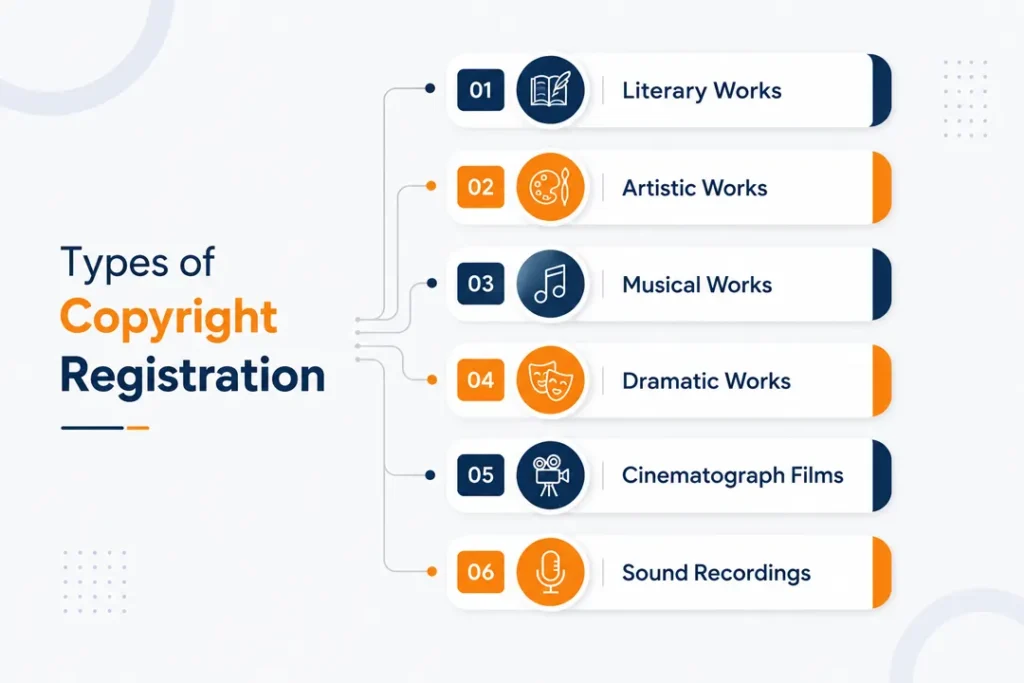
The Copyright Act, 1957 provides protection to various categories of original creative works. Copyright registration can be obtained for the following types of works:
Literary Works
Literary works cover written and textual creations, including both traditional and digital content.
Examples include:
- Books and novels
- Articles and research papers
- Poems and manuscripts
- Blogs and website content
- Educational materials
- Computer programs, source code, object code, and databases
Artistic Works
Artistic works protect original visual and graphical creations.
Examples include:
- Paintings and drawings
- Illustrations and designs
- Photographs
- Maps and technical drawings
- Sculptures
- Architectural works
- Artistic elements of logos
It is important to understand that copyright protection for a logo covers its artistic expression, while trademark registration protects the logo as a brand identity.
Musical Works
Musical works protect the original composition and creative arrangement of music.
Examples include:
- Musical compositions
- Melodies
- Musical scores
- Original arrangements
Sound Recordings
Sound recording protection applies to the recorded version of a sound creation, separate from the underlying musical or literary work.
Examples include:
- Song recordings
- Podcast recordings
- Speeches
- Audio productions
Cinematograph Films
Cinematograph film protection applies to visual recordings and audiovisual creations.
Examples include:
- Feature films
- Short films
- Documentaries
- Animation content
- Video productions
Dramatic Works
Dramatic works cover creations intended for performance or presentation.
Examples include:
- Plays
- Screenplays
- Scripts
- Choreography
- Pantomime performances
Software and Computer Programs
Copyright protection applies to the expression of software, including its source code and object code.
Examples include:
- Computer programs
- Software code
- Applications
- Databases
Copyright protects the written expression of software but does not protect ideas, concepts, algorithms, or functionality behind the software.
Derivative Works
Derivative works are creative works developed by modifying, adapting, or transforming an existing copyrighted work.
Examples include:
- A screenplay adapted from a novel
- Translation of a literary work
- Music remixes
- Adapted stories
- Creative works based on existing content
Registration of derivative works may require permission from the original copyright owner unless the underlying work is no longer protected.
Legal Rights of a Copyright Owner
Copyright ownership provides creators with exclusive rights to control the use and commercial exploitation of their work.
These rights are divided into economic rights and moral rights.
Economic Rights Under Copyright
Economic rights allow copyright owners to use, license, and commercially benefit from their creations.
Right to Reproduce
The copyright owner has the exclusive right to create copies of the work in physical or digital formats.
Right to Distribute
The owner can control the sale, transfer, rental, or distribution of copies of the copyrighted work.
Right to Public Performance
For literary, dramatic, musical, and cinematographic works, the owner has the right to perform or communicate the work publicly.
Right to Create Adaptations and Recordings
The owner has the authority to create adaptations, films, sound recordings, translations, or other forms based on the original work.
Right to Translate or Modify
Copyright owners can authorise translation, adaptation, or transformation of their creative work.
Right to Communicate the Work to Public
The owner can control broadcasting, streaming, online sharing, or other forms of public communication.
Right of Commercial Rental
For specific categories such as software, films, and sound recordings, copyright owners may control commercial rental rights.
Moral Rights of Authors
Under Section 57 of the Copyright Act, 1957, authors have certain special rights that remain connected with their creative identity.
Right of Attribution
The creator has the right to claim recognition and be identified as the author of the work.
Right Against Distortion
The author can object to any modification, distortion, or misuse of their work that may negatively affect their reputation.
Moral rights generally continue even when economic rights are transferred or assigned to another party.
Laws Governing Copyright Registration in India
Copyright registration in India operates under a structured legal framework that protects creators and defines their rights.
The primary laws include:
International Protection of Copyright
India follows several international agreements that support copyright protection across different countries.
Berne Convention
The Berne Convention provides international copyright protection by ensuring that member countries recognise the rights of creators from other member nations.
Universal Copyright Convention (UCC)
The UCC provides an additional framework for international copyright recognition and protection.
TRIPS Agreement
The TRIPS Agreement establishes minimum standards for intellectual property protection among World Trade Organization member countries.
WIPO Copyright Treaty (WCT)
The WIPO Copyright Treaty provides additional protection for digital works and online content in the modern technological environment.
Authorities Responsible for Copyright Registration in India
The following authorities play important roles in copyright administration and enforcement:
Copyright Office
The Copyright Office manages copyright applications, maintains the Register of Copyrights, and processes registration-related matters.
Courts
Commercial Courts, District Courts, and High Courts handle copyright disputes, infringement matters, appeals, and licensing-related issues.
Department for Promotion of Industry and Internal Trade (DPIIT)
DPIIT works under the Ministry of Commerce and Industry and oversees intellectual property policies and development initiatives in India.