GST • Income Tax • Registration • Payroll • Advisory • FSSAI • Virtual CFO

Payroll Services for Accurate, Timely & Compliant Salary Management

Managing employee payroll involves much more than calculating monthly salaries. Every payroll cycle requires accurate salary computation, statutory deductions, tax compliance, timely salary processing, record maintenance, and adherence to changing labour and tax regulations. Even minor payroll errors can lead to employee dissatisfaction, compliance notices, financial penalties, and unnecessary administrative burdens.

Whether your organization has a small workforce or a large employee base with multiple salary structures, Cotaxo delivers dependable payroll support tailored to your business requirements.

Enter Your Details to Receive a Full Quote and Consultation

What Sets Cotaxo Apart

Dedicated Expert Assistance

Transparent Pricing

End-to-End Compliance Support

Pan-India Service Coverage

What are Payroll Services?

Payroll Services refer to the professional management of an organization’s employee salary process, ensuring that every employee receives the correct salary on time while complying with all applicable statutory and tax regulations.

Payroll is one of the most critical business functions because it directly affects employees, business finances, taxation, and regulatory compliance. It involves calculating gross salary, deductions, allowances, bonuses, incentives, reimbursements, income tax deductions, provident fund contributions, employee state insurance contributions, and other statutory obligations before arriving at the employee’s net salary.

Apart from salary calculation, payroll management also includes maintaining payroll records, preparing salary registers, generating payslips, filing statutory returns wherever applicable, and ensuring compliance with employment laws.

An efficient payroll process helps businesses maintain transparency, improve employee confidence, reduce administrative effort, and minimize compliance risks.

At Cotaxo, payroll services are managed by experienced professionals who coordinate with businesses through WhatsApp, Email, and Phone to ensure payroll activities are completed accurately and within the required timelines.

Why Payroll Management is Important for Every Business

As a business grows, payroll management becomes increasingly complex. New employees, changing salary structures, tax deductions, employee benefits, statutory contributions, reimbursements, leave adjustments, and regulatory updates require continuous monitoring.

Without a structured payroll system, businesses may face:

  • Salary calculation errors
  • Incorrect tax deductions
  • Delayed salary payments
  • PF and ESI compliance issues
  • Professional Tax errors
  • Labour law non-compliance
  • Employee grievances
  • Government notices and penalties
  • Inaccurate financial records

Professional payroll management helps eliminate these risks while allowing business owners to focus on growth instead of routine administrative work.

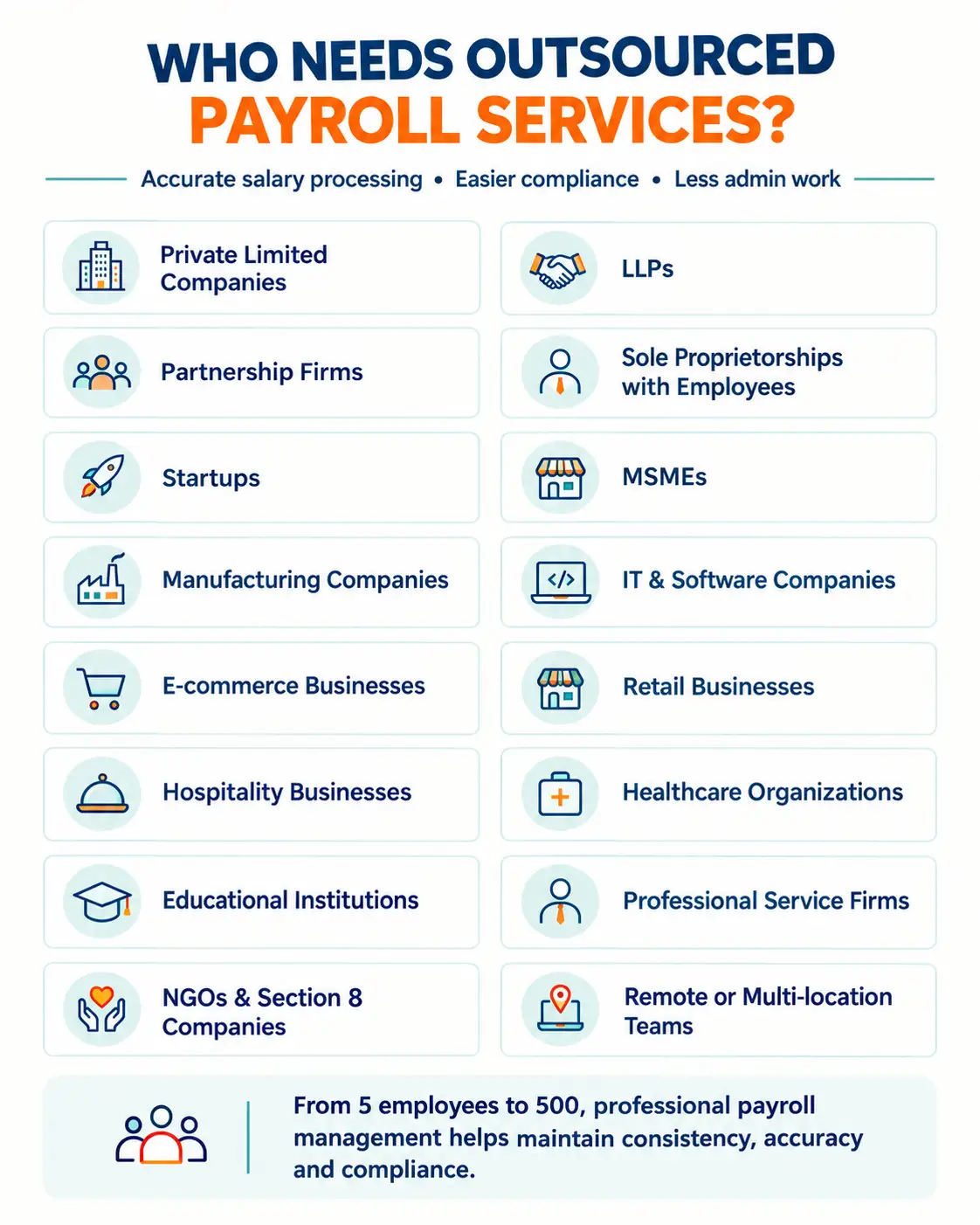
Who Needs Payroll Services?

Payroll services are beneficial for businesses of all sizes that want to ensure accurate salary processing and statutory compliance while reducing the burden of managing payroll internally.

Organizations that commonly benefit from payroll outsourcing include:

  • Private Limited Companies
  • Limited Liability Partnerships (LLPs)
  • Partnership Firms
  • Sole Proprietorship Businesses with Employees
  • Startups
  • MSMEs
  • Manufacturing Companies
  • IT & Software Companies
  • E-commerce Businesses
  • Retail Businesses
  • Hospitality Businesses
  • Healthcare Organizations
  • Educational Institutions
  • Professional Service Firms
  • NGOs and Section 8 Companies
  • Businesses with Remote or Multi-location Employees

Whether you employ five people or five hundred, professional payroll management helps maintain consistency, accuracy, and compliance.

Key Features of Payroll Services

Payroll management is a combination of salary administration, statutory compliance, tax management, and employee record maintenance. Cotaxo offers comprehensive payroll support designed to simplify each stage of the payroll cycle.

Accurate Salary Processing

Employee salaries are calculated based on approved salary structures, attendance records, leave adjustments, incentives, reimbursements, overtime, bonuses, and statutory deductions to ensure accurate payroll every month.

Flexible Payroll Management

Every organization follows a different compensation model. Payroll services can be customized to accommodate various salary structures, allowances, variable pay components, and employee benefit policies.

Statutory Compliance Support

Payroll involves compliance with multiple employment and taxation regulations. Payroll professionals help businesses manage statutory deductions and reporting requirements in accordance with applicable laws.

Income Tax Support

Payroll includes accurate computation of Tax Deducted at Source (TDS) on salaries based on employee declarations, eligible exemptions, deductions, and applicable tax regimes.

Employee Payroll Records

Proper payroll documentation helps businesses maintain transparent records for employees, auditors, financial institutions, and regulatory authorities whenever required.

Confidential Payroll Management

Employee salary information is highly sensitive. Professional payroll management ensures payroll data is handled securely with appropriate confidentiality.

Payroll Reporting

Businesses receive payroll reports that support accounting, budgeting, financial planning, statutory compliance, and management decision-making.

Benefits of Professional Payroll Services

Managing payroll through experienced professionals offers several operational and compliance advantages for businesses.

Saves Valuable Time

Payroll involves repetitive monthly calculations, statutory deductions, document preparation, and reporting. Outsourcing payroll allows business owners and HR teams to focus on strategic activities instead of administrative work.

Improves Accuracy

Professional payroll processing reduces the likelihood of salary errors, incorrect deductions, duplicate entries, and calculation mistakes that may otherwise affect employee satisfaction and compliance.

Supports Regulatory Compliance

Employment laws, taxation provisions, and statutory requirements frequently change. Professional payroll management helps businesses remain aligned with applicable regulations and filing requirements.

Enhances Employee Satisfaction

Employees expect salaries to be processed accurately and credited on time. Reliable payroll management builds trust and contributes to a positive workplace experience.

Protects Sensitive Information

Payroll data contains confidential employee and salary information. Professional payroll processes help maintain data confidentiality and controlled access to payroll records.

Better Financial Planning

Accurate payroll reports provide businesses with clear visibility into employee costs, statutory liabilities, and monthly payroll expenses, supporting informed financial planning and budgeting.

Why Businesses are Outsourcing Payroll

Modern businesses increasingly prefer outsourced payroll because it improves operational efficiency while reducing compliance risks and administrative complexity.

Instead of investing significant internal resources in payroll administration, businesses can rely on experienced professionals to handle salary processing, statutory calculations, payroll reporting, and compliance-related activities.

This approach enables management teams to devote more time to business growth, employee development, customer service, and strategic planning while maintaining confidence that payroll responsibilities are being managed professionally and accurately.

Complete Payroll Process

Payroll is a structured process that involves much more than calculating employee salaries. Every payroll cycle requires collecting employee data, verifying attendance, calculating earnings and deductions, ensuring statutory compliance, processing salaries, and maintaining payroll records. A well-managed payroll system helps businesses ensure timely salary payments while meeting all applicable legal and taxation requirements.

At Cotaxo, our payroll professionals follow a systematic approach to ensure every payroll cycle is completed accurately and efficiently.

Step 1: Collect Employee Information

The payroll process begins with collecting and maintaining employee information. Accurate employee records form the foundation of an efficient payroll system.

This generally includes:

  • Employee personal details
  • Employee ID
  • Date of joining
  • Department and designation
  • Salary structure
  • Bank account details
  • PAN
  • Aadhaar details, wherever applicable
  • PF and ESI details
  • Tax declarations
  • Attendance and leave records

Keeping employee information updated helps avoid payroll discrepancies and statutory reporting errors.

Step 2: Verify Attendance and Leave Records

Before salary processing begins, attendance data is verified for each employee.

This may include:

  • Working days
  • Paid leave
  • Leave without pay
  • Casual leave
  • Sick leave
  • Earned leave
  • Overtime
  • Shift allowances
  • Holiday work
  • Attendance adjustments

Accurate attendance verification ensures employees are paid correctly based on company policies.

Step 3: Calculate Gross Salary

Gross salary consists of various salary components as defined in the employee’s compensation structure.

Common salary components include:

  • Basic Salary
  • House Rent Allowance (HRA)
  • Dearness Allowance (DA), wherever applicable
  • Special Allowance
  • Conveyance Allowance
  • Medical Allowance
  • Performance Incentives
  • Bonus
  • Commission
  • Overtime
  • Other Allowances

Each employee may have a different salary structure depending on the organization’s compensation policy.

Step 4: Calculate Payroll Deductions

Once gross salary is determined, applicable deductions are calculated before arriving at the net salary payable.

Payroll deductions generally include:

  • Provident Fund (PF)
  • Employees’ State Insurance (ESI)
  • Professional Tax (PT)
  • Labour Welfare Fund (LWF)
  • Tax Deducted at Source (TDS)
  • Salary Advances
  • Loan Recoveries
  • Other Authorized Deductions

Accurate deduction calculations help ensure statutory compliance while preventing payroll disputes.

Step 5: Calculate Net Salary

After considering all earnings and deductions, the employee’s net salary is calculated.

The calculation generally follows:

Gross Salary
Less: Statutory Deductions
Less: Income Tax (TDS), if applicable
Less: Other Authorized Deductions

= Net Salary Payable

The final payroll is reviewed before salary disbursement.

Step 6: Salary Disbursement Support

After payroll approval, salary disbursement is processed according to the organization’s payroll schedule.

The payroll cycle also includes:

  • Salary payment support
  • Payroll summaries
  • Salary advice
  • Bank transfer reports
  • Employee salary records

Timely salary processing helps build employee confidence and improves workplace satisfaction.

Step 7: Generate Payroll Reports

Payroll reporting provides management with valuable financial and employee cost information.

Common payroll reports include:

  • Monthly Payroll Register
  • Department-wise Salary Report
  • Cost Centre Reports
  • Salary Summary
  • Deduction Reports
  • Statutory Reports
  • Payroll MIS Reports
  • Annual Salary Reports

These reports assist management in budgeting, accounting, audits, and business planning.

Payroll Compliance in India

Payroll management in India is governed by multiple labour laws, taxation provisions, and statutory regulations. Employers are responsible for ensuring that employee salaries, deductions, contributions, and statutory payments comply with the applicable legal requirements.

Failure to comply with payroll regulations may result in penalties, notices, employee disputes, and additional compliance obligations.

Professional payroll management helps businesses remain compliant while reducing administrative complexity.

Key Payroll Compliance Requirements

Payroll compliance may involve multiple statutory obligations depending on the nature of the business, employee strength, salary structure, and applicable laws.

Some of the common payroll-related compliance areas include:

  • Employees’ Provident Fund (EPF)
  • Employees’ State Insurance (ESI)
  • Professional Tax (PT)
  • Labour Welfare Fund (LWF)
  • Payment of Bonus
  • Payment of Gratuity
  • Tax Deducted at Source (TDS) on Salary
  • Labour Law Compliance
  • Salary Record Maintenance
  • Statutory Registers
  • Payroll Documentation

Employees’ Provident Fund (EPF)

The Employees’ Provident Fund is a retirement benefit scheme governed by the Employees’ Provident Funds and Miscellaneous Provisions Act, 1952.

Eligible employers are required to deduct the employee’s PF contribution and deposit both employer and employee contributions within the prescribed timelines.

Payroll management includes:

  • PF calculation
  • Monthly contribution computation
  • Employee records
  • PF deduction management
  • Compliance support

Employees’ State Insurance (ESI)

The Employees’ State Insurance Scheme provides medical and social security benefits to eligible employees.

Payroll processing involves:

  • Employee eligibility verification
  • ESI contribution calculations
  • Salary-based deduction management
  • Compliance record maintenance

Professional Tax (PT)

Professional Tax is levied by certain State Governments on salaried employees and professionals.

Payroll management includes:

  • Employee-wise Professional Tax calculation
  • State-specific compliance support
  • Deduction management
  • Payroll reporting

Since Professional Tax rules differ across states, businesses operating in multiple locations require careful payroll administration.

Labour Welfare Fund (LWF)

Several states require employers and employees to contribute to the Labour Welfare Fund.

Payroll professionals help businesses:

  • Calculate contributions
  • Apply state-specific rules
  • Maintain deduction records
  • Support compliance documentation

Bonus Compliance

Eligible employees are entitled to statutory bonus under applicable laws.

Payroll administration includes:

  • Bonus eligibility calculation
  • Bonus amount computation
  • Annual bonus records
  • Payroll integration

Gratuity Management

Gratuity is a statutory retirement benefit payable to eligible employees under the applicable provisions of law.

Payroll support includes:

  • Gratuity eligibility assessment
  • Service period calculation
  • Gratuity amount estimation
  • Record maintenance

Income Tax Compliance in Payroll

Income Tax forms an important part of payroll management.

Employers are responsible for deducting Tax Deducted at Source (TDS) from employee salaries wherever applicable under the Income-tax Act, 1961.

Payroll tax management generally includes:

  • Employee tax declarations
  • Tax computation
  • Tax regime consideration
  • Salary-based TDS calculation
  • Annual tax adjustments
  • Payroll tax records

Accurate tax computation helps employees avoid excess deductions while enabling employers to meet their statutory obligations.

Payroll Documentation and Record Maintenance

Maintaining organized payroll documentation is essential for statutory compliance, audits, financial reporting, and employee record management.

Payroll records generally include:

  • Employee Master Records
  • Salary Registers
  • Attendance Records
  • Leave Records
  • Salary Revision Records
  • Payroll Reports
  • Payslips
  • Tax Computation Statements
  • Deduction Registers
  • Bonus Records
  • Gratuity Records
  • Compliance Documents

Proper documentation also simplifies employee verification, financial audits, and statutory inspections.

Payroll Reporting and MIS

Payroll data plays an important role in financial planning and workforce management. Regular payroll reports help businesses monitor employee costs, analyze compensation trends, and make informed business decisions.

Payroll Management Information System (MIS) reports may include:

  • Monthly Payroll Reports
  • Employee Cost Reports
  • Salary Comparison Reports
  • Department-wise Payroll Analysis
  • Cost Centre Reports
  • Tax Deduction Reports
  • PF and ESI Reports
  • Bonus Reports
  • Gratuity Reports
  • Payroll Variance Reports
  • Annual Payroll Summary

These reports provide management with valuable insights while supporting budgeting, accounting, compliance, and long-term financial planning.

Common Payroll Challenges Faced by Businesses

Payroll management becomes increasingly complex as organizations grow. Frequent changes in employment laws, salary revisions, tax regulations, and workforce expansion often create administrative challenges.

Some common payroll issues include:

  • Incorrect salary calculations
  • Delayed salary processing
  • Errors in statutory deductions
  • Changing tax regulations
  • Incorrect employee data
  • Payroll reconciliation issues
  • Non-compliance with labour laws
  • Multiple salary structures
  • Attendance and leave calculation errors
  • Inadequate payroll documentation

Professional payroll support helps businesses address these challenges through standardized processes and accurate compliance management.

Who Should Consider Payroll Services?

Payroll services are suitable for organizations of every size that want to ensure timely salary processing, statutory compliance, and accurate employee compensation. Whether you are hiring your first employee or managing a large workforce across multiple locations, professional payroll management helps streamline operations while reducing administrative burden.

Businesses commonly using payroll services include:

  • Startups
  • Private Limited Companies
  • Limited Liability Partnerships (LLPs)
  • Partnership Firms
  • Sole Proprietorships with employees
  • MSMEs
  • Manufacturing Companies
  • IT & Software Companies
  • E-commerce Businesses
  • Retail Businesses
  • Hospitality Businesses
  • Healthcare Organizations
  • Educational Institutions
  • Consulting Firms
  • Professional Service Providers
  • NGOs and Section 8 Companies
  • Businesses operating across multiple states
  • Organizations with contractual, temporary, or remote employees

Regardless of the industry, businesses that process employee salaries regularly can benefit from a structured and compliant payroll management system.

Documents Required for Payroll Services

Proper documentation is essential for accurate payroll processing and statutory compliance. Businesses should maintain updated employee records and payroll-related information before each payroll cycle.

The documents and information generally required include:

Business Documents

  • PAN of the business
  • TAN (Tax Deduction and Collection Account Number), where applicable
  • GST Registration Certificate, if applicable
  • Company Incorporation or Registration Documents
  • Bank Account Details
  • Authorized Signatory Details

Employee Information

  • Employee Name
  • Employee ID
  • Date of Joining
  • Designation
  • Department
  • Employment Type
  • Salary Structure
  • PAN
  • Aadhaar, wherever applicable
  • Bank Account Details
  • UAN (for PF), where applicable
  • ESIC Number, where applicable

Attendance & Salary Records

  • Attendance Register
  • Leave Records
  • Overtime Details
  • Incentive Details
  • Bonus Details
  • Reimbursement Claims
  • Salary Revision Details
  • Loan or Advance Recovery Details

Statutory Information

  • Provident Fund Details
  • Employees’ State Insurance Details
  • Professional Tax Details
  • Labour Welfare Fund Details
  • Income Tax Declarations
  • Investment Proofs submitted by employees
  • Previous Payroll Records, if applicable

Maintaining accurate documentation helps ensure smooth payroll processing while reducing the chances of compliance issues and payroll discrepancies.

Payroll Processing Timeline

Although every organization may follow its own payroll calendar, a typical monthly payroll process generally follows a structured timeline.

Stage Activity
Employee Data Collection Update employee records, salary revisions, and new joiners
Attendance Verification Verify attendance, leave, overtime, and holidays
Salary Computation Calculate gross salary, allowances, and deductions
Tax & Statutory Calculation Compute PF, ESI, PT, TDS, LWF, and other deductions
Payroll Review Verify payroll calculations and approvals
Salary Processing Prepare salary statements and support salary disbursement
Payroll Reporting Generate payslips, payroll reports, and MIS
Record Maintenance Maintain payroll and statutory records

A structured payroll timeline helps organizations maintain consistency and complete payroll activities within scheduled deadlines.

Payroll Services vs In-House Payroll Management

Many businesses initially manage payroll internally. However, as the workforce grows, payroll administration becomes increasingly time-consuming and compliance-intensive.

The following comparison highlights the difference between in-house payroll management and professional payroll services.

Particulars In-House Payroll Payroll Services by Cotaxo
Payroll Expertise Depends on internal staff Managed by experienced payroll professionals
Compliance Monitoring Internal responsibility Professional compliance support
Payroll Accuracy Depends on available resources Structured review process
Time Requirement High Reduced administrative effort
Salary Processing Manual or internal process Professionally managed
Payroll Documentation Internal maintenance Organized documentation support
Reporting Limited Payroll reports and MIS support
Scalability May require additional staff Easily accommodates business growth

Professional payroll services enable businesses to focus on operations while experienced professionals manage payroll responsibilities.

Advantages of Payroll Services

Professional payroll management offers several operational and compliance benefits that support long-term business growth.

Improved Accuracy

Accurate payroll calculations reduce salary errors, incorrect deductions, and employee grievances.

Better Compliance

Professional payroll management helps businesses remain aligned with applicable tax and labour regulations.

Time Efficiency

Payroll administration requires significant time each month. Outsourcing allows management and HR teams to focus on strategic activities.

Reduced Administrative Burden

Routine payroll activities such as salary calculations, deductions, reporting, and documentation are handled efficiently by experienced professionals.

Better Record Management

Proper payroll documentation simplifies audits, financial reporting, statutory inspections, and employee record maintenance.

Enhanced Employee Experience

Timely salary processing and accurate payslips contribute to employee satisfaction and workplace confidence.

Improved Financial Planning

Payroll reports provide valuable insights into employee costs, statutory liabilities, and workforce expenditure.

Limitations of Managing Payroll Without Professional Support

Businesses that manage payroll without adequate expertise may encounter several operational challenges.

Some common limitations include:

  • Payroll calculation errors
  • Delayed salary processing
  • Incorrect statutory deductions
  • Frequent compliance issues
  • Difficulty keeping up with changing regulations
  • Increased administrative workload
  • Limited payroll reporting
  • Inconsistent documentation
  • Greater risk of notices and penalties

Professional payroll services help minimize these risks through standardized processes and regular compliance monitoring.

Common Payroll Mistakes Businesses Should Avoid

Payroll errors can affect both employee satisfaction and statutory compliance. Businesses should implement proper review mechanisms to minimize mistakes.

Some of the most common payroll mistakes include:

  • Incorrect employee salary structures
  • Errors in attendance calculations
  • Delayed salary processing
  • Incorrect overtime calculations
  • Wrong tax deductions
  • Incorrect PF or ESI calculations
  • Missing statutory deductions
  • Failure to update employee salary revisions
  • Incomplete payroll documentation
  • Delayed compliance activities
  • Errors in payroll reports
  • Inaccurate employee records

Identifying and correcting these issues at an early stage helps maintain payroll accuracy and supports smooth business operations.

Common Payroll Challenges Faced by Businesses

Managing payroll internally can become increasingly difficult as a business grows. Even small calculation errors can affect employee satisfaction and lead to compliance issues.

Some common payroll challenges include:

  • Frequently changing payroll regulations
  • Multiple salary structures across departments
  • Employee reimbursements and allowances
  • Attendance and leave adjustments
  • Variable incentive calculations
  • Incorrect TDS deductions
  • Delayed statutory filings
  • Manual spreadsheet errors
  • Maintaining confidential employee information
  • Generating management reports
  • Handling employee exits and full-and-final settlements
  • Payroll processing during business expansion

Professional payroll management helps reduce these operational challenges while improving overall efficiency.

Talk To Our Experts

Frequently Asked Questions (FAQs)

What are payroll services?

Payroll services involve managing employee salary calculations, statutory deductions, salary disbursement support, payroll reporting, and payroll compliance for businesses.

Payroll outsourcing is suitable for startups, MSMEs, growing companies, large enterprises, NGOs, educational institutions, and organizations looking to simplify payroll management and compliance.

Most businesses process payroll monthly. However, some organizations may follow weekly, fortnightly, or bi-weekly payroll cycles depending on their policies.

Generally, payroll processing requires:

  • Employee master details
  • Salary structure
  • Attendance records
  • Leave details
  • Incentives and reimbursements
  • Statutory deduction details
  • Bank account information

Yes. Payroll services commonly include assistance with statutory calculations and compliance relating to PF, ESI, Professional Tax, TDS, Bonus, Gratuity, Labour Welfare Fund, and other applicable regulations.

Professional payroll processes follow strict confidentiality practices to protect employee salary records and personal information.

Yes. Payroll services can be customized to support organizations operating across multiple branches, offices, or states while considering applicable statutory requirements.

Businesses typically receive payroll summaries, salary registers, deduction reports, statutory reports, bank transfer statements, cost analysis reports, and management information reports (MIS).

Yes. Payroll processing can be tailored to accommodate different salary components, allowances, reimbursements, incentives, deductions, and compensation policies.

Cotaxo offers professionally managed payroll solutions supported by experienced consultants who assist businesses with payroll processing, statutory compliance, reporting, and payroll administration through convenient online managed services.

Why Choose Cotaxo for Payroll Services?

Payroll management requires accuracy, confidentiality, and continuous compliance with evolving labour and tax regulations. Cotaxo provides professionally managed payroll solutions designed to simplify salary administration while helping businesses maintain statutory compliance.

Why Businesses Prefer Cotaxo:

  • Dedicated payroll professionals
  • Customized payroll processing solutions
  • Payroll support for startups, SMEs, and established businesses
  • Assistance with PF, ESI, PT, TDS, Bonus, and Gratuity compliance
  • Accurate salary computation
  • Secure handling of payroll information
  • Timely payroll reports
  • Flexible payroll support based on business requirements
  • Personalized assistance through Phone, WhatsApp, and Email
  • End-to-end online managed payroll services

Our objective is to help businesses build an efficient payroll process that supports compliance, improves operational efficiency, and enhances employee confidence.

Why Cotaxo
Speak with a Payroll Consultant at Cotaxo today

Ready to Simplify Your Payroll Management?

Managing payroll should not distract you from growing your business. Whether you have a small team or a large workforce, Cotaxo provides reliable payroll support tailored to your business requirements.

Our experts assist with payroll processing, statutory deductions, salary calculations, compliance support, reporting, and payroll administration through a fully managed online service.