GST • Income Tax • Registration • Payroll • Advisory • FSSAI • Virtual CFO

GST Registration Online in India

Get your business registered under the Goods and Services Tax (GST) regime with professional assistance from Cotaxo. Our expert consultants help businesses, startups, and professionals complete the GST registration process with accurate documentation and compliance support.
A valid GST registration enables eligible businesses to collect GST, claim Input Tax Credit (ITC), and operate smoothly under India’s indirect tax framework.

Enter Your Details to Receive a Full Quote and Consultation

What Sets Cotaxo Apart

Dedicated Expert Assistance

Transparent Pricing

End-to-End Compliance Support

Pan-India Service Coverage

Overview of GST Registration in India

GST (Goods and Services Tax) Registration is the process through which eligible businesses obtain a unique GST Identification Number (GSTIN) from the government. It is mandatory for businesses involved in the supply of goods or services that meet the prescribed turnover limits or fall under specific categories requiring registration under GST laws.

GST registration applies to various types of businesses, including:

  • Manufacturers.
  • Traders.
  • Service providers.
  • E-commerce sellers.
  • Freelancers.
  • Businesses operating online or across multiple states.

The Goods and Services Tax was introduced to create a unified indirect tax system in India by replacing multiple central and state-level taxes. Before GST implementation, businesses were required to manage various taxes such as VAT, Excise Duty, and Service Tax, which made tax compliance more complex.

GST simplified the taxation structure by bringing different indirect taxes under a single framework, enabling businesses to maintain better compliance and manage their tax obligations more efficiently.

What is GST Registration?

GST Registration is the process through which a business or individual gets registered under the Goods and Services Tax (GST) system and obtains a unique GST Identification Number (GSTIN) from the government.

A GSTIN acts as official recognition that the registered person or business is authorised to collect GST from customers and comply with GST regulations. GST registration is essential for businesses involved in taxable supplies as it enables them to legally operate, collect tax, claim eligible Input Tax Credit (ITC), and expand their business operations.

GST follows a value-added taxation system, where tax is applied at different stages of the supply chain, starting from the manufacturer and continuing through distributors, retailers, and service providers.

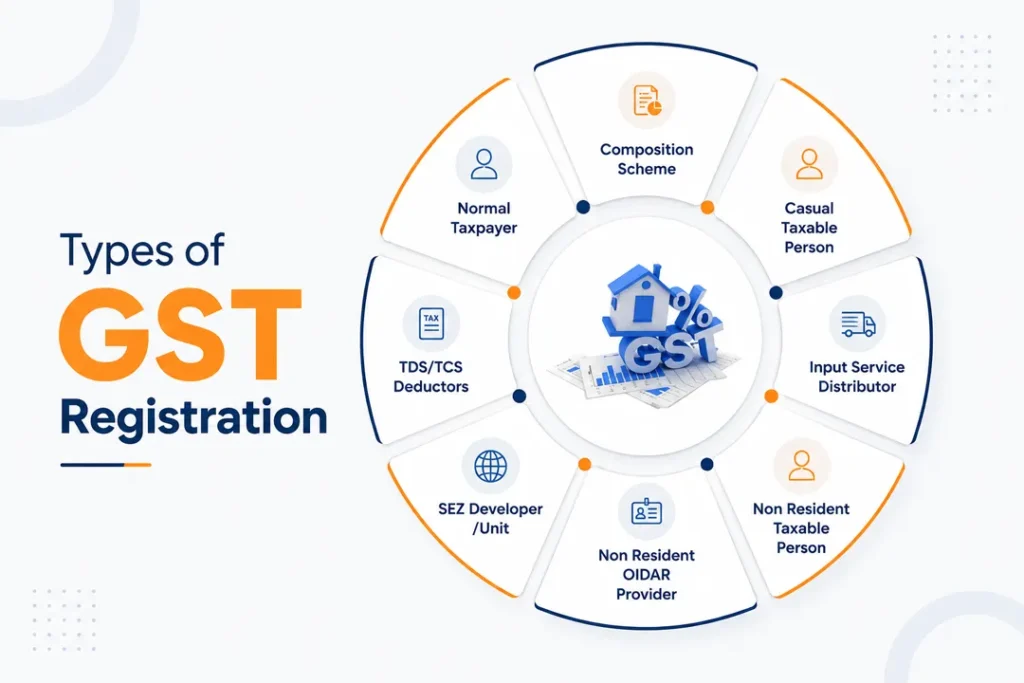
Types of GST Registration in India

Types of GST Registration

GST registration requirements vary depending on the nature of business activities, turnover, and category of taxpayer. The major types of GST registration include:

Normal Taxpayer Registration

This registration applies to regular businesses whose annual turnover exceeds the prescribed GST threshold limits. It allows businesses to:

  • Collect GST from customers.
  • Claim eligible Input Tax Credit (ITC).
  • Conduct regular taxable business activities.
  • Fulfil standard GST compliance requirements.

Casual Taxable Person Registration

This registration applies to businesses that operate temporarily or seasonally in a state where they do not have a permanent place of business.

Key features include:

  • Advance payment of estimated GST liability.
  • Validity period of 90 days.
  • Extension of validity for an additional 90 days, subject to applicable provisions.

Non-Resident Taxable Person Registration

This GST registration is required for individuals or businesses located outside India but supplying goods or services within India without having a permanent business establishment in the country.

Non-Resident Online Service Provider Registration

This category applies to foreign businesses providing online services to customers in India, such as:

  • Digital platforms.
  • Software subscription services.
  • Online streaming services.

Such businesses are required to comply with GST requirements applicable to non-resident online service providers.

Special Economic Zone (SEZ) Developer or Unit Registration

Businesses operating as SEZ developers or units may require GST registration to undertake activities related to international trade and exports. Such registration supports compliance for transactions involving SEZ operations.

Tax Deductor at Source (TDS) / Tax Collector at Source (TCS) Registration

Government departments, notified entities, and specified persons responsible for deducting or collecting tax at source under GST provisions are required to obtain GST registration.

These entities are responsible for:

  • Deducting or collecting applicable GST amounts.
  • Depositing the collected tax.
  • Filing required GST returns.

Components of GST: CGST, SGST, IGST, and UTGST

GST follows a dual taxation structure in India, allowing both the Central Government and State Governments to collect tax on eligible transactions. The GST framework consists of four major components:

CGST (Central Goods and Services Tax)

CGST is collected by the Central Government on intra-state transactions, where the supply of goods or services takes place within the same state or Union Territory.

SGST (State Goods and Services Tax)

SGST is collected by the respective State Government on intra-state transactions. For transactions within the same state, CGST and SGST are generally charged together and the revenue is shared between the Central and State Governments.

IGST (Integrated Goods and Services Tax)

IGST applies to:

  • Inter-state supplies of goods and services.
  • Imports into India.

The tax is collected by the Central Government and distributed between the Centre and relevant states as per applicable provisions.

UTGST (Union Territory Goods and Services Tax)

UTGST applies to intra-state transactions taking place in Union Territories without a legislature.

It is applicable in Union Territories such as:

  • Chandigarh.
  • Lakshadweep.
  • Andaman and Nicobar Islands.
  • Daman and Diu.
  • Dadra and Nagar Haveli.

UTGST works similarly to SGST and is charged along with CGST on eligible transactions.

GST Registration Threshold & Turnover Limits

GST registration becomes mandatory when the aggregate turnover of a business exceeds the prescribed limits during a financial year. The applicable threshold depends on the type of supply and the state category.

Turnover Limits for GST Registration

Component Rate Minimum Amount (If Applicable) Example (10 Employees @ ₹15,000 Basic Salary) Payable Amount (₹)
EPF Administrative Charges 0.50% of basic wages (A/c No. 2) ₹500 per contributory month / ₹75 if no contribution 0.5% of ₹1,50,000 = ₹750 ₹750
EDLI Administrative Charges 0.001% of basic wages (A/c No. 22) Minimum ₹2 0.001% of ₹1,50,000 = ₹1.5, rounded up ₹2
EDLI Contribution 0.50% of basic wages (A/c No. 21) No minimum amount 0.5% of ₹1,50,000 = ₹750 ₹750
Total EPFO Filing Charges Sum of applicable charges - ₹750 + ₹2 + ₹750 ₹1,502
Professional Fee (Consultant) ₹1,000 to ₹5,000 (depending on scope and employee count) Varies by service provider Average indicative fee: ₹2,000 ₹2,000 (Approx.)
Total Cost with Consultant - - ₹1,502 + ₹2,000 ₹3,502 (Approx.)

GST Threshold for Goods Suppliers

For businesses primarily engaged in the supply of goods, GST registration is generally required when annual turnover exceeds ₹40 lakh in most states.

GST Threshold for Service Providers

For service providers, GST registration is generally mandatory when annual turnover exceeds ₹20 lakh in most states.

Special Category States

Certain states have lower GST registration thresholds due to their specific economic conditions. These states include:

  • Arunachal Pradesh.
  • Assam.
  • Himachal Pradesh.
  • Jammu & Kashmir.
  • Manipur.
  • Meghalaya.
  • Mizoram.
  • Nagaland.
  • Puducherry.
  • Sikkim.
  • Tripura.
  • Uttarakhand.

Businesses should evaluate their turnover, business activity, and applicable state category before determining GST registration requirements.

Key Benefits of Obtaining GST Registration in India

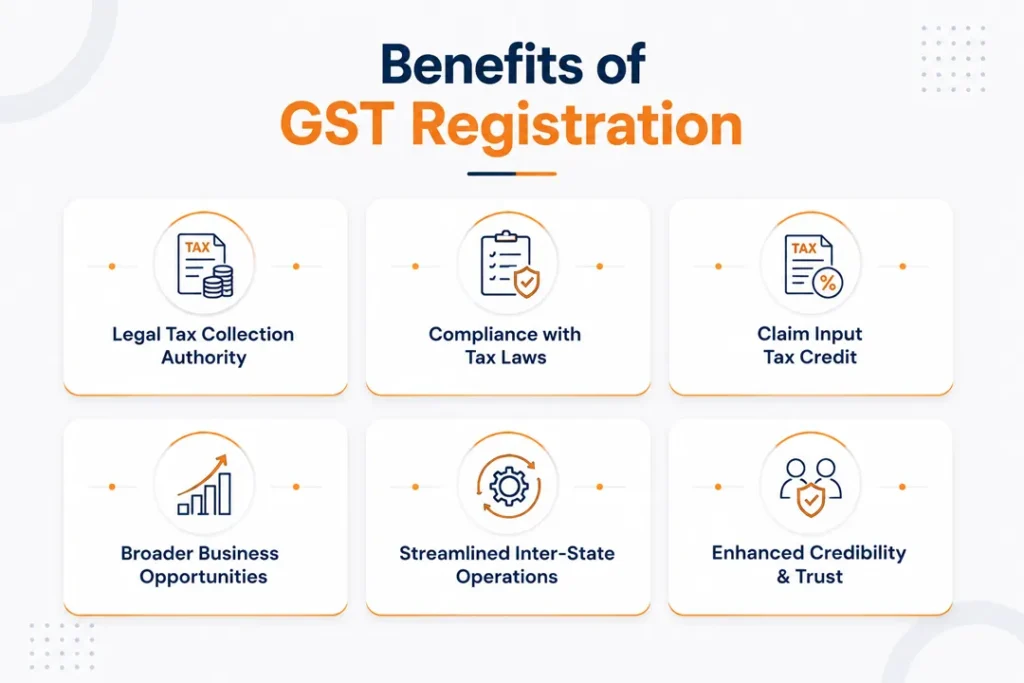
GST registration provides several advantages for businesses by enabling legal tax compliance, improving credibility, and creating opportunities for expansion. A registered business can operate within the GST framework, issue valid tax invoices, claim eligible Input Tax Credit (ITC), and manage tax obligations more efficiently.

Benefits of GST Registration

The major benefits of GST registration include:

Collect Tax Legally and Build Business Credibility

Authorised Tax Collection

GST registration allows businesses to legally collect GST from customers and deposit it with the government as per applicable tax regulations. This ensures transparency in transactions and helps businesses maintain proper tax compliance.

Improved Business Trust

Issuing GST-compliant invoices with a valid GSTIN helps establish credibility among customers, vendors, and business partners. A registered business reflects better compliance practices and creates confidence in commercial transactions.

Claim Input Tax Credit (ITC)

Reduces Overall Tax Liability

GST registration enables eligible businesses to claim Input Tax Credit on GST paid for business-related purchases and expenses. This helps reduce the overall tax burden and improves cash flow management.

Encourages Proper Accounting Practices

Maintaining GST records and claiming credits requires accurate accounting and documentation. This promotes better financial record-keeping and supports smoother reconciliation and compliance processes.

Simplifies Tax Compliance

Proper GST registration helps businesses follow a structured tax system where input credits, invoices, and tax payments are maintained according to statutory requirements.

Wider Business Opportunities

Access to Business Contracts

Many companies and organisations prefer working with GST-registered businesses. GST registration can help businesses participate in B2B transactions, corporate contracts, and eligible government tenders.

Expand Market Reach

A valid GST registration allows businesses to operate more efficiently across states and undertake online business activities where GST compliance is required. It helps businesses build a wider customer base and explore new markets.

Compliance with Legal Requirements

Avoids Compliance Issues

GST registration ensures that eligible businesses follow applicable GST laws and avoid issues arising from non-compliance, such as penalties, notices, and restrictions on business activities.

Supports Smooth Audits

Proper GST filings, invoices, and financial records help businesses maintain organised documentation, making tax assessments and audits more manageable.

Strengthens Business Reputation

Consistent GST compliance demonstrates responsible financial practices and helps improve the overall reputation of the business among customers, suppliers, and stakeholders.

Easier Business Expansion

Operate Across Multiple States

GST registration supports interstate business operations by providing a unified tax structure across India. It simplifies compliance requirements and enables smoother movement of goods and services between states.

Enables Online Selling

GST registration helps businesses sell products through online marketplaces such as Amazon and Flipkart, subject to meeting platform requirements and submitting necessary documents. It allows businesses to explore e-commerce opportunities and expand their digital presence.

Who is Eligible for GST Registration?

GST registration applies to businesses, individuals, and organisations involved in the supply of goods or services in India. Depending on turnover, business activity, and specific categories notified under GST law, registration may be mandatory or can be obtained voluntarily.

You are required or eligible to obtain GST registration if:

  • Your aggregate annual turnover exceeds the prescribed threshold limit:
    • ₹40 lakh for suppliers of goods in most states.
    • ₹20 lakh for service providers in most states.
    • ₹10 lakh for certain special category states, including North Eastern and hill states.
  • You are involved in inter-state supply of goods or services, where GST registration may be required regardless of turnover.
  • You are an e-commerce seller or supplier operating through platforms such as Amazon, Flipkart, or other online marketplaces.
  • You operate as a Casual Taxable Person, meaning you supply goods or services occasionally in a state where you do not have a permanent place of business.
  • You are a Non-Resident Taxable Person (NRTP) supplying goods or services in India without having a fixed business establishment in India.
  • You are liable to pay GST under the Reverse Charge Mechanism (RCM) for specified transactions.
  • You are an Input Service Distributor (ISD) distributing eligible input tax credit among different business units.
  • You act as an agent of a supplier or represent a registered taxpayer for business activities.
  • You provide Online Information and Database Access or Retrieval (OIDAR) services from outside India to customers in India.
  • You are required to deduct or collect tax under GST provisions as a TDS or TCS deductor.

Businesses that do not fall under mandatory registration categories may also opt for voluntary GST registration to claim Input Tax Credit (ITC), improve business credibility, and expand operations.

Mandatory GST Registration for Specific Businesses

Apart from turnover-based requirements, certain businesses and individuals are required to obtain GST registration due to the nature of their activities.

Casual Taxable Persons

Businesses or individuals supplying goods or services occasionally in a state where they do not have a permanent place of business are required to register under GST.

Example: A business setting up a temporary stall at an exhibition or trade fair in another state.

Non-Resident Taxable Persons (NRTPs)

Foreign individuals or companies supplying goods or services in India without having a permanent business establishment in India must obtain GST registration.

Inter-State Taxable Suppliers

Persons involved in inter-state supply of goods or services may require GST registration, even if their turnover is below the general threshold limit.

E-Commerce Operators and Sellers

Businesses selling through online platforms and e-commerce operators are required to comply with GST registration requirements as applicable.

This includes sellers operating through platforms such as:

  •  Amazon.
  •  Flipkart.
  • Other online marketplaces.

Agents of Registered Taxpayers

Persons supplying goods or services on behalf of another registered taxpayer may be required to obtain GST registration.

Persons Liable Under Reverse Charge Mechanism (RCM)

Businesses or individuals required to pay GST under the reverse charge mechanism must obtain registration as per applicable GST provisions.

Input Service Distributors (ISD)

Businesses distributing GST input tax credit from a central office to different branches or units are required to register as an ISD.

TDS and TCS Deductors

Entities responsible for deducting or collecting GST under the TDS or TCS provisions must obtain GST registration.

OIDAR Service Providers

Foreign companies providing online services such as digital content, software subscriptions, or online database services to Indian customers are required to comply with GST registration requirements.

Aggregators

Platforms that connect customers with service providers, such as transport or service aggregation platforms, may be required to obtain GST registration.

Businesses Registered Under Previous Tax Laws

Businesses registered under earlier indirect tax systems such as VAT, Excise Duty, or Service Tax were required to migrate to the GST system after its implementation.

Voluntary GST Registration for Businesses

Businesses that do not meet the mandatory GST registration criteria can still choose to register voluntarily under GST.

Voluntary GST registration provides several advantages, including:

Claim Input Tax Credit (ITC)

Registered businesses can claim eligible GST paid on business purchases as Input Tax Credit, helping reduce tax costs and improve cash flow management.

Build Business Credibility

A GST registration certificate provides legal recognition and improves trust among customers, vendors, and business partners.

Expand Across India

GST registration enables businesses to undertake interstate transactions and expand their operations across different states.

Sell Through Online Platforms

Many e-commerce platforms require sellers to have GST registration. Obtaining registration early helps businesses access online selling opportunities more easily.

Support Business Growth

GST registration can help businesses participate in tenders, work with larger organisations, and maintain compliance while scaling operations.

Carry Forward Eligible Tax Credits

Businesses with eligible previous tax credits may benefit from transitional credit provisions as applicable under GST rules.

Improve Loan and Rental Opportunities

GST registration and proper tax records can strengthen business credibility when applying for loans, renting commercial spaces, or entering formal business agreements.

Choosing the Right GST Scheme: Regular vs. Composition

Selecting the appropriate GST scheme is an important decision for businesses as it directly affects tax liability, compliance requirements, and day-to-day operations. Under the GST framework, businesses can generally choose between two primary schemes:

  • Regular Taxpayer Scheme
  • Composition Scheme

The suitable option depends on factors such as turnover, business type, customer base, interstate operations, and the need to claim Input Tax Credit (ITC).

Regular Taxpayer Scheme

The Regular GST Scheme applies to businesses that exceed the prescribed turnover limits under GST law. Businesses below the threshold limit can also voluntarily opt for this scheme.

The scheme is generally suitable for:

  • Medium and large businesses.
  • Manufacturers.
  • Service providers.
  • E-commerce operators.
  • Businesses involved in B2B transactions.
  • Businesses engaged in interstate supplies.

The Regular Scheme is beneficial for businesses that want to claim Input Tax Credit (ITC) and maintain a standard GST compliance structure. It is especially useful for businesses that deal with multiple suppliers, operate across states, or require tax credit benefits.

Composition Scheme

The Composition Scheme is designed for small businesses that prefer simpler compliance requirements and lower tax rates.

Businesses with annual aggregate turnover up to:

  • ₹1.5 crore in most states.
  • ₹75 lakh in specified special category states, including certain North-Eastern states and Himachal Pradesh.

may opt for this scheme, subject to applicable conditions.

Under this scheme, businesses pay GST at a fixed percentage of turnover instead of charging standard GST rates.

Applicable rates include:

  • 1% for traders and manufacturers.
  • 5% for restaurants not serving alcohol.
  • 6% for eligible service providers.

The Composition Scheme is generally suitable for small businesses that mainly operate within a state, serve regular consumers (B2C), and prefer reduced compliance requirements.

Difference Between Regular GST Scheme and Composition Scheme

Criteria Regular GST Scheme Composition Scheme
Turnover Limit Mandatory for turnover exceeding ₹40 lakh for goods and ₹20 lakh for services in most states. Businesses below the limit may also opt voluntarily. Available for businesses with turnover up to ₹1.5 crore in most states and ₹75 lakh in specified special category states.
Input Tax Credit (ITC) Eligible businesses can claim Input Tax Credit on eligible purchases. Input Tax Credit cannot be claimed.
Tax Rates Applicable standard GST rates such as 5%, 12%, 18%, and 28% based on the nature of goods or services. Fixed lower tax rates, such as 1% for traders/manufacturers, 5% for restaurants, and 6% for service providers.
Compliance Requirements Higher compliance requirements, including detailed invoices, regular returns, and reconciliation. Simpler compliance with fewer reporting requirements.
Invoice Type Can issue GST Tax Invoices and collect GST from customers. Must issue a Bill of Supply and cannot separately collect GST from customers.
Inter-State Sales Allowed for eligible businesses. Generally not permitted for interstate supplies.
E-Commerce Sales Allowed, subject to applicable GST rules. Restrictions apply on supplying goods through e-commerce operators.
Suitable For Medium and large businesses, B2B businesses, manufacturers, service providers, and interstate businesses. Small businesses, local traders, B2C businesses, and businesses seeking simplified compliance.

Businesses should evaluate their turnover, transaction nature, and future expansion plans before selecting a GST scheme. Choosing the right scheme helps maintain efficient tax management while ensuring compliance with GST regulations.

Documents Required for GST Registration in India

The documents required for GST registration may vary depending on the type of business entity and its structure. However, certain basic documents and details are commonly required for most GST registration applications.

The essential documents include:

  • PAN Card:
    A valid PAN card is mandatory for GST registration as the GST Identification Number (GSTIN) is linked with the PAN of the business or applicant.
  • Aadhaar Card:
    Aadhaar details are required for identity verification and Aadhaar authentication, which can help streamline the GST registration process.
  • Proof of Business Address:
    Documents supporting the principal place of business are required to verify the registered business location. The proof may vary depending on whether the premises are owned, rented, or shared.
  • Bank Account Details:
    Business bank account details may be required to link banking information with the GST registration.
  • Passport-Size Photographs:
    Photographs of the proprietor, partners, directors, or authorised signatories may be required for identification purposes.
  • Digital Signature Certificate (DSC):
    A valid DSC is mandatory for companies and LLPs for electronically signing and submitting the GST registration application.
  • Authorisation Letter or Board Resolution:
    An authorisation letter or board resolution may be required to authorise a representative or signatory to manage GST-related matters on behalf of the business.

The specific documents required may differ based on the business structure. For example:

  • A Partnership Firm may require a Partnership Deed.
  • A Limited Liability Partnership (LLP) may require an LLP Agreement.
  • A Company may require incorporation documents and details of directors.

Businesses should prepare documents according to their entity type and applicable GST requirements to ensure a smooth registration process.

Step-by-Step Guide to Online GST Registration Process

Businesses and individuals can complete the GST registration process through the official GST portal by following a structured application procedure. The process involves generating an application reference, providing business details, uploading documents, completing verification, and submitting the application.

The step-by-step GST registration process is as follows:

Step 1: Generate Temporary Reference Number (TRN)

The first step of GST registration is generating a Temporary Reference Number (TRN), which allows applicants to save and continue their registration application.

The process includes:

  • Visit the official GST portal.
  • Select Services → Registration → New Registration.
  • Choose the applicant type as Taxpayer.
  • Select the relevant State and District.
  • Enter business name, PAN details, email address, and mobile number.
  • Complete the captcha verification and click on Proceed.
  • Verify the mobile number and email address using the OTPs received.
  • After successful verification, a Temporary Reference Number (TRN) will be generated.

Step 2: Log in Using TRN

After generating the TRN:

  • Visit the GST portal.
  • Select New Registration → TRN.
  • Enter the generated TRN.
  • Complete OTP verification using the registered mobile number and email address.

Step 3: Access and Continue Saved Application

After logging in:

  • Open the My Saved Application
  • Select the saved GST registration application.
  • Click on the edit option to continue filling Form GST REG-01.

Step 4: Enter Business Details

Provide important business-related information, including:

  • Trade name.
  • Nature and type of business.
  • District details.
  • Business commencement date.
  • GST liability date.
  • Applicable GST scheme details, including the Composition Scheme if eligible.

Step 5: Add Promoter or Partner Details

Enter details of promoters, partners, or directors associated with the business, including:

  •  Name
  • PAN details.
  • Aadhaar details.
  • Contact information.
  • Director Identification Number (DIN), where applicable.

Step 6: Provide Authorised Signatory Details

Add details of the person authorised to handle GST compliance activities on behalf of the business.

Required information may include:

  • Name and contact details.
  • Identity details.
  • Authorisation documents, wherever applicable.

Step 7: Provide Business Address Details

Enter the principal place of business details and upload supporting documents.

The details generally include:

  • Complete business address.
  • Ownership or possession details.
  • Address proof.
  • Additional business locations, if any.

Step 8: Add Details of Goods and Services

Provide details of goods or services supplied by the business, including:

  • Product or service description.
  • HSN codes for goods.
  • SAC codes for services.

Step 9: Submit Bank Account Details

Provide business banking information, including:

  • Bank account number.
  • IFSC code.
  • Cancelled cheque or relevant bank document, where required.

Step 10: Provide State-Specific Information

Enter any additional details required by the respective state authorities, wherever applicable.

Step 11: Complete Aadhaar Authentication

Applicants can complete Aadhaar authentication for identity verification and faster processing.

Alternatively, applicants may proceed through the applicable verification process as prescribed under GST rules.

Step 12: Final Submission of GST Application

Before submission:

  • Review all entered information.
  • Accept the declaration.
  • Submit the application using the applicable method:
    • Digital Signature Certificate (DSC).
    • e-Sign.
    • Electronic Verification Code (EVC).

After successful submission, an Application Reference Number (ARN) is generated.

The ARN is a unique 15-digit reference number used to track the status of the GST registration application. It is sent to the registered email address and mobile number of the applicant.

GST Registration Timeline and Validity

The time required for completing GST registration depends on factors such as the verification method selected, accuracy of submitted information, document verification, and the nature of the business.

GST Registration Timeline

The approximate processing time for GST registration is as follows:

  • With Aadhaar Authentication:
    GST registration is generally processed within 3 to 7 working days. If the GST officer does not take any action within the prescribed period, the application may proceed as per the applicable auto-approval provisions.
  • Without Aadhaar Authentication:
    The registration process may take approximately 21 to 30 working days or more due to additional verification requirements, including possible physical verification or detailed document checks.

Factors Affecting GST Registration Timeline

Several factors can impact the approval time of a GST registration application, including:

  • Incomplete or Incorrect Information:
    Errors, missing details, or incorrect information submitted in the application can lead to clarification requests and delays.
  • Document Verification:
    GST authorities review submitted documents to verify the accuracy and authenticity of the information provided.
  • Type of Business Entity:
    Certain categories of applicants, such as Casual Taxable Persons or businesses requiring DSC-based verification, may involve additional verification steps.
  • Government Processing Workload:
    High application volumes may increase the time required for processing and approval.
  • Delayed Response to Queries:
    If the applicant does not respond promptly to clarification notices or queries raised by the GST officer, the registration timeline may be extended.

Validity of GST Registration Certificate

The validity of a GST registration certificate depends on the category of taxpayer.

Regular Taxpayers

For regular taxpayers, GST registration is generally valid permanently unless it is cancelled, surrendered, or suspended as per applicable GST provisions.

Regular taxpayers do not need to renew their GST registration, provided they continue to meet compliance requirements.

Casual Taxable Persons

GST registration for Casual Taxable Persons is temporary in nature.

  • The registration is valid for 90 days from the date of registration.
  • It can be extended for an additional 90 days by following the prescribed GST procedure.

Non-Resident Taxable Persons

For Non-Resident Taxable Persons, GST registration remains valid for:

  • The period specified in the registration certificate, or
  • The period for which advance tax has been deposited,

whichever is earlier.

Maintaining timely GST compliance, including return filing and tax payment obligations, is essential to keep the registration active and avoid cancellation-related issues.

GST Registration Fees and Penalties

The cost and requirements associated with GST registration depend on the category of taxpayer and the nature of business operations. While the government does not charge any registration fee in most cases, certain categories may require additional compliance-related deposits.

GST Registration Fees

The applicable GST registration requirements are as follows:

  • Regular Businesses:
    GST registration does not involve any government registration fee. Regular taxpayers can apply for GST registration without paying any statutory charges.
  • Casual Taxable Persons:
    GST registration is free; however, applicants may be required to deposit advance tax as per estimated tax liability before obtaining registration. The applicable requirements may vary depending on the nature of business and applicable GST provisions.
  • Non-Resident Taxable Persons:
    Similar to casual taxable persons, non-resident applicants are required to complete registration formalities and comply with applicable advance tax deposit requirements before commencing taxable supplies in India.

Penalty for Not Obtaining GST Registration

Businesses that become liable for GST registration but fail to register within the prescribed time may face penalties and interest on unpaid tax liabilities.

General Penalty

If a person fails to obtain GST registration despite being liable, the penalty may be:

  • ₹10,000 or 10% of the tax amount due, whichever is higher.

Penalty in Case of Fraud or Deliberate Tax Evasion

Where non-registration is linked with fraud, intentional tax evasion, or suppression of facts, a higher penalty may apply:

  • ₹10,000 or 100% of the tax amount due, whichever is higher.

Timely GST registration helps businesses avoid unnecessary penalties, maintain compliance, and ensure smooth tax operations.

GST Registration Renewal & Cancellation

GST registration requirements differ based on the category of taxpayer. While regular taxpayers generally do not need to renew their GST registration, certain temporary categories must manage their registration validity carefully.

GST Registration Renewal

For regular taxpayers, GST registration does not have an expiry date. Therefore, there is no separate renewal process or government renewal fee required.

The GSTIN remains valid as long as the taxpayer continues to comply with GST obligations, including:

  • Timely filing of GST returns.
  • Payment of applicable taxes.
  • Maintaining proper business records.
  • Following GST compliance requirements.

For regular taxpayers, maintaining continuous compliance effectively keeps the GST registration active.

However, the following points should be considered:

  • Casual Taxable Persons and Non-Resident Taxable Persons (NRTPs):
    GST registration for these categories is temporary and remains valid for a limited period, generally up to 90 days or the period specified in the registration certificate.
  • If taxable activities continue beyond the validity period, the taxpayer may need to apply for an extension or complete fresh registration as per applicable GST rules.

GST Registration Cancellation

GST registration can be cancelled either voluntarily by the taxpayer or by a GST officer due to non-compliance, fraudulent activities, or other valid reasons under GST law.

Voluntary Cancellation by Taxpayer

A taxpayer may apply for cancellation of GST registration in situations such as:

  • Discontinuation or closure of business operations.
  • Transfer of business due to merger, amalgamation, demerger, sale, lease, or other forms of transfer.
  • Change in business constitution resulting in a change of PAN, such as conversion of a proprietorship into a company.
  • Aggregate turnover falling below the mandatory GST registration threshold.
  • Death of a sole proprietor.
  • Voluntary registration obtained by a business that does not commence operations within the prescribed period.

Cancellation by GST Officer (Suo Moto Cancellation)

A GST officer may cancel registration if the taxpayer fails to comply with GST provisions or is found involved in irregular activities.

Common reasons for cancellation include:

  • Failure to file GST returns for the prescribed continuous period.
  • Issuing invoices without actual supply of goods or services.
  • Wrongful claiming or utilisation of Input Tax Credit (ITC).
  • Obtaining GST registration through fraud, misstatement, or suppression of facts.
  • Not operating from the declared principal place of business.
  • Violation of provisions under the GST Act or Rules.

Before cancellation by the GST officer, the taxpayer is generally provided an opportunity to respond through a show-cause notice.

Important Requirement Before GST Cancellation

A GST registration cannot generally be cancelled without completing pending compliance obligations.

The taxpayer must:

  • File all pending GST returns.
  • Clear outstanding tax liabilities, interest, and penalties, if applicable.
  • Submit the required final return after cancellation.

After receiving the cancellation order, the taxpayer must file Form GSTR-10 (Final Return) to complete the cancellation process.

Process for GST Registration Cancellation

The GST cancellation process involves the following steps:

Step 1: Log in to the GST Portal

Visit the official GST portal and log in using the registered username and password.

Step 2: Apply for Cancellation of Registration

Navigate to:

Services → Registration → Application for Cancellation of Registration

Step 3: Submit Cancellation Application (Form GST REG-16)

Complete the required details in Form GST REG-16, including:

  • Reason for cancellation.
  • Effective date of cancellation.
  • Supporting details and documents, wherever required.

Submit the application after verification.

Step 4: Verification and Approval by GST Officer

The GST officer reviews the application and supporting information.

If satisfied, the officer issues the cancellation order in Form GST REG-19, generally within the prescribed time period.

The cancellation becomes effective from the date determined by the officer.

Step 5: File Final Return (Form GSTR-10)

After receiving the cancellation order, the taxpayer must file the final GST return in Form GSTR-10 to report final liabilities and complete the cancellation procedure.

Cancellation Initiated by GST Officer

If cancellation is initiated by the GST officer, a show-cause notice in Form GST REG-17 is issued first.

The taxpayer gets an opportunity to submit a response and provide clarification before the final decision is taken.

Post-Registration: GST Compliance and Return Filing

Obtaining GST registration is only the first step towards maintaining tax compliance. After registration, businesses must regularly follow GST rules, maintain proper records, file applicable returns, and deposit collected taxes within the prescribed timelines.

Proper GST compliance helps businesses avoid penalties, maintain accurate financial records, and ensure smooth business operations.

Key GST Compliance Requirements After Registration

Businesses registered under GST are required to follow several compliance obligations, including:

  • Keep GST Information Updated:
    Any changes in business details, such as registered address, business activities, authorised signatory, or other information, should be updated on the GST portal.
  • Maintain Proper Records:
    Businesses must maintain accurate books of accounts, tax invoices, purchase records, sales records, and e-way bills for the prescribed period under GST regulations.
  • Issue GST-Compliant Invoices:
    Registered taxpayers must issue invoices containing all mandatory GST details for every taxable supply of goods or services.
  • File GST Returns on Time:
    Businesses must submit applicable GST returns based on their turnover, registration type, and selected GST scheme.
  • Pay Collected GST:
    GST collected from customers must be deposited with the government within the applicable due dates.
  • Generate E-Way Bills:
    An e-way bill is required for the movement of goods exceeding the prescribed value limit, generally applicable when the consignment value exceeds ₹50,000.
  • Use Correct HSN and SAC Codes:
    Businesses must correctly mention HSN codes for goods and SAC codes for services in invoices and GST return filings.

GST Return Filing Requirements

All GST-registered businesses are required to file applicable GST returns. The frequency of filing depends on factors such as turnover, business category, and the GST scheme selected.

Form Name Applicable For Frequency Due Date Purpose
GSTR-1 Normal registered taxpayers reporting outward supplies Monthly / Quarterly under QRMP Scheme 11th of the following month (Monthly) / 13th of the month following the quarter (Quarterly) Reports details of outward supplies or sales made during the tax period.
GSTR-2A / GSTR-2B Auto-generated statement of inward supplies Monthly Dynamic for GSTR-2A / 12th of the following month for GSTR-2B Used for viewing and reconciling Input Tax Credit details based on supplier filings.
GSTR-3B Normal registered taxpayers Monthly / Quarterly under QRMP Scheme 20th of the following month (Monthly) / 22nd or 24th of the month following the quarter (Quarterly) Summary return containing sales, purchases, ITC claimed, tax liability, and tax payment details.
GSTR-4 Composition Scheme taxpayers Quarterly 18th of the month following the quarter Return for composition taxpayers to report turnover and pay applicable tax.
GSTR-9 Normal registered taxpayers Annually 31st December of the following financial year Annual return providing reconciliation of periodic returns with annual financial records. Applicable subject to turnover limits.
GSTR-10 Taxpayers whose GST registration has been cancelled Once (Final Return) Within 3 months from the date of cancellation order Final return filed after cancellation to declare pending liabilities.
GSTR-5 Non-Resident Taxable Persons Monthly 20th of the following month Reports inward and outward supplies made by non-resident taxable persons.
GSTR-6 Input Service Distributors (ISD) Monthly 13th of the following month Reports receipt and distribution of Input Tax Credit by ISDs.
GSTR-7 GST TDS deductors Monthly 10th of the following month Reports tax deducted at source under GST provisions.
GSTR-8 E-commerce operators collecting TCS Monthly 10th of the following month Reports supplies made through e-commerce platforms and tax collected at source.
GSTR-11 Persons holding Unique Identification Number (UIN) claiming refunds Monthly 28th of the month following the month for which the statement is filed Reports inward supplies for UIN holders applying for refunds.

Maintaining timely GST compliance ensures accurate reporting, proper utilisation of Input Tax Credit, and reduced risk of notices, interest, and penalties under GST law.

GST Registration Certificate

A GST Registration Certificate is an official document issued by the GST Department after successful approval of a GST registration application. It acts as legal proof that a business is registered under the Goods and Services Tax system and is authorised to collect and deposit GST as per applicable regulations.

The certificate is issued in Form GST REG-06 and contains important details related to the registered taxpayer and business operations.

Key Details Mentioned in GST Registration Certificate

The GST Registration Certificate includes the following information:

  • GSTIN (Goods and Services Tax Identification Number):
    A unique 15-digit identification number assigned to every registered taxpayer under GST.
  • Legal Name and Trade Name of Business:
    The registered legal name and business trade name mentioned during the GST registration process.
  • Constitution of Business:
    Details regarding the structure of the business, such as proprietorship, partnership, LLP, company, or other entity types.
  • Principal Place of Business:
    The registered business address provided in the GST application.
  • Date of Registration:
    The official date from which the GST registration becomes effective.
  • Type of Registration:
    The category of GST registration, such as Regular Taxpayer, Composition Taxpayer, Casual Taxable Person, or other applicable categories.

How to Download GST Registration Certificate (Form GST REG-06)

After approval of the GST registration application, the GST Department issues the registration certificate in Form GST REG-06.

The certificate is not provided as a physical document by the authorities. Registered taxpayers can download it digitally from the GST portal.

Follow these steps to download the GST Registration Certificate:

Step 1: Log in to the GST Portal

Visit the official GST portal and log in using your registered username and password.

Step 2: Open Certificate Section

After logging in, navigate to:

Services → User Services → View/Download Certificates

Step 3: Download Registration Certificate

The list of certificates issued by the GST authorities will appear.

  • Locate Registration Certificate (Form GST REG-06).
  • Click on the download option available under the certificate section.

Step 4: Save or Print Certificate

The certificate will be downloaded in PDF format.

You can:

  • Save the certificate digitally for future reference.
  • Print a physical copy for business records or compliance requirements.

The GST Registration Certificate should be preserved carefully as it contains essential registration details required for GST invoices, filings, and business transactions.

Form Name Applicable For Frequency Due Date Purpose
GSTR-1 Normal registered taxpayers reporting outward supplies Monthly / Quarterly under QRMP Scheme 11th of the following month (Monthly) / 13th of the month following the quarter (Quarterly) Reports details of outward supplies or sales made during the tax period.
GSTR-2A / GSTR-2B Auto-generated statement of inward supplies Monthly Dynamic for GSTR-2A / 12th of the following month for GSTR-2B Used for viewing and reconciling Input Tax Credit details based on supplier filings.
GSTR-3B Normal registered taxpayers Monthly / Quarterly under QRMP Scheme 20th of the following month (Monthly) / 22nd or 24th of the month following the quarter (Quarterly) Summary return containing sales, purchases, ITC claimed, tax liability, and tax payment details.
GSTR-4 Composition Scheme taxpayers Quarterly 18th of the month following the quarter Return for composition taxpayers to report turnover and pay applicable tax.
GSTR-9 Normal registered taxpayers Annually 31st December of the following financial year Annual return providing reconciliation of periodic returns with annual financial records. Applicable subject to turnover limits.
GSTR-10 Taxpayers whose GST registration has been cancelled Once (Final Return) Within 3 months from the date of cancellation order Final return filed after cancellation to declare pending liabilities.
GSTR-5 Non-Resident Taxable Persons Monthly 20th of the following month Reports inward and outward supplies made by non-resident taxable persons.
GSTR-6 Input Service Distributors (ISD) Monthly 13th of the following month Reports receipt and distribution of Input Tax Credit by ISDs.
GSTR-7 GST TDS deductors Monthly 10th of the following month Reports tax deducted at source under GST provisions.
GSTR-8 E-commerce operators collecting TCS Monthly 10th of the following month Reports supplies made through e-commerce platforms and tax collected at source.
GSTR-11 Persons holding Unique Identification Number (UIN) claiming refunds Monthly 28th of the month following the month for which the statement is filed Reports inward supplies for UIN holders applying for refunds.

Maintaining timely GST compliance ensures accurate reporting, proper utilisation of Input Tax Credit, and reduced risk of notices, interest, and penalties under GST law.

Talk To Our Experts

Frequently Asked Questions (FAQs)

What is GST registration?

GST registration is the process through which a business or individual gets officially registered under the Goods and Services Tax system. After successful registration, the applicant receives a unique 15-digit GSTIN (Goods and Services Tax Identification Number) and becomes authorised to collect and deposit GST on applicable supplies.

GST registration can be obtained by submitting an online application through the GST portal along with required business details, PAN, identity proof, address proof, and other supporting documents. After verification and approval by the GST authorities, the GST Registration Certificate is issued.

Businesses and individuals involved in the supply of goods or services may be eligible for GST registration based on turnover limits, nature of business activities, and specific categories mentioned under GST law. This includes traders, manufacturers, service providers, e-commerce sellers, casual taxable persons, and non-resident taxable persons.

GST registration is mandatory for businesses that cross the prescribed turnover threshold or fall under categories requiring compulsory registration, such as interstate suppliers, e-commerce operators, casual taxable persons, non-resident taxable persons, and persons liable under reverse charge provisions.

The commonly required documents include PAN card, Aadhaar card, business address proof, bank account details, photographs, DSC (where applicable), and authorisation documents. Additional documents may be required depending on the business structure.

The GST registration timeline depends on factors such as Aadhaar authentication, document verification, and the nature of the business. Applications with successful Aadhaar authentication are generally processed faster, while applications requiring additional verification may take longer.

The GST Registration Certificate can be downloaded from the GST portal after approval. Taxpayers can log in and navigate to Services → User Services → View/Download Certificates to download Form GST REG-06.

GST registration application status can be checked through the GST portal using the ARN (Application Reference Number) generated after submission of the registration application.

The GST registration threshold depends on the nature of supply and location of the business. Generally, the threshold is ₹40 lakh for goods suppliers and ₹20 lakh for service providers in most states, subject to applicable GST rules and exceptions.

GST registration is mandatory for businesses that exceed the applicable turnover limit or fall under compulsory registration categories specified under the GST Act.

A registered taxpayer can update the business address by submitting an amendment application through the GST portal. After verification and approval, the updated details are reflected in the GST registration certificate.

Aggregate turnover includes the value of taxable supplies, exempt supplies, exports, and interstate supplies of persons having the same PAN, calculated on an all-India basis. Certain taxes and specific excluded items are not included.

The trade name can be updated by filing an amendment application on the GST portal. After approval by the GST authorities, the revised trade name is updated in GST records.

GST registration requirements for share trading depend on the nature of activities and whether the person is involved in taxable supplies under GST. Share trading as an investment activity generally does not require GST registration.

The registered mobile number can be updated by submitting a core amendment application through the GST portal and completing the required verification process.

Yes, PAN is mandatory for GST registration as the GSTIN is linked with the PAN of the business or applicant.

GST registration helps businesses collect GST legally, claim eligible Input Tax Credit, improve business credibility, expand operations across states, and comply with tax regulations.

If a GST registration application is rejected, the applicant may review the reason for rejection, correct the issues, and submit a fresh application or take appropriate action as permitted under GST rules.

HSN codes can be added or updated by filing an amendment application through the GST portal. Businesses must mention appropriate HSN codes based on the goods supplied.

A letter of authorization is a document that authorises a person to act as an authorised signatory or representative for GST-related activities on behalf of the business.

Changes in partner details can be updated by filing an amendment application on the GST portal along with relevant supporting documents.

Yes, a business may obtain multiple GST registrations within the same state or Union Territory for different business verticals, subject to applicable GST provisions.

GSTIN is a unique 15-digit identification number issued to registered taxpayers under GST. It is used for tax identification, invoice generation, return filing, and compliance purposes.

GST registration can be cancelled by submitting an online cancellation application through the GST portal. After verification, the GST officer issues a cancellation order if the request is approved.

To close GST registration, taxpayers must apply for cancellation, complete pending GST returns, clear applicable liabilities, and file the required final return after cancellation.

A cancelled GST registration may be revoked by filing an application for revocation through the GST portal within the prescribed time limit, subject to approval by the GST officer.

Generally, pending GST returns must be filed before cancellation of registration. Taxpayers are required to complete outstanding compliance obligations before final cancellation.

Why Choose Cotaxo for GST Registration?

Obtaining GST registration requires accurate documentation, proper application filing, and understanding of applicable GST requirements. Cotaxo provides expert-guided GST registration support to help businesses complete the process efficiently while maintaining compliance with applicable regulations.

Why Businesses Prefer Cotaxo:

  • Expert GST Guidance: Get assistance from professionals who understand GST registration requirements, documentation, and compliance procedures.
  • Complete Documentation Support: Cotaxo helps you prepare and organise the required documents based on your business structure and registration category.
  • Accurate Application Filing: We ensure that the GST registration application is prepared with accurate business details to reduce the chances of errors or delays.
  • Support Across Business Structures: Assistance is available for proprietorships, partnerships, LLPs, companies, startups, and other eligible business entities.
  • Online Managed Service: The entire process is managed online by expert consultants through WhatsApp, Email, and Phone, making GST registration convenient and accessible.
  • Post-Registration Compliance Guidance: Receive guidance on GST return filing, invoice requirements, and ongoing compliance obligations after registration.
Why Cotaxo
Get GST Registration Assistance from Experts

Start Your GST Registration Today

Register your business under GST with professional guidance from Cotaxo. Our experts help you complete the registration process with proper documentation and compliance support.