GST • Income Tax • Registration • Payroll • Advisory • FSSAI • Virtual CFO

Income Tax Return Filing Online in India

File your Income Tax Return with confidence through Cotaxo’s online managed tax filing services. Whether you are a salaried individual, freelancer, business owner, or professional, our expert consultants help you prepare and file your return accurately while ensuring compliance with the Income-tax Act, 1961. From selecting the appropriate ITR form to claiming eligible deductions and reporting income correctly, we provide end-to-end assistance to make the filing process simple and hassle-free.

Enter Your Details to Receive a Full Quote and Consultation

What Sets Cotaxo Apart

Dedicated Expert Assistance

Transparent Pricing

End-to-End Compliance Support

Pan-India Service Coverage

Overview of Income Tax Return (ITR)

An Income Tax Return (ITR) is an annual statement filed by individuals, professionals, and businesses with the Income Tax Department of India. It contains details of income earned from various sources, such as salary, business or profession, house property, capital gains, and other income, during a particular financial year.
Filing an ITR helps taxpayers comply with the provisions of the Income-tax Act, 1961. It also serves as proof of income, supports various financial and legal requirements, and enables the Income Tax Department to determine the taxpayer’s tax liability or eligible refund.

What is Income Tax Return (ITR) Filing?

Income Tax Return (ITR) filing is the process of reporting income earned during a financial year to the Income Tax Department of India. Individuals, professionals, and businesses file the prescribed ITR form to declare income from sources such as salary, business or profession, house property, capital gains, and other income, while claiming eligible deductions and exemptions available under the Income-tax Act, 1961.

The appropriate ITR form depends on the taxpayer’s category, source of income, and applicable tax provisions. Forms such as ITR-1, ITR-2, ITR-3, and others are designed for different types of taxpayers and income profiles.

Why is Filing Your Income Tax Return Important?

Filing an Income Tax Return is not only a legal requirement for eligible taxpayers but also offers several financial and practical benefits.

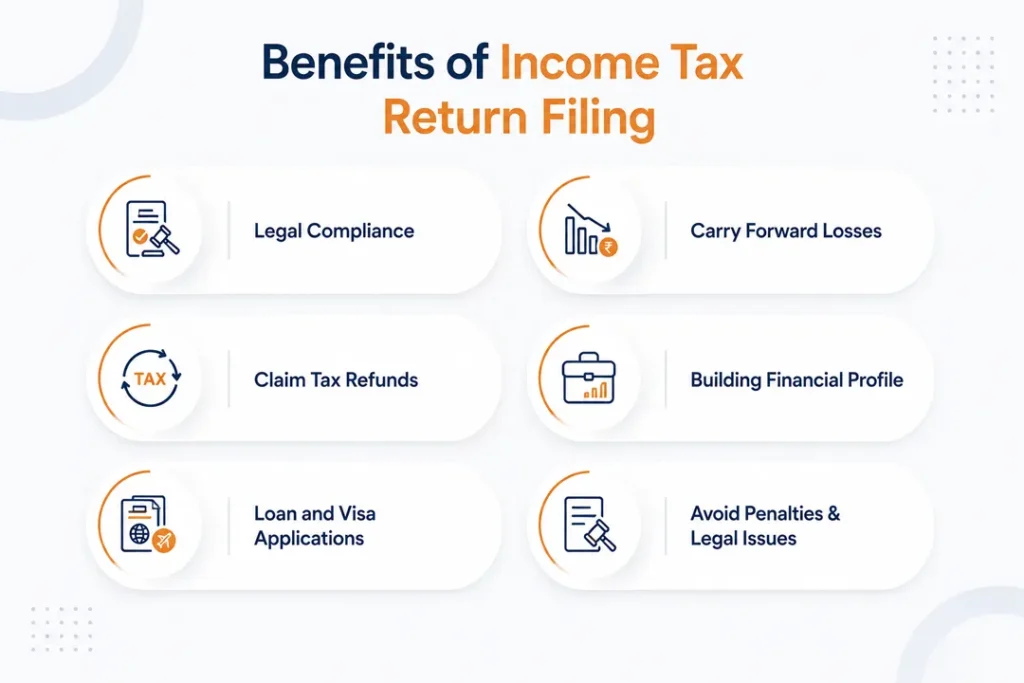
Benefits of Income Tax Return Filing

  • Comply with the applicable provisions of the Income-tax Act, 1961.
  • Avoid penalties and consequences associated with delayed or non-filing.
  • Claim refunds for excess tax deducted or paid during the financial year.
  • Carry forward eligible business or capital losses, subject to applicable provisions.
  • Provide income proof for loan applications, visa processing, and other financial requirements.
  • Maintain an official record of your income and tax compliance.
Benefits of ITR Filings

Financial Year (FY) vs Assessment Year (AY)

Understanding the difference between the Financial Year (FY) and the Assessment Year (AY) is essential while filing an Income Tax Return.

Feature Financial Year (FY) Assessment Year (AY)
Definition The period during which income is earned. The period in which the income earned during the Financial Year is assessed and taxed.
Duration From 1 April to 31 March of the following year. From 1 April to 31 March immediately after the relevant Financial Year.
Purpose Covers income earned, expenses incurred, and financial transactions. Used for filing the Income Tax Return and assessing tax liability for the preceding Financial Year.
Example FY 2025-26: Income earned between 1 April 2025 and 31 March 2026. AY 2026-27: Return filed for income earned during FY 2025-26.
ITR Filing Income is earned during this period. Income Tax Returns are filed for the relevant Assessment Year.
Relationship Followed by the corresponding Assessment Year. Always relates to the immediately preceding Financial Year.

Latest Income Tax Slabs and Rates

Understanding the applicable income tax slabs is essential for accurate Income Tax Return (ITR) filing. Individuals can choose between the New Tax Regime and the Old Tax Regime, subject to the applicable provisions of the Income-tax Act, 1961.

New Tax Regime (FY 2025-26 | AY 2026-27)

The New Tax Regime offers lower tax rates with limited deductions and exemptions.

Taxable Income Tax Rate
Up to ₹4,00,000 Nil
₹4,00,001 to ₹8,00,000 5%
₹8,00,001 to ₹12,00,000 10%
₹12,00,001 to ₹16,00,000 15%
₹16,00,001 to ₹20,00,000 20%
₹20,00,001 to ₹24,00,000 25%
Above ₹24,00,000 30%

Rebate under Section 87A

For FY 2025-26 (AY 2026-27), resident individuals can claim the following rebate, subject to the applicable conditions:

  • Under the New Tax Regime, a rebate of up to ₹60,000 is available for total income up to ₹12 lakh.
  • Salaried individuals under the New Tax Regime can also claim a standard deduction of ₹75,000, making income up to ₹12.75 lakh effectively tax-free, subject to applicable conditions.
  • Under the Old Tax Regime, a rebate of up to ₹12,500 is available for total income up to ₹5 lakh.

Old Tax Regime

The Old Tax Regime allows taxpayers to claim eligible deductions and exemptions, including those available under Sections 80C, 80D, HRA, LTA, and other applicable provisions.

Individuals Below 60 Years and HUF

Taxable Income Tax Rate
Up to ₹2,50,000 Nil
₹2,50,001 to ₹5,00,000 5%
₹5,00,001 to ₹10,00,000 20%
Above ₹10,00,000 30%

Senior Citizens (60 Years to Less Than 80 Years)

Taxable Income Tax Rate
Up to ₹3,00,000 Nil
₹3,00,001 to ₹5,00,000 5%
₹5,00,001 to ₹10,00,000 20%
Above ₹10,00,000 30%

Super Senior Citizens (80 Years and Above)

Taxable Income Tax Rate
Up to ₹5,00,000 Nil
₹5,00,001 to ₹10,00,000 20%
Above ₹10,00,000 30%

Choosing the Right Tax Regime

The choice between the Old Tax Regime and the New Tax Regime depends on your income, eligible deductions, exemptions, and overall tax planning. Taxpayers with substantial deductions may benefit from the Old Tax Regime, while those preferring lower tax rates with fewer deductions may find the New Tax Regime more suitable.

As the tax implications vary from one taxpayer to another, it is advisable to evaluate both options before filing your Income Tax Return.

Tax Rates for Different Entities

Income tax rates also differ based on the type of taxpayer. While individuals and Hindu Undivided Families (HUFs) are taxed according to slab rates, companies, partnership firms, LLPs, and other entities are governed by separate tax provisions and applicable rates under the Income-tax Act, 1961. The applicable tax liability may also include surcharge and Health and Education Cess, wherever relevant.

Who Needs to File an Income Tax Return (ITR)?

An Income Tax Return (ITR) must generally be filed by individuals and entities whose gross total income exceeds the applicable basic exemption limit under the Income-tax Act, 1961. In certain cases, filing may also be mandatory even if the income is below the exemption limit, subject to the prescribed conditions.

The following categories commonly require ITR filing:

  • Salaried individuals
  • Self-employed professionals and freelancers
  • Proprietorships, Partnership Firms, LLPs, and Companies
  • Individuals earning income from house property
  • Taxpayers with capital gains
  • Individuals having income from other sources, such as interest or dividends

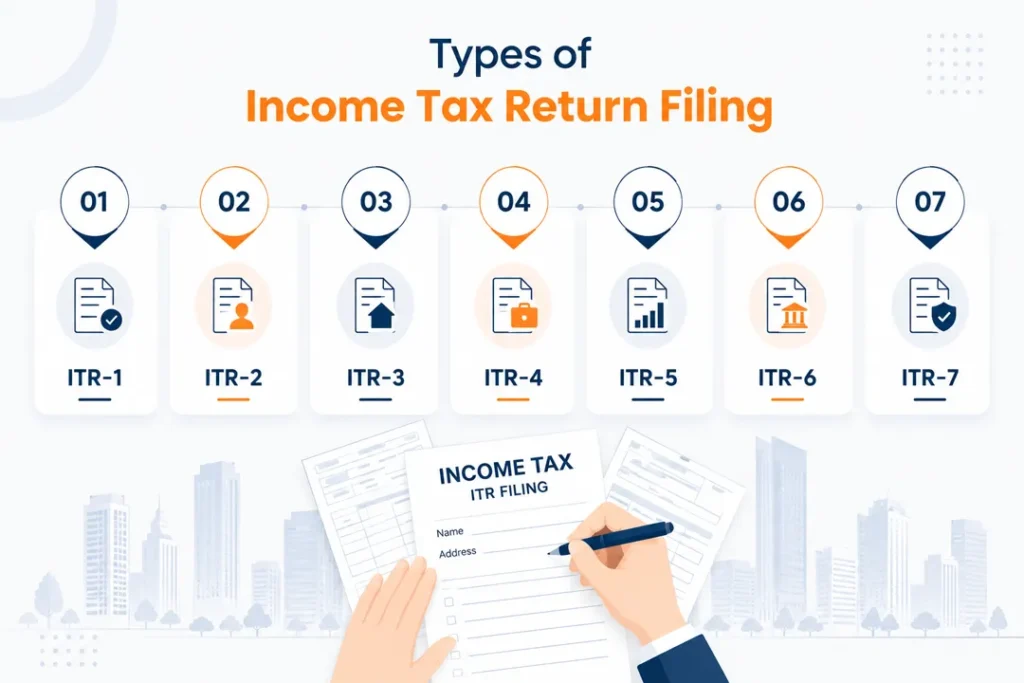
Different Income Tax Return (ITR) Forms in India

Selecting the correct ITR form is an important part of the return filing process. The applicable form depends on the taxpayer’s category, sources of income, and other prescribed conditions. Filing an incorrect form may result in the return being treated as defective by the Income Tax Department.

Types of ITR Form
ITR Form Applicable To Income Covered Not Applicable For
ITR-1 (Sahaj) Resident individuals with total income up to ₹50 lakh Salary or pension, one house property, income from other sources, and agricultural income up to ₹5,000 Business or professional income, capital gains, foreign assets, or multiple specified incomes
ITR-2 Individuals and HUFs without business or professional income Salary, pension, multiple house properties, capital gains, foreign income and assets, and other sources Business or professional income
ITR-3 Individuals and HUFs having income from business or profession Business or professional income along with salary, house property, capital gains, and other sources Not applicable where ITR-4 conditions are fulfilled under the presumptive scheme, if chosen
ITR-4 (Sugam) Resident individuals, HUFs, and firms (excluding LLPs) opting for presumptive taxation Income under Sections 44AD, 44ADA, or 44AE, along with eligible salary, house property, and other income Taxpayers not eligible for the presumptive taxation scheme or exceeding prescribed limits
ITR-5 Partnership Firms, LLPs, AOPs, BOIs, co-operative societies, local authorities, and similar entities Income applicable to the specified entities Individuals, HUFs, and companies filing under other applicable forms
ITR-6 Companies other than those claiming exemption under Section 11 Income of domestic and other eligible companies Companies claiming exemption under Section 11
ITR-7 Trusts, charitable institutions, political parties, educational institutions, research associations, and other specified entities Income required to be reported under the applicable provisions of the Income-tax Act, 1961 Taxpayers not covered under the specified provisions

The Income Tax Department periodically updates the ITR forms, utilities, and reporting requirements. Taxpayers should always use the latest applicable ITR form and filing utility for the relevant Assessment Year to ensure accurate and compliant filing.

Documents Required for Income Tax Return (ITR) Filing

Keeping the necessary documents ready before filing your Income Tax Return helps ensure accurate reporting and a smoother filing process.

  • PAN Card and Aadhaar Card
    PAN is mandatory for filing an Income Tax Return, while Aadhaar is required for identity verification and PAN linking, wherever applicable.
  • Form 16
    Salaried individuals should keep Form 16 issued by their employer, as it contains details of salary paid and tax deducted at source (TDS). If you have changed employers during the financial year, collect Form 16 from each employer.
  • Bank Statements and Interest Certificates
    These documents help report interest earned from savings accounts, fixed deposits, recurring deposits, and other bank accounts. They are also useful for verifying financial transactions and tax refunds.
  • Investment and Deduction Proofs
    Keep documents supporting deductions claimed under applicable provisions, such as Section 80C, Section 80D, and other eligible deductions. These may include investment receipts, insurance premium receipts, and other supporting records.
  • Form 26AS, AIS, and TIS
    Form 26AS provides details of tax deducted, tax collected, advance tax, self-assessment tax, and refunds linked to your PAN. The Annual Information Statement (AIS) and Taxpayer Information Summary (TIS) provide additional financial information that helps ensure accurate income reporting and tax compliance.

How to File an Income Tax Return (ITR) Online?

Filing an Income Tax Return involves reporting your income, claiming eligible deductions, calculating your tax liability, and submitting the applicable ITR form to the Income Tax Department. Here’s how the process typically works:

Step 1: Gather the Required Documents

Collect all the necessary documents before starting the filing process. These generally include:

  • PAN Card and Aadhaar Card
  • Form 16 (for salaried individuals)
  • Form 16A, Form 16B, or Form 16C, where applicable
  • Bank statements and interest certificates
  • Investment and deduction proofs
  • Home loan statements, if applicable
  • Form 26AS, Annual Information Statement (AIS), and Taxpayer Information Summary (TIS)

Step 2: Calculate Your Taxable Income

Calculate your total income by considering all applicable sources, including:

  • Salary or pension
  • House property
  • Business or professional income
  • Capital gains
  • Income from other sources

After determining your gross total income, identify the applicable tax regime and calculate your taxable income.

Step 3: Claim Eligible Deductions

Claim all eligible deductions and exemptions available under the Income-tax Act, 1961, wherever applicable. Common deductions include those available under Sections 80C, 80D, 80E, 80G, 80TTA, 80TTB, and Section 24(b), depending on your eligibility.

Step 4: File the Appropriate ITR Form

Select the correct ITR form based on your income profile and taxpayer category. Verify the pre-filled information, enter the required details, calculate any remaining tax payable or refund, and submit the return through the Income Tax Department’s e-filing portal.

Step 5: Complete the E-Verification

After submitting the return, complete the mandatory e-verification process. Your Income Tax Return can generally be verified through one of the following methods:

  • Aadhaar OTP
  • Net Banking
  • Electronic Verification Code (EVC)
  • Bank ATM, where available
  • Digital Signature Certificate (DSC), wherever applicable

An Income Tax Return is considered successfully filed only after it has been e-verified within the prescribed time limit.

Income Tax Return Filing Fees, Due Dates and Penalties

Timely filing of your Income Tax Return helps you remain compliant with the Income-tax Act, 1961 while avoiding unnecessary penalties, interest, and other legal consequences. Understanding the applicable filing timelines, professional charges, and consequences of delayed filing can help you plan your tax compliance more effectively.

Income Tax Return Filing Charges

The cost of filing an Income Tax Return varies depending on the filing method, complexity of income, and the level of professional assistance required.

Self-Filing Through the Income Tax Portal

The official Income Tax e-Filing portal allows eligible taxpayers to file their returns without any government filing charges. This option is generally suitable for individuals having simple income sources and who are comfortable completing the filing process on their own. The portal also provides pre-filled information from Form 26AS, AIS, and TIS to simplify return preparation.

Online Tax Filing Platforms

Several online platforms offer self-service ITR filing with guided assistance. These services are generally suitable for taxpayers seeking a simplified filing experience without engaging a tax professional.

The charges usually vary depending on the taxpayer’s income profile and may range from approximately ₹99 to ₹800 or more for basic returns. Certain platforms may also provide free filing for specific taxpayer categories or simple income profiles.

Expert-Assisted Income Tax Filing

Many taxpayers prefer professional assistance for preparing and filing their Income Tax Returns, especially where multiple income sources or complex tax situations are involved.

Professional charges generally depend on factors such as:

  • Salary income with Form 16
  • Multiple employers
  • House property income
  • Capital gains
  • Business or professional income
  • Foreign income or foreign assets
  • Cryptocurrency transactions
  • Share trading and F&O transactions
  • NRI tax filing requirements

The fee generally increases with the complexity of the return and the level of advisory support required.

Chartered Accountant or Tax Consultant

Taxpayers may also choose to engage a Chartered Accountant or tax consultant for personalized assistance. Besides return filing, professionals may also provide support relating to tax planning, notices issued by the Income Tax Department, business taxation, and advisory services.

Professional fees differ based on the scope of work, complexity of the return, and the services requested.

Factors Affecting ITR Filing Charges

The overall filing charges may depend on several factors, including:

  • Nature of income
  • Number of income sources
  • Volume of financial transactions
  • Applicable ITR form
  • Requirement of professional assistance
  • Additional advisory or compliance services

Due Dates, Late Filing Penalties and Consequences

Due Dates for Filing Income Tax Return

The due date for filing an Income Tax Return depends upon the category of taxpayer and the applicable provisions of the Income-tax Act, 1961.

Category of Taxpayer General Due Date*
Individuals and non-audit cases Generally 31st July of the relevant Assessment Year unless extended by the Government
Taxpayers requiring audit Generally 31st October of the relevant Assessment Year
Taxpayers covered under transfer pricing provisions (Section 92E) Generally 30th November of the relevant Assessment Year

*The Central Board of Direct Taxes (CBDT) may extend these due dates through official notifications whenever applicable.

Penalty for Late Filing of ITR

If an Income Tax Return is filed after the prescribed due date, a late filing fee may be levied under Section 234F of the Income-tax Act, 1961.

Generally:

  • A late fee of up to ₹1,000 may apply where the total income does not exceed ₹5 lakh.
  • A late fee of up to ₹5,000 may apply where the total income exceeds ₹5 lakh, subject to the applicable provisions.
  • The applicable late filing fee depends upon the date of filing and the provisions in force for the relevant Assessment Year.

Interest on Delayed Tax Payment

Apart from the late filing fee, interest may also become payable if there is any outstanding tax liability.

Interest may be charged under the following provisions:

  • Section 234A for delay in filing the Income Tax Return where tax remains unpaid.
  • Section 234B for short payment or non-payment of advance tax.
  • Section 234C for deferment of advance tax instalments.

The applicable interest is generally calculated at the prescribed rate under the Income-tax Act, 1961, depending on the nature and duration of the default.

What Happens if You Miss the ITR Filing Due Date?

Missing the due date may have several financial and legal consequences, including:

  • Requirement to file a belated return within the prescribed time limit.
  • Liability to pay late filing fees under Section 234F, wherever applicable.
  • Interest on unpaid taxes under Sections 234A, 234B, and 234C.
  • Delay in processing of eligible income tax refunds.
  • Restriction on carrying forward certain eligible business or capital losses.
  • Higher chances of receiving notices or scrutiny from the Income Tax Department.
  • Difficulties in obtaining loans, visas, or other financial approvals where ITR acknowledgements are required.
  • In serious cases involving persistent non-compliance, action may be initiated in accordance with the provisions of the Income-tax Act, 1961.

Filing your Income Tax Return within the prescribed due date helps avoid unnecessary penalties and ensures timely processing of refunds while maintaining proper tax compliance.

How to Save More on Taxes with Smart Deductions?

Claiming eligible deductions is one of the most effective ways to reduce your taxable income while filing your Income Tax Return. Understanding the deductions available under the Income-tax Act, 1961 can help you optimise your tax liability and improve your overall tax planning.

Deductions Available Under Section 80C

Section 80C is one of the most commonly claimed tax-saving provisions, allowing eligible individuals and Hindu Undivided Families (HUFs) to claim deductions of up to ₹1.5 lakh in a financial year for specified investments and eligible expenses.

Eligible investments and payments include:

  • Public Provident Fund (PPF)
  • Employees’ Provident Fund (EPF)
  • Equity Linked Savings Schemes (ELSS)
  • National Savings Certificate (NSC)
  • Life Insurance Premiums
  • Principal repayment of a home loan
  • Tuition fees for up to two children
  • Sukanya Samriddhi Yojana (SSY)
  • Senior Citizen Savings Scheme (SCSS)
  • Five-year Tax Saving Fixed Deposits

Health Insurance Deduction Under Section 80D

Section 80D allows taxpayers to claim deductions for health insurance premiums paid for themselves and eligible family members.

The available deduction limits are generally as follows:

Covered Person Maximum Deduction
Self, spouse, and dependent children Up to ₹25,000
Parents below 60 years Additional deduction up to ₹25,000
Senior citizen parents Additional deduction up to ₹50,000
Self or spouse who is a senior citizen Up to ₹50,000

A deduction for preventive health check-ups is also available within the overall limits prescribed under Section 80D.

Deduction on Home Loan Interest

Interest paid on a housing loan may be claimed as a deduction under Section 24(b), subject to the applicable conditions.

  • For a self-occupied residential property, interest deduction is generally available up to ₹2 lakh per financial year.
  • For a let-out property, the actual interest paid may be claimed, subject to the provisions governing the set-off and carry forward of house property losses.
  • Unadjusted eligible losses may generally be carried forward in accordance with the provisions of the Income-tax Act.

Standard Deduction for Salaried Taxpayers

The standard deduction is available to eligible salaried individuals and pensioners without requiring any investment proof or expense documentation.

For FY 2025-26 (AY 2026-27):

  • Under the New Tax Regime, the standard deduction is ₹75,000.
  • Under the Old Tax Regime, the standard deduction is ₹50,000.

This deduction reduces taxable salary income and simplifies the return filing process.

Other Important Tax Deductions

Apart from Sections 80C, 80D, and Section 24(b), taxpayers may also be eligible for several other deductions, depending on their financial circumstances.

Some commonly claimed deductions include:

  • Section 80G: Deduction for eligible donations made to approved charitable institutions and funds.
  • Section 80TTA: Deduction on interest earned from savings accounts for eligible individuals and HUFs.
  • Section 80TTB: Higher deduction on interest income for senior citizens from eligible bank and deposit accounts.
  • Section 80E: Deduction on interest paid towards eligible education loans.
  • Section 80EE and Section 80EEA: Additional deductions on home loan interest for eligible first-time homebuyers, subject to the prescribed conditions.

Before filing your Income Tax Return, it is advisable to review all eligible deductions applicable to your income and investments so that you can optimise your tax liability while remaining fully compliant with the provisions of the Income-tax Act, 1961.

Common Mistakes While Filing an Income Tax Return (ITR)

Filing an Income Tax Return requires careful attention to detail. Even minor mistakes can result in notices from the Income Tax Department, delayed refunds, additional tax liability, or penalties. Being aware of these common errors can help ensure a smooth and accurate filing process.

Missing the Filing Due Date

Filing your ITR after the prescribed due date may attract late filing fees, interest on unpaid taxes, and restrictions on carrying forward certain eligible losses in accordance with the Income-tax Act, 1961.

Choosing the Wrong ITR Form

Selecting an incorrect ITR form based on your income sources or taxpayer category may cause your return to be treated as defective, requiring corrections or fresh filing.

Not Reporting All Sources of Income

All taxable income should be disclosed while filing your return. Commonly missed income includes:

  • Interest from savings accounts and fixed deposits
  • Dividend income
  • Capital gains
  • Rental income
  • Freelance or professional income
  • Interest received on income tax refunds

Failure to disclose complete income may result in additional tax, interest, penalties, or notices from the Income Tax Department.

Mismatch with Form 26AS, AIS and TIS

The details reported in your ITR should match the information available in Form 26AS, the Annual Information Statement (AIS), and the Taxpayer Information Summary (TIS). Any mismatch may lead to delays in processing or further verification by the Income Tax Department.

Not Completing E-Verification

Submitting the Income Tax Return alone is not sufficient. The return must be e-verified within the prescribed time limit; otherwise, it may be treated as invalid.

Entering Incorrect Personal or Bank Details

Errors in PAN, Aadhaar, contact information, or bank account details can delay communication from the Income Tax Department and may also affect the processing of tax refunds.

Claiming Incorrect Deductions or Exemptions

Taxpayers should claim only those deductions and exemptions for which they are eligible and maintain proper supporting documents wherever required. Incorrect or unsupported claims may result in penalties and additional tax liability.

Incorrect Residential Status

Residential status plays an important role in determining tax liability, particularly where foreign income or overseas assets are involved. Selecting an incorrect residential status may lead to inaccurate tax computation and compliance issues.

How to Check Your Income Tax Return (ITR) Filing Status?

After filing your Income Tax Return, it is important to check its status to confirm whether the return has been successfully verified, processed, or requires any further action. You can check your ITR status using the following methods.

Method 1: Through the Income Tax e-Filing Portal

  1. Visit the official Income Tax e-Filing portal and log in using your PAN or Aadhaar, password, and other required credentials.
  2. From the menu, navigate to e-File > Income Tax Returns > View Filed Returns.
  3. Select the relevant Assessment Year for which you want to check the return status.
  4. Click View Details against the respective Income Tax Return.
  5. The portal will display the current status of your return, such as:
    • Submitted and Pending for E-Verification
    • Successfully E-Verified
    • Under Processing
    • Processed
    • Defective
    • Transferred to the Assessing Officer

You can also view the complete processing timeline of your return through the ITR lifecycle available on the portal.

Method 2: Using PAN and ITR Acknowledgement Number

  1. Visit the official Income Tax e-Filing portal.
  2. Access the option to check the Income Tax Return status, where available.
  3. Enter your PAN and the 15-digit ITR Acknowledgement Number.
  4. Verify your identity using the OTP sent to your registered mobile number, wherever applicable.
  5. After successful verification, the portal will display the current status of your Income Tax Return.

Depending on the portal’s latest security requirements, certain status-related services may require you to log in before viewing your return details.

What to Expect After Filing Your Income Tax Return

After filing your Income Tax Return (ITR), there are a few important steps that determine whether your return is successfully processed and whether any eligible refund is issued. Understanding the post-filing process helps you stay informed and respond promptly if any action is required.

E-Verification of Your Income Tax Return

E-verification is the final step in the ITR filing process. It confirms that the return has been filed by the taxpayer and authorises the Income Tax Department to begin processing it.

If the return is not e-verified within the prescribed time limit, it may be treated as invalid, and the Income Tax Department may not process the return or issue any applicable refund.

Methods to E-Verify Your ITR

The Income Tax Department provides multiple options for completing the e-verification process.

  • Aadhaar OTP: Verify the return using the One-Time Password sent to the mobile number linked with your Aadhaar.
  • Net Banking: Complete e-verification directly through the net banking facility of an authorised bank.
  • Electronic Verification Code (EVC): Use an EVC generated through a pre-validated bank account or other eligible methods.
  • Bank ATM: Certain banks allow taxpayers to generate an EVC through their ATM services.
  • Digital Signature Certificate (DSC): Businesses, professionals, and other eligible taxpayers may verify their returns using a valid Digital Signature Certificate.

Tracking Your Income Tax Refund

If your Income Tax Return results in a refund, you can track its status online after the return has been processed.

Through the Income Tax e-Filing Portal

  1. Log in to the Income Tax e-Filing portal.
  2. Navigate to e-File > Income Tax Returns > View Filed Returns.
  3. Select the relevant Assessment Year.
  4. Open the return details to view the current refund status.

Through the Refund Status Portal

You can also check your refund status by entering your PAN and the relevant Assessment Year on the authorised refund status portal, wherever applicable.

The refund status may indicate stages such as:

  • Refund Processed
  • Refund Issued
  • Refund Failed
  • Refund Rejected

To avoid delays, ensure that your bank account details are correctly updated and pre-validated with the Income Tax Department.

Responding to an Income Tax Notice

Receiving an income tax notice does not always indicate a major issue. Notices may be issued for verification, clarification, correction of discrepancies, or additional information.

If you receive a notice:

  1. Carefully read the notice and understand the reason for its issuance.
  2. Check the response deadline mentioned in the notice.
  3. Collect all relevant supporting documents.
  4. Prepare an accurate response addressing the points raised by the Income Tax Department.
  5. Submit your response through the Income Tax e-Filing portal using the appropriate online facility, wherever applicable.

Responding within the prescribed time and providing complete information helps ensure that the matter is resolved efficiently and in accordance with the applicable provisions of the Income-tax Act, 1961.

Talk To Our Experts

Frequently Asked Questions (FAQs)

Can I file my Income Tax Return without Form 16?

Yes. Although Form 16 simplifies the filing process for salaried individuals, it is not mandatory. You can prepare your Income Tax Return using salary slips, bank statements, Form 26AS, AIS, TIS, and other relevant financial records to accurately report your income and taxes paid.

If you discover an error after filing your Income Tax Return, you may be able to file an updated or revised return, subject to the applicable provisions and prescribed time limits under the Income-tax Act, 1961. It is advisable to correct mistakes as early as possible to avoid future notices or penalties.

Not always. Filing may not be mandatory if your income is below the applicable exemption limit. However, in certain situations prescribed under the Income-tax Act, 1961, an Income Tax Return may still be required even if no tax is payable.

The applicable ITR form depends on factors such as your taxpayer category, residential status, sources of income, and whether you earn income from business or profession. Selecting the correct form is essential for successful return filing.

Cotaxo provides online managed Income Tax Return filing services through experienced tax consultants. We assist with document review, selecting the appropriate ITR form, tax computation, deduction claims, return preparation, and filing support through WhatsApp, Email, and Phone.

Yes. If excess tax has been deducted at source or paid during the financial year, you can claim the eligible refund by filing your Income Tax Return, subject to verification by the Income Tax Department.

Late filing may attract a late filing fee, interest on outstanding tax, and certain restrictions under the Income-tax Act, 1961. It may also delay the processing of your tax refund.

PAN is mandatory for filing an Income Tax Return. Aadhaar is also required in cases where PAN-Aadhaar linking and identity verification are applicable under the prevailing tax provisions.

Yes. Taxpayers can file their own Income Tax Return through the official Income Tax e-Filing portal. However, professional assistance can help reduce errors, ensure proper reporting of income, and maximise eligible deductions where applicable.

Yes. If you identify any omission or incorrect information after filing your return, you may file a revised return within the time permitted under the Income-tax Act, 1961, subject to the applicable conditions.

The documents required generally include PAN, Aadhaar, Form 16 (where applicable), bank statements, investment proofs, Form 26AS, AIS, TIS, and any other documents relevant to your income and deduction claims.

The processing time depends on the Income Tax Department and may vary based on the type of return, verification status, and individual case. Refunds, if applicable, are generally issued after the return has been successfully processed.

Why Choose Cotaxo for Income Tax Return Filing?

Filing an Income Tax Return involves more than simply submitting an online form. It requires accurate income reporting, correct selection of the applicable ITR form, proper tax calculations, and compliance with the latest tax provisions. At Cotaxo, our experienced tax consultants help individuals, professionals, and businesses complete the filing process with accuracy and confidence.

Why Choose Cotaxo?

  • Expert Tax Assistance: Receive professional guidance from experienced consultants for accurate Income Tax Return filing.
  • End-to-End Filing Support: From document review and tax computation to return preparation and e-filing guidance, we assist throughout the process.
  • Accurate ITR Form Selection: We help determine the appropriate ITR form based on your income sources, taxpayer category, and applicable tax provisions.
  • Tax Deduction Guidance: Our consultants help identify eligible deductions and exemptions to ensure accurate tax computation in accordance with the Income-tax Act, 1961.
  • Support for Multiple Taxpayer Categories: Whether you are a salaried employee, freelancer, professional, business owner, partnership firm, LLP, or company, we provide filing assistance tailored to your requirements.
  • Dedicated Consultant Support: Get prompt assistance through WhatsApp, Email, and Phone whenever you need clarification during the filing process.
  • Compliance-Focused Approach: We focus on timely filing, complete documentation, and adherence to the latest Income Tax Department requirements to help you remain compliant.
Why Cotaxo
Get started with your Income Tax Return filing

File Your Income Tax Return with Professional Guidance

Whether you are filing your Income Tax Return for the first time or managing multiple sources of income, professional guidance can help simplify the process and reduce the chances of errors. Cotaxo provides online managed Income Tax Return filing services with expert support for accurate documentation, tax computation, and timely compliance.