GST • Income Tax • Registration • Payroll • Advisory • FSSAI • Virtual CFO

GST Registration Fees & Documents Checklist in India: 2026 Rules

Starting a business in India comes with an important compliance question: Do I need GST registration, how much does GST registration cost, and which documents are required? Understanding these requirements before applying can help you avoid unnecessary delays, clarification notices and errors in your application.

The good news is that applying for GST registration through the official GST portal does not involve a government registration fee. However, if you hire a CA, tax consultant or professional service provider, you may have to pay a separate professional service charge. The documents required for registration also depend on your business structure, such as proprietorship, partnership, LLP or private limited company.

Another important question is: what is the threshold limit for GST registration in India in 2026? The answer depends on your type of business, the nature of your supplies, your state and whether any compulsory-registration provision applies to you. The commonly used threshold figures of ₹40 lakh for eligible suppliers of goods and ₹20 lakh for many service providers should therefore be treated as part of a wider eligibility check rather than as a universal rule.

This guide explains GST registration fees, GST registration documents, eligibility, threshold limits, the online registration process and application-status tracking in a practical format.

GST Registration Fees in India in 2026

One of the first things business owners search for is GST registration fees. If you are applying for GST registration yourself through the official GST portal, there is no government application fee for normal GST registration.

You can submit the GST registration application electronically through the GST portal using Form GST REG-01. The portal’s registration guidance explains the online application process, including submission and the generation of an Application Reference Number (ARN).

This means you should distinguish between two completely different types of costs:

Government GST registration fee
Is it mandatory?Explanation
Government GST registration feeNoNo government application fee is charged for normal online GST registration
CA/tax consultant feeOptionalCharged if you hire a professional to prepare or manage the application
Document preparation/notary chargesDependsMay apply depending on the documents and circumstances
Professional clarification supportDependsSome consultants include it; others may charge separately

Is GST Registration Free?

Yes. GST registration itself is free when you complete the application through the official GST portal.

However, “free GST registration” does not necessarily mean that you will incur no business-related expense. If you hire a professional to review your documents, prepare the application, handle authentication or respond to a clarification, that professional can charge a service fee.

The amount charged by private professionals is not a government-prescribed GST registration fee. It can vary depending on the business structure, location, documentation and scope of work. Therefore, avoid presenting a fixed amount such as ₹500–₹2,500 as an official or standard GST registration charge unless you are clearly describing a particular service provider’s pricing.

GST Registration Documents Checklist

Having the correct GST registration documents ready before starting your application can make the process much smoother.

The exact documents depend on the constitution of your business. A sole proprietor does not have the same incorporation documents as a private limited company, while an LLP or partnership firm has its own constitution documents.

The GST portal’s official checklist includes documents relating to the principal place of business, authorised signatory and other supporting information. Accepted premises documents can include a property tax receipt, municipal khata copy, electricity bill, rent or lease agreement, consent letter or certain government-issued documents.

Basic GST Registration Documents

Depending on your business structure, you should generally keep the following information and documents ready:

  • PAN card
  • Aadhaar details
  • Passport-size photographs where applicable
  • Proof of business constitution or incorporation
  • Proof of principal place of business
  • Details of partners, promoters or directors, as applicable
  • Authorisation letter or resolution for the authorised signatory, where applicable
  • Bank-account information/documents as required in the application
  • Additional-place-of-business documents, if applicable
  • Location of Authorised Person (Longitude and Latitude)
  • Location of principal place of Business

The precise document requirement can vary according to the taxpayer’s constitution and circumstances, so businesses should use the current GST portal checklist rather than relying on a generic internet checklist.

GST Registration Documents for Sole Proprietorship

For a sole proprietorship, the proprietor and the business are not separate legal persons in the same way as a company. Therefore, the proprietor’s identity and PAN details are central to the registration application.

Commonly required information includes:

  • Proprietor’s PAN
  • Proprietor’s Aadhaar details
  • Photograph
  • Mobile number and email address
  • Proof of principal place of business
  • Bank details/documents as applicable

Proof of Business Address for a Proprietorship

The principal place of business is an important part of the GST application.

Depending on the circumstances, acceptable supporting documents can include:

  • Electricity bill
  • Property tax receipt
  • Municipal khata document
  • Rent or lease agreement
  • Consent letter
  • Government-issued property or premises document

The official GST document checklist specifically lists these categories of proof for the principal place of business.

If you operate your business from your home or another person’s property, do not simply upload an electricity bill and assume that is always sufficient. The relationship between the applicant and premises should be supported by the appropriate document, such as a consent letter or other accepted proof where applicable.

GST Registration Documents for Partnership Firms

A partnership firm generally needs documentation that establishes the constitution of the firm and identifies the partners.

Depending on the circumstances, the application may require:

  • Partnership deed
  • PAN of the firm
  • PAN and identity details of partners
  • Photograph/details of relevant authorised persons
  • Principal-place-of-business proof
  • Authorisation for the authorised signatory

The goal is to establish three things clearly: who the business is, who is authorised to act for it, and where the business operates.

GST Registration Documents for LLPs

An LLP has a separate legal structure and therefore requires entity-specific documentation.

Common documents and information can include:

  • LLP incorporation/registration documents
  • LLP PAN
  • Details and identity documents of designated partners
  • Photograph/details of the authorised signatory
  • Proof of principal place of business
  • Authorisation documents where applicable

Before uploading documents, check that the names and entity details match the information being entered into the GST application.

GST Registration Documents for Private Limited Companies

A private limited company generally requires more corporate/company documentation than a proprietorship.

The GST registration file may include:

  • Certificate of Incorporation
  • Company PAN
  • Memorandum of Association (MOA)
  • Articles of Association (AOA), where applicable
  • Details and identity information of directors
  • Photograph/details of authorised signatory
  • Board resolution or other authorisation document, where applicable
  • Proof of principal place of business
  • Location of Principal place of business

The GST portal’s official checklist recognises a letter of authorisation and, where applicable, a copy of a resolution passed by the Board of Directors or Managing Committee along with an acceptance letter for authorised-signatory purposes.

GST Registration Services in Rohini, Delhi

Starting a business in Rohini, Delhi? CoTaxo Compliance Mentors Private Limited provides assistance with GST registration, document verification and compliance support for businesses, startups, traders and service providers. We help you understand the applicable GST registration fees, eligibility and required documents and guide you through the registration process.

What Is the Threshold Limit for GST Registration?

If you are searching “what is the threshold limit for GST registration?”, the answer depends on several factors.

The commonly applicable threshold for many businesses is:

Business situationCommon threshold
Eligible exclusive suppliers of goods in states where ₹40 lakh threshold applies
₹40 lakh
Many service providers in normal-category states₹20 lakh
Specified states/categoriesLower threshold may apply

The important word here is eligible. The ₹40 lakh threshold should not be presented as a universal GST exemption for every goods business.

The GST framework also contains compulsory-registration provisions under Section 24. Therefore, a business can potentially have a registration obligation even when its turnover is below the general threshold, depending on its activities and applicable provisions.

GST Threshold Limit for Goods

For eligible businesses engaged exclusively in supplying goods, the threshold can be ₹40 lakh in states where the higher threshold has been made applicable.

This is particularly relevant for small traders, retailers, manufacturers and other eligible businesses whose activities fall within the applicable conditions.

However, you should not determine GST registration solely by asking whether annual sales are below ₹40 lakh. You also need to consider your state, nature of supply, aggregate turnover and whether another provision creates a registration requirement.

GST Threshold Limit for Services

For many service providers, the commonly applicable threshold is ₹20 lakh.

This can affect:

  • Consultants
  • Digital marketing agencies
  • Freelancers
  • IT service providers
  • Professional service providers
  • Advertising agencies
  • Design businesses
  • Other service-based businesses

A service provider should therefore avoid using the ₹40 lakh goods threshold as its default GST-registration benchmark.

What Is Aggregate Turnover Under GST?

Another important compliance concept is aggregate turnover.To accurately determine your business’s legal registration obligations, you must first calculate your aggregate turnover under GST using specific Ministry of Finance guidelines. 

Aggregate turnover is not simply the amount deposited into one business bank account. GST rules consider supplies made under the same PAN and include specified categories such as taxable supplies, exempt supplies, exports and inter-State supplies, subject to statutory exclusions.

For example, CBIC explains that aggregate turnover is considered across businesses associated with the same PAN rather than being calculated independently for each state in isolation.

This is why businesses with multiple locations should examine their total GST-relevant turnover carefully.

Who Needs GST Registration Below the Threshold?

This is one of the most important sections to include if you want this article to answer search intent properly.

A business being below ₹20 lakh or ₹40 lakh does not automatically mean that GST registration is unnecessary.

Section 24 of the CGST Act contains specific compulsory-registration provisions. These provisions cover certain categories of taxpayers and transactions, including specified inter-State taxable supplies, certain persons liable under reverse charge, specified agents, Input Service Distributors and certain e-commerce-related situations.

However, the rules contain exceptions and subsequent amendments, so it is inaccurate to tell every small online seller that GST registration is automatically mandatory simply because they sell through Amazon, Flipkart or another marketplace.

Your article should therefore avoid the blanket statement:

“Anyone selling online through Amazon, Flipkart or Meesho must register for GST.”

Instead, explain that e-commerce sellers should check the specific registration provisions applicable to their supply, operator and transaction structure.

GST Registration Process Online

Once you have confirmed that registration is required or that you want voluntary registration, the application can be submitted online through the GST portal.

The broad process is:

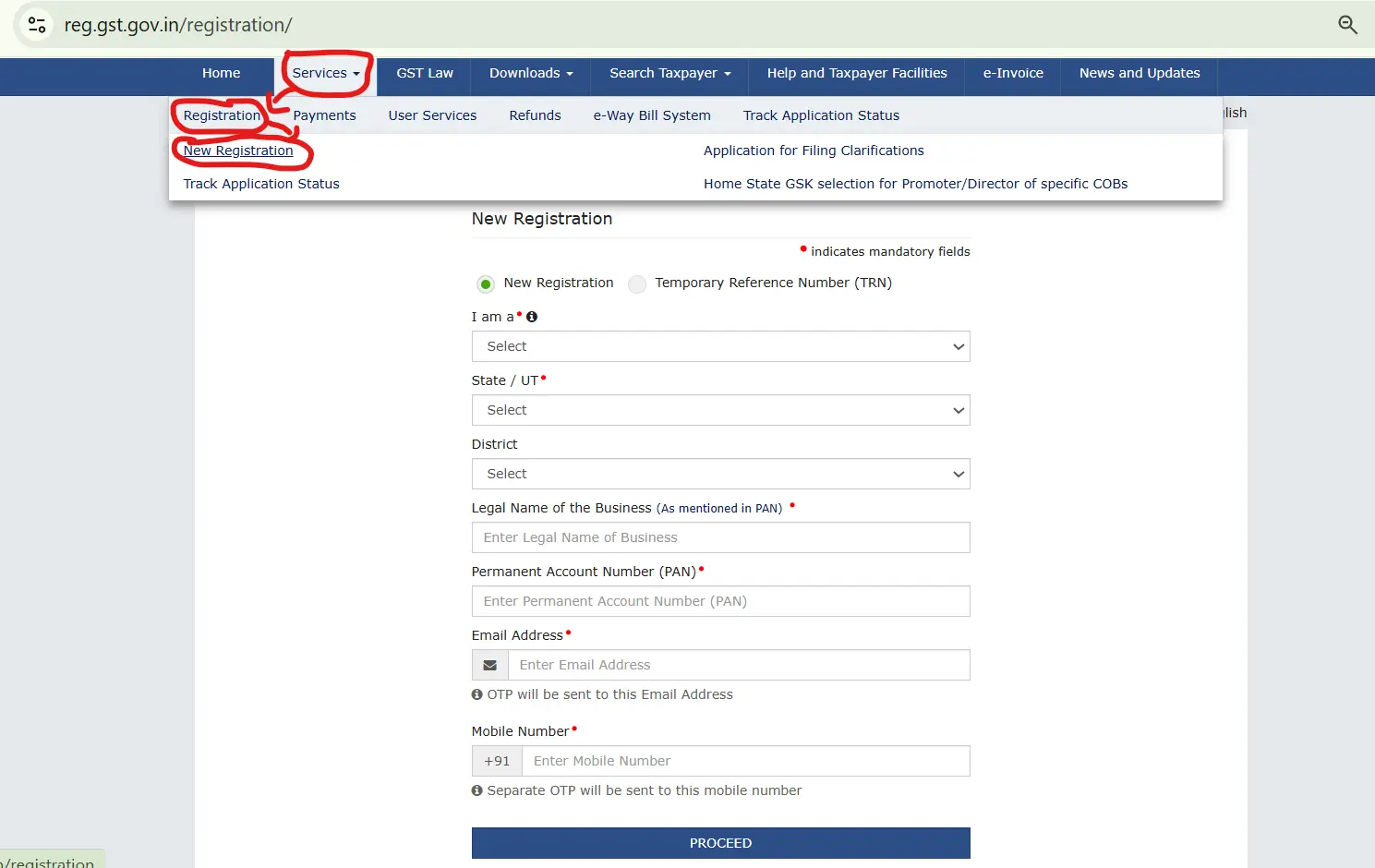
  1. Visit the official GST portal.
  2. Select Services → Registration → New Registration.
  3. Enter the required Part A details.
  4. Complete mobile and email verification.
  5. Generate the Temporary Reference Number (TRN).
  6. Log in using the TRN.
  7. Complete the remaining registration application.
  8. Enter business, promoter/partner/director and authorised-signatory information.
  9. Add principal and additional places of business.
  10. Upload the required documents.
  11. Complete the applicable authentication/signature process.
  12. Submit the application.
  13. Save the generated ARN for tracking.

The GST portal states that a saved application using a TRN must be submitted within the prescribed period, after which the saved information associated with the TRN is purged. Once the application is successfully submitted, the ARN can be used to track its status.

How to Track GST Registration Status Online?

After submitting the application, you can monitor your GST registration status through the GST portal.

The GST portal’s registration guidance directs applicants to:

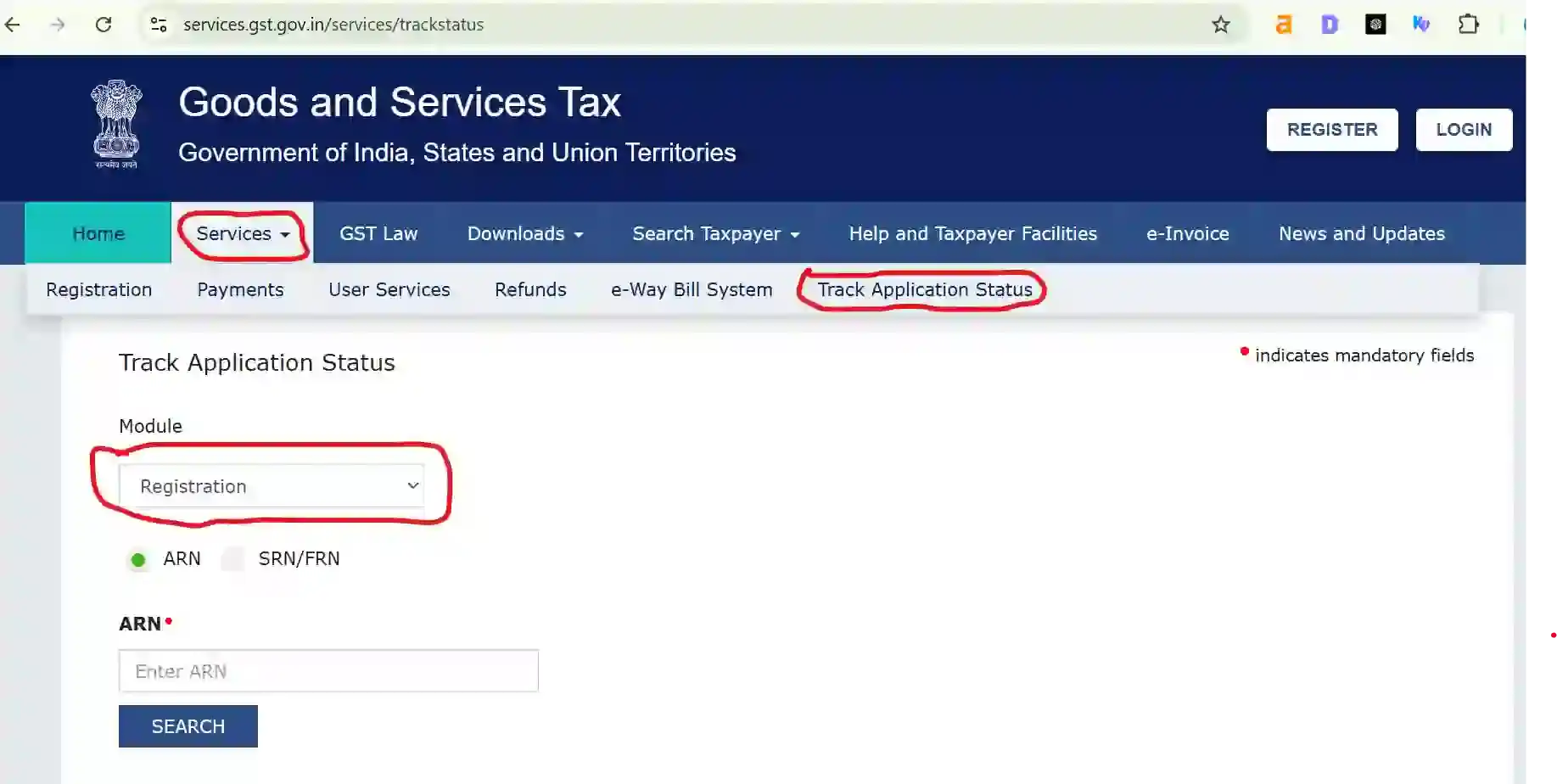
Services → Registration → Track Application Status

You can then use the relevant reference details, such as the ARN, to check the status of the application.

Common GST Registration Statuses

Your application may move through different stages during processing.

Pending for Processing

This generally means the application has been successfully filed and is awaiting action by the concerned tax official. The GST portal’s troubleshooting guidance specifically describes Pending for Processing in this context.

Pending for Clarification

If the tax authority requires clarification or additional supporting information, the application may move into a clarification stage.

At this point, the applicant should carefully read the clarification request and submit the required response and supporting documents within the applicable timeline. Do not state a universal “7 working days” deadline without checking the specific notice because the applicable timeline can depend on the particular process or communication.

Approved

If the registration is approved, the taxpayer receives the GST registration details and can access the registration information through the GST system.

How to Avoid GST Registration Rejection

A large part of successful GST registration comes down to document consistency. Before submitting your application, compare the information across your:
 
  • PAN Card: Ensure your legal name matches your other documents exactly down to the spelling.
  • Business Constitution: Check that your business structure (Proprietorship, Partnership, or Private Limited) is selected correctly.
  • Address Proof: Verify that your principal business address matches your supporting utility bills or rent agreement word-for-word.
  • Authorized Signatory: Make sure your signatory details and signatures are perfectly accurate and clean.


GST Registration Fees vs Professional Service Charges

It is important to separate government GST registration fees from professional service charges.

ItemGovernment chargePossible private charge
Online GST registration application₹0
Document reviewDepends on service provider
Application preparationDepends on service provider
Clarification supportDepends on service provider
Additional compliance servicesDepends on scope

GST Registration Documents Checklist: Quick Reference

Before starting your GST application, use this practical checklist:

For most applicants

  • PAN
  • Aadhaar details
  • Mobile number
  • Email address
  • Photograph where applicable
  • Business constitution documents
  • Principal-place-of-business proof
  • Bank details/documents as applicable
  • Authorised-signatory information

For proprietorships

  • Proprietor PAN
  • Proprietor Aadhaar
  • Photograph
  • Business address proof
  • Consent/rent documentation where applicable

For partnerships

  • Partnership deed
  • Firm PAN
  • Partner details
  • Authorisation document
  • Business premises proof
  • Location of Principal place of business

For LLPs

  • LLP incorporation documents
  • LLP PAN
  • Designated partner details
  • Authorised-signatory details
  • Business premises proof
  • LLP Agreement including Supplementary agreement(s), if any
  • Location of Principal place of business

For private limited companies

  • Certificate of Incorporation
  • Company PAN
  • MOA/AOA where applicable
  • Director details
  • Director’s KYC documents like pan card and aadhar card
  • Authorisation/Board Resolution
  • Principal-place-of-business proof
  • Location of Principal place of business

Always compare your final document set against the latest GST portal checklist before submission because document requirements and portal functionality can change.

Frequently Asked Questions About GST Registration

How to check GST registration status?

Go to the official GST Portal.

Hover over Services, go to Registration, and click Track Application Status.

Enter your 15-digit Application Reference Number (ARN) or Service Request Number (SRN).

Fill in the Captcha code and click Search.

Yes. There is no government application fee for normal GST registration submitted through the GST portal. Professional assistance, document preparation or other private services may carry separate charges.

For many eligible suppliers of goods in states where the higher threshold applies, the threshold is ₹40 lakh. For many service providers, it is ₹20 lakh. However, the applicable threshold can vary according to the state, nature of supply and relevant GST provisions.

Common documents required for GST registration include:

  • PAN Card: Permanent Account Number of the business or applicant.
  • Identity Proof: Aadhaar details and passport-sized photographs.
  • Constitution of Business: Partnership deed, registration certificate, or incorporation documents.
  • Address Proof: Valid proof of the principal place of business (like a electricity bill, rent agreement, or NOC).
  • Authorisation Proof: Authorised signatory documents and bank account statements.

Yes, voluntary registration is possible even when a person is not otherwise liable under the normal threshold provisions. However, once voluntarily registered, the taxpayer becomes subject to the applicable obligations of a registered person.

The processing timeline depends on the application and whether the tax authority raises an objection or requests clarification. The GST system has specific processing and deemed-approval rules, so businesses should avoid promising a fixed approval time to every applicant.

Yes. A business can apply for voluntary GST registration even when its turnover is below the applicable threshold, subject to GST rules. GST registration can allow an eligible taxpayer to claim Input Tax Credit (ITC) on qualifying business purchases.

You need to register for GST based on how much money your business makes, where you sell, or how you do business:

1. Registration Based on Sales (Annual Turnover)

  • Selling Products/Goods: You must register if your total sales in a year cross ₹40 Lakhs (₹20 Lakhs if your business is in the North-Eastern states).
  • Providing Services: You must register if your total income in a year crosses ₹20 Lakhs (₹10 Lakhs for North-Eastern states).

2. Mandatory Registration (Required even with zero sales)
You must register for GST immediately from day one if you match any of these:

  • Selling Outside Your State: Anyone sending goods or services from one state to another.
  • Online Sellers: Anyone selling items on online websites like Amazon, Flipkart, or Meesho.
  • Temporary Stall Owners: People setting up temporary shops or stalls at festival exhibitions in another state.
  • Foreign/Outside Businesses: Individuals or companies located outside India who want to do business inside the country.
  • Special Tax Buyers: Businesses that are required by law to pay tax directly on the goods they buy (called Reverse Charge).

Note: If you run a small business or work as a freelancer, you can still apply for Voluntary GST Registration even if your sales are low. This helps you get back the tax you paid on your business expenses (called Input Tax Credit).

  • GST eligibility means your business meets the conditions to apply for GST registration.
  • Mandatory GST registration means the law requires your business to register once specific conditions are met.
  • A business may be eligible for voluntary registration even if its turnover is below the applicable threshold.
  • Registration can become mandatory based on turnover, type of supply, or certain business activities.
  • Therefore, being eligible for GST registration does not always mean registration is compulsory.
  • The exact requirement depends on your turnover, state, type of supply, and applicable GST provisions.

Final Checklist Before You Apply for GST Registration

Before clicking submit, take five minutes to verify the following:

  • PAN details are correct
  • Business constitution is selected correctly
  • Principal business address matches your supporting documents
  • Authorised signatory details are accurate
  • Required documents are readable
  • The applicable turnover threshold has been checked
  • Compulsory-registration provisions have been considered
  • ARN is saved after submission
  • GST registration status is monitored after filing

GST registration is much easier when you treat it as a document-verification exercise rather than simply an online form.

For businesses searching for gst registration fees, the most important point is that the government application itself does not carry a normal registration fee. For businesses searching for gst registration documents, the right checklist depends on the entity structure and premises arrangement. And for anyone searching “what is the threshold limit for GST registration?”, the answer depends on turnover, type of supply, state and compulsory-registration provisions.

Getting these details right before filing can help your application move through the GST registration process with fewer avoidable problems.

Submit your Details to get an Instant All-inclusive Quote and a FREE Expert consultation

Call Us WhatsApp