GST • Income Tax • Registration • Payroll • Advisory • FSSAI • Virtual CFO

How to Register a Pvt Ltd Company in India: Full Guide 2026

Starting a business in India is exciting, but choosing the right legal structure and completing the registration process can feel complicated. If you are planning to start a company in India, Pvt Ltd company registration is one of the most commonly considered options for founders who want a separate legal entity, limited liability and a formal corporate structure.

Many entrepreneurs searching for private limited company registration also have practical questions such as:

  • How do I register a private limited company in India?
  • What documents are required?
  • How much does Pvt Ltd company registration cost?
  • What are the government fees?
  • How long does registration take?
  • Can a single person register a company?
  • What is the difference between a Private Limited Company and an OPC?

This guide explains the pvt ltd company registration process, required documents, fees, estimated costs, eligibility requirements and important post-registration considerations in simple language.

The incorporation process is handled through the Ministry of Corporate Affairs (MCA) using the SPICe+ framework. MCA’s SPICe+ system includes name reservation and incorporation-related services, including applications for DIN and PAN/TAN and, where applicable, GSTIN.

How Does Pvt Ltd Company Registration Work?

In simple terms, Pvt Ltd company registration involves selecting a suitable company name, preparing the required documents, obtaining digital signatures, completing the MCA incorporation forms and receiving the Certificate of Incorporation after approval.

The broad process is:

  1. Decide the company structure and proposed name.
  2. Check the availability and suitability of the proposed name.
  3. Obtain Digital Signature Certificates (DSCs) for the applicable subscribers/directors.
  4. Prepare the incorporation information and documents.
  5. File SPICe+ Part A and Part B and the linked incorporation forms.
  6. Pay applicable government fees and stamp duty.
  7. Respond to any MCA clarification or resubmission request, if applicable.
  8. Receive the Certificate of Incorporation after approval.
  9. Obtain the company’s PAN and TAN through the incorporation process.
  10. Complete applicable post-incorporation and compliance requirements.

SPICe+ Part A deals with name reservation, while Part B contains the remaining information required for incorporation. MCA allows Part A to be filed separately for name reservation or together with Part B for name reservation and incorporation.

What Is a Private Limited Company?

A Private Limited Company is a company incorporated under the Companies Act, 2013. It is a separate legal entity from its members, meaning the company has its own legal identity and can own assets, enter into contracts and conduct business in its own name.

A private company generally suits businesses that want a formal corporate structure and intend to operate with multiple shareholders.

Some commonly associated characteristics include:

  • Separate legal identity
  • Limited liability of members, subject to applicable law
  • Ability to have shareholders
  • Structured ownership through shares
  • Perpetual succession
  • Corporate governance and statutory compliance requirements
  • Suitable structure for businesses planning to grow and potentially raise investment

A private company must have at least two directors, while the Companies Act provides for a minimum of two directors for a private company and one director for an OPC.

Who Can Register a Private Limited Company in India?

Before starting the Pvt Ltd registration process, founders should check whether the proposed structure suits their business and whether the proposed directors and subscribers meet the applicable requirements.

A typical private limited company incorporation involves:

  • At least two members/subscribers
  • At least two directors
  • At least one director meeting the applicable Indian residency requirement
  • A lawful business object
  • A suitable registered office address
  • Appropriate identity and address documents
  • A proposed company name that satisfies applicable naming requirements

The Companies Act states that a private company requires a minimum of two directors. It also provides that every company must have at least one director who has stayed in India for the required period during the previous calendar year, subject to the applicable provisions.

Requirements can vary depending on factors such as foreign shareholders/directors, corporate shareholders, regulated activities and the nature of the proposed business.

Which Documents Are Required for the Registration of a Pvt Ltd Company?

One of the most searched questions before incorporation is which documents are required for the registration of a company.

For a standard Indian private limited company, the documentation generally includes identity and address proof of the proposed subscribers/directors and documents relating to the registered office.

Documents generally required from directors and subscribers

Depending on the circumstances, you may need:

  • PAN card
  • Identity proof
  • Address proof
  • Recent photograph where applicable
  • Email address
  • Mobile number
  • Residential address details
  • Digital Signature Certificate (DSC), where required for signing the incorporation documents

The exact documentation can vary depending on whether the person is an Indian resident, non-resident, foreign national or corporate subscriber.

Documents generally required for the registered office

Common registered-office documents may include:

  • Proof of ownership or lawful use of the premises
  • Recent utility bill or other acceptable address proof
  • Rent or lease agreement, where applicable
  • No Objection Certificate (NOC) from the owner, where applicable

The documents must satisfy the applicable MCA requirements and should contain consistent information.

For example, if the registered office is rented, the documentation should establish the company’s lawful right to use the premises. Additional documents may be required depending on the circumstances.

MCA’s incorporation FAQs and instructions provide document requirements for incorporation and explain additional attestation requirements in cases involving foreign subscribers/directors.

Pvt Ltd Company Registration Process Step by Step

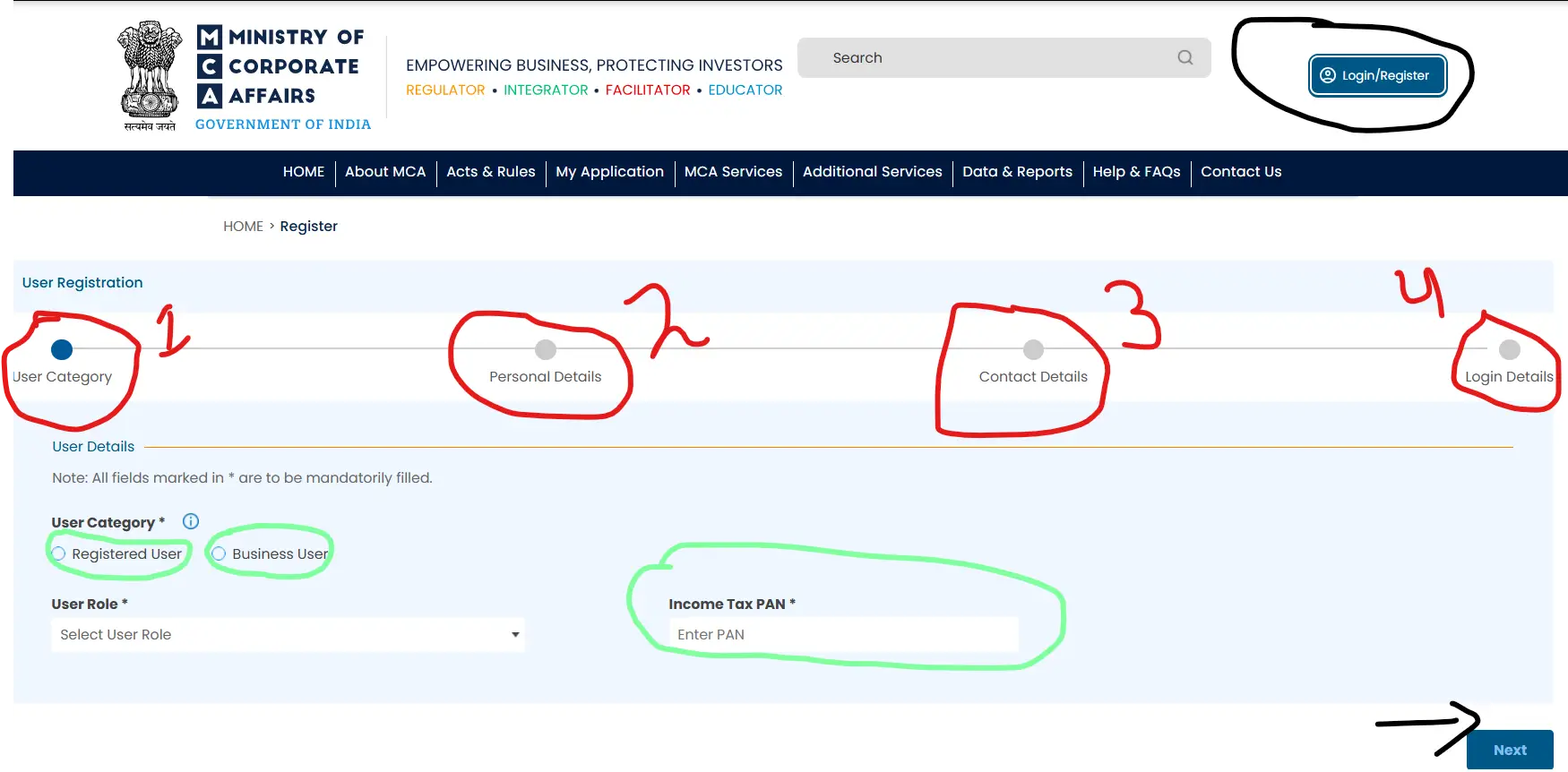
Ministry of Corporate Affairs (MCA) user registration page for pvt ltd company registration in India, showing a four-step setup tracker with user category and PAN input options highlighted.
Navigating the 4-step account creation process on the official Ministry of Corporate Affairs (MCA) portal.

The private limited company registration process is completed through MCA’s online incorporation system. Understanding each stage before filing can reduce avoidable errors and delays.

Step 1: Decide the Company Structure

First, determine whether a Private Limited Company is appropriate for your business.

Consider factors such as:

  • Number of founders
  • Ownership structure
  • Funding plans
  • Business activity
  • Liability considerations
  • Compliance requirements
  • Long-term business plans

If you are the only founder, you should also consider whether an OPC or another structure is more suitable.

Step 2: Choose a Company Name

The proposed company name should be checked carefully before submission.

A suitable name should:

  • Be distinguishable from existing company names
  • Avoid prohibited or undesirable wording
  • Follow applicable naming rules
  • Not improperly infringe an existing trademark
  • Match the proposed business activity appropriately

Name selection is an important step because an unsuitable name can result in rejection or the need to submit another name.

Step 3: Obtain Digital Signature Certificates

Digital signatures are used to electronically sign applicable MCA incorporation documents.

The relevant subscribers/directors who are required to sign the forms need the appropriate DSC arrangements.

MCA also advises stakeholders using its V3 system that applicable signatories should register as Business Users and associate their DSC where required.

Step 4: File SPICe+ Part A for Name Reservation

SPICe+ Part A is used for company name reservation.

There are two broad approaches:

  • File Part A separately for name reservation and proceed after approval.
  • File Part A together with Part B when applying for name reservation and incorporation together.

MCA’s current SPICe+ instructions specifically describe Part A as the name-reservation section and Part B as the section containing the remaining incorporation information.

Step 5: Prepare SPICe+ Part B and Linked Forms

Once the incorporation information is ready, the required details are submitted through SPICe+ Part B and the relevant linked forms.

SPICe+ Part B covers services including:

  • Application for company registration
  • DIN application for eligible proposed directors
  • PAN application
  • TAN application
  • Other applicable integrated services

GSTIN application can also be made through the incorporation process where applicable.

Step 6: Prepare MOA and AOA

The Memorandum of Association (MOA) sets out important information concerning the company’s objects and structure.

The Articles of Association (AOA) contain the company’s internal rules and regulations.

These documents form an important part of the incorporation process and should be prepared carefully according to the proposed company’s structure and requirements.

Step 7: Submit the Application and Pay Applicable Fees

After the forms and supporting documents are prepared, the incorporation application is submitted through MCA.

The applicable amount can include:

  • MCA filing fees, where applicable
  • Stamp duty
  • MOA/AOA-related fees, where applicable
  • PAN/TAN-related charges
  • DSC or professional service charges, depending on how the incorporation is being handled

The exact government cost is not necessarily the same for every company because applicable charges can depend on factors such as authorised capital and the state in which the company is registered.

Step 8: MCA Review and Possible Resubmission

After submission, the application is reviewed by the appropriate MCA processing system/authority.

If there is an issue with the application or documents, clarification or resubmission may be required.

Common reasons for additional clarification can include:

  • Incorrect information
  • Name-related issues
  • Inconsistent documents
  • Registered-office documentation problems
  • Signature/DSC issues
  • Incorrect attachments
  • Incomplete information

It is therefore important to review every document and field before submitting the application.

Step 9: Receive the Certificate of Incorporation

Once the incorporation application is approved, the company receives its Certificate of Incorporation (COI).

The Certificate of Incorporation confirms that the company has been incorporated.

MCA’s SPICe+ FAQs also state that PAN is allotted by the Income Tax Department and is reflected in the Certificate of Incorporation, with PAN and TAN details communicated along with the incorporation documents.

Fees for Registration of Private Limited Company

The fees for registration of a private limited company are not necessarily a single fixed amount for every applicant.

The overall cost can contain different components.

Cost component

What it may cover

MCA filing fee

Applicable incorporation filing charges

Stamp duty

State-specific statutory charges

PAN/TAN charges

Applicable statutory charges

MOA/AOA charges

Applicable incorporation document fees

DSC

Digital signature-related cost

Professional fee

Consultant/professional assistance, if used

Additional services

Optional services selected by the applicant

MCA’s SPICe+ FAQ states that fees depend on factors including authorised share capital, while stamp duty can differ between states. MCA’s published instructions also provide fee tables and explain that state-wise stamp duty applies.

Therefore, when someone searches for Pvt Ltd company registration cost, it is important to distinguish between:

Government/statutory cost + professional service cost + optional services.

This distinction helps avoid confusion when comparing different registration packages.

Pvt Ltd Company Registration Cost: What Affects the Final Amount?

The final Pvt Ltd company registration cost can vary based on the company’s circumstances.

Important factors can include:

  • Authorised share capital
  • State of incorporation
  • Stamp duty applicable in that state
  • Number of subscribers/directors
  • Whether any foreign person is involved
  • DSC requirements
  • Professional assistance
  • Additional registrations requested
  • Special business or regulatory requirements

MCA’s published SPICe+ material notes that stamp duty is state-specific and that incorporation fees are linked to applicable capital and filing rules.

This is why a very low advertised registration price may not represent the complete amount payable in every case.

Before selecting a service provider, check whether the quoted amount includes:

  • Government fees
  • Stamp duty
  • DSC
  • PAN/TAN
  • MOA/AOA
  • Professional charges
  • Any additional registrations
  • Applicable taxes

How Long Does Private Limited Company Registration Take?

Based on current Ministry of Corporate Affairs (MCA) processing speeds, a straightforward application takes 7 to 12 working days to get fully approved.

If there are no errors in your paperwork, here is the approximate step-by-step breakdown of how those days are spent:
 

Phase-by-Phase Timeline Breakdown

Phase 1: Procuring DSC (1 to 2 Days:  Digital Signature Certificates (Class 3 DSC) are generated for all proposed directors. This requires quick video and mobile OTP verification by the applicants.

Phase 2: Name Approval via RUN Portal (1 to 2 Days): The proposed company names are submitted to the Central Registration Centre (CRC). Security checks ensure the name does not conflict with existing trademarks or companies.

Phase 3: Legal Document Drafting (1 to 2 Days): Your corporate legal advisor or CA drafts the Memorandum of Association (MoA) and Articles of Association (AoA) based on your approved name and business goals.

Phase 4: SPICe+ Processing & MCA Approval (3 to 5 Days): The final application is uploaded to the MCA portal. Once the Registrar of Companies (RoC) reviews and approves the data, your official Certificate of Incorporation (CoI), PAN, and TAN are issued simultaneously.

The “Resubmission” Factor: What Delays the Process?

If the MCA finds errors, they will issue a clarification request (called a Resubmission or Send Back). Common triggers include mismatched addresses on utility bills, blurred ID scans, or a name that is too similar to an existing brand.
If a resubmission is raised, it typically adds an extra 3 to 5 working days to the overall process, as you must correct the documents and wait for the MCA to re-verify the file.

How to Avoid Delays in Your Company Registration

While MCA processing speeds are out of your hands, most registration delays happen due to simple mistakes made during the application phase. If you want your pvt ltd company registration approved within the standard 7 to 12 days without getting “sent back” for resubmission, follow this checklist closely.
 

Pre-Filing Checklist to Prevent Delays

  • Match Names Exactly: Ensure the spelling of the director’s name and father’s name is identical across their PAN card, Aadhaar card, and bank statement. Even a missing middle name will trigger an immediate MCA rejection.
  • Check Utility Bill Dates: The electricity, water, or gas bill used as proof for your registered office address must be less than 2 months old.
  • Verify Address Legibility: Ensure the address written on the NOC (No Objection Certificate) and the rent agreement matches the utility bill word-for-word, down to the pin code and premise number.
  • Submit High-Resolution Scans: Avoid using phone camera photos for your paperwork. Government portals automatically reject blurred, cropped, or low-resolution PDF scans of ID cards.
  • Run a Strict Trademark Search: Before submitting your name via the RUN portal, search the official IP India portal to ensure your name doesn’t conflict with an active trademark class. Avoid generic terms like “Tech,” “Global,” or “Solutions” unless you have a strong prefix.
  • Complete DSC Video KYC Instantly: Once the application is initiated, directors must complete their video verification link within 24 hours to keep the workflow moving.

What Happens After Pvt Ltd Company Registration?

Receiving the Certificate of Incorporation is an important milestone, but incorporation is not necessarily the end of the company’s compliance journey.

Depending on the company’s circumstances, founders may need to consider:

  • Opening a company bank account
  • Completing applicable commencement-related requirements
  • Maintaining statutory registers and records
  • Appointment of the first auditor
  • Accounting and bookkeeping
  • Income tax compliance
  • GST compliance, if registered/applicable
  • TDS compliance, where applicable
  • Annual MCA filings
  • Other licences or registrations relevant to the business

The exact post-incorporation requirements depend on the company’s activities, registrations, transactions and applicable laws.

A company should therefore plan for ongoing compliance instead of treating incorporation as a one-time administrative task.

One Person Company Registration Online: Is It an Alternative?

If you are a single founder, you may also search for one person company registration online.

An One Person Company (OPC) is a separate company structure provided under the Companies Act for a company with one member. The Companies Act also provides for a minimum of one director for an OPC.

An OPC can therefore be relevant when an individual wants a corporate structure but does not have another member to form a standard private company.

Before choosing between an OPC and a Private Limited Company, consider:

Factor

Private Limited Company

OPC

Minimum members

2

1

Minimum directors

2

1

Ownership

Multiple members possible

One member

Suitable for

Multiple founders/business teams

Single-member business structure

Investment/funding structure

Generally more suitable for multiple shareholders

Different ownership structure

Compliance

Applicable company compliance

Applicable OPC/company compliance

The right structure depends on the founder’s circumstances and business objectives. It should not be selected only on the basis of registration cost.

Private Limited Company vs OPC: Which Should You Choose?

A Private Limited Company can be considered when there are multiple founders or when the business is being structured around multiple shareholders.

An OPC may be considered when there is one member who wants to operate through the OPC structure.

Think about:

  • How many owners will the business have?
  • Do you expect additional shareholders?
  • Are you planning to raise external investment?
  • Will ownership change in the future?
  • What level of corporate compliance are you prepared to maintain?
  • Which structure fits the actual business model?

Choosing the structure before filing can prevent the need for restructuring later.

Common Mistakes During Private Limited Company Registration

Many incorporation delays are caused by avoidable documentation or information errors.

Before submitting the application, check for:

  • Name spelling differences
  • Incorrect PAN details
  • Incorrect residential address
  • Mismatch between documents
  • Expired or unsuitable address proof
  • Incorrect registered-office information
  • Missing NOC
  • Incorrectly prepared incorporation documents
  • DSC/signature problems
  • Incorrect business activity or objects
  • Incomplete attachments
  • Selecting an unsuitable company structure

A simple document checklist before filing can reduce the risk of unnecessary clarification or resubmission.

Frequently Asked Questions About Pvt Ltd Company Registration

How can I register a Pvt Ltd company in India?

You can register a Pvt Ltd company through the MCA’s online incorporation system.

The broad process includes:

  • Selecting the company structure
  • Choosing a suitable name
  • Obtaining applicable DSCs
  • Preparing incorporation documents
  • Filing SPICe+ forms and linked forms
  • Paying applicable fees and stamp duty
  • Responding to clarification, if required
  • Receiving the Certificate of Incorporation after approval

A private company generally requires a minimum of two directors under the Companies Act, 2013. An OPC has a minimum of one director.

A standard private limited company requires at least two members, while an OPC is structured around a single member.

The total Pvt Ltd company registration cost depends on applicable government fees, stamp duty, authorised capital, DSC costs and professional service charges.

Registering a standard Private Limited (Pvt Ltd) company in India with two directors and up to ₹15 Lakhs in authorized capital generally costs between ₹7,000 and ₹25,000 all-inclusive.

While the Ministry of Corporate Affairs (MCA) charges nothing for basic government form fees under this limit, the final expense depends on state stamp duty and whether you hire a professional or use an online platform.

There is therefore no single universal total that applies to every company.

A standard Private Limited Company requires at least two members and two directors. If there is only one member, an OPC may be a structure to consider, subject to the applicable legal requirements.

What is SPICe+ in company registration?

SPICe+ is MCA’s integrated incorporation web form.

It is divided into:

  • SPICe+ Part A: Name reservation
  • SPICe+ Part B: Incorporation and related services

Part B includes services such as company registration, DIN application, PAN/TAN application and other integrated services.

SPICe+ is MCA’s integrated incorporation web form.

It is divided into:

  • SPICe+ Part A: Name reservation
  • SPICe+ Part B: Incorporation and related services

Part B includes services such as company registration, DIN application, PAN/TAN application and other integrated services.

A company needs a registered office address in accordance with the applicable Companies Act and incorporation requirements. Appropriate proof of the premises and supporting documents may be required.

PAN and TAN are integrated into the SPICe+ incorporation process. MCA’s FAQs state that PAN is allotted by the Income Tax Department and PAN/TAN details are communicated along with the incorporation documentation.

Foreign nationals can be involved in an Indian company’s incorporation subject to applicable requirements. Additional notarisation, apostille or consularisation requirements may apply depending on the country and circumstances.

Final Checklist for Private Limited Company Registration

Before submitting your application, make sure you have checked:

  • Suitable company structure selected
  • Proposed company name checked
  • PAN and identity documents ready
  • Address proof ready
  • Registered-office documents ready
  • NOC arranged where applicable
  • DSC requirements completed
  • Business objects prepared
  • MOA and AOA information reviewed
  • SPICe+ information checked
  • Applicable government fees and stamp duty considered
  • Contact details verified
  • All supporting documents are consistent
  • Post-incorporation compliance requirements understood

Get Help With Pvt Ltd Company Registration

For founders, the most time-consuming part of incorporation is often not filling out a form but making sure the company structure, name, documents and application information are correct before submission.

If you want professional assistance with your company incorporation, Cotaxo can help with the registration process, documentation and related requirements.

You can explore the Pvt Ltd company registration service by Cotaxo and submit your requirements online.

Conclusion

Pvt Ltd company registration can provide a structured way to establish a business as a company in India. However, successful incorporation requires more than simply submitting an online form. The proposed name, company structure, director and member details, registered-office documents, MOA, AOA and incorporation forms all need to be prepared correctly.

If you are comparing the fees for registration of a private limited company, remember that the final amount can include statutory charges, state-specific stamp duty, DSC costs and professional fees. The Pvt Ltd company registration cost can therefore vary from one incorporation to another.

For a single founder, one person company registration online may also be worth considering, while businesses with multiple owners may consider a standard Private Limited Company.

The simplest way to approach incorporation is to work backwards from your business needs:

Choose the right structure → prepare the documents → select the name → complete SPICe+ → submit the application → receive incorporation approval → complete ongoing compliance.

A properly prepared application can make the registration process considerably easier and help you start your business with the right legal structure from the beginning.

Submit your Details to get an Instant All-inclusive Quote and a FREE Expert consultation

Call Us WhatsApp