Trademark Registration Fees in India (2026): Government Fee + Total Cost
CoTaxo Team
The government fee to register a trademark in India is ₹4,500 per class for individuals, startups and small enterprises, and ₹9,000 per class for companies, LLPs and other applicants (online filing). Filing in person costs ₹500 to ₹1,000 more per class. These fees have been fixed since 2017 under the Trade Marks Rules, 2017.
But the government fee is only part of what you will spend. This guide shows the full cost in simple terms: what you pay the government, what you pay a professional, what GST applies, and what extra costs can appear later.
Government Fees for Registering a Trademark
Applicant type
Online filing (per class)
Physical filing (per class)
Individual / Sole proprietor
₹4,500
₹5,000
DPIIT-recognised startup
₹4,500
₹5,000
Udyam-registered MSME (small enterprise)
₹4,500
₹5,000
Partnership firm
₹9,000
₹10,000
LLP
₹9,000
₹10,000
Private / Public limited company
₹9,000
₹10,000
Trust, society, NGO
₹9,000
₹10,000
Good to know: The lower fee applies to the type of applicant, not to the size of your idea. To claim ₹4,500, you must upload a valid Udyam or DPIIT startup certificate when you file. If you forget, you will be charged ₹9,000.
Tip: if you are a Private Limited Company or LLP that is also a DPIIT-recognised startup or Udyam-registered, the lower fee can apply to you as well. Check your eligibility before you file. If you are not registered yet, our Startup India registration and MSME registration services can help you qualify for the lower fee.
Who Decides the Government Fee for Trademark Registration?
The fee is set by the First Schedule of the Trade Marks Rules, 2017. It is paid to the Trade Marks Registry when you file Form TM-A, and it is the same no matter who files your application. Whether you file yourself or hire a professional, the government charges the same amount.
4 Things That Decide Your Total Government Fee
1. Who you are (applicant type). Individuals, startups and small enterprises pay ₹4,500. Everyone else pays ₹9,000.
2. How many classes you file in. India follows the Nice Classification, with 45 classes. Classes 1 to 34 are for goods (like clothing, food, machinery) and classes 35 to 45 are for services (like marketing, education, consulting). The fee is charged for each class.
3. How many marks you file. The fee is charged per class and per mark. Your brand name and your logo are two different marks. If you want to protect both in one class, you pay for two applications.
4. How you file. Online filing on the IP India portal is cheaper than physical filing, and it is faster too.
Example: A company that sells clothes (Class 25) and also offers marketing services (Class 35) needs two classes. Online, that is 2 × ₹9,000 = ₹18,000 in government fees for one mark.
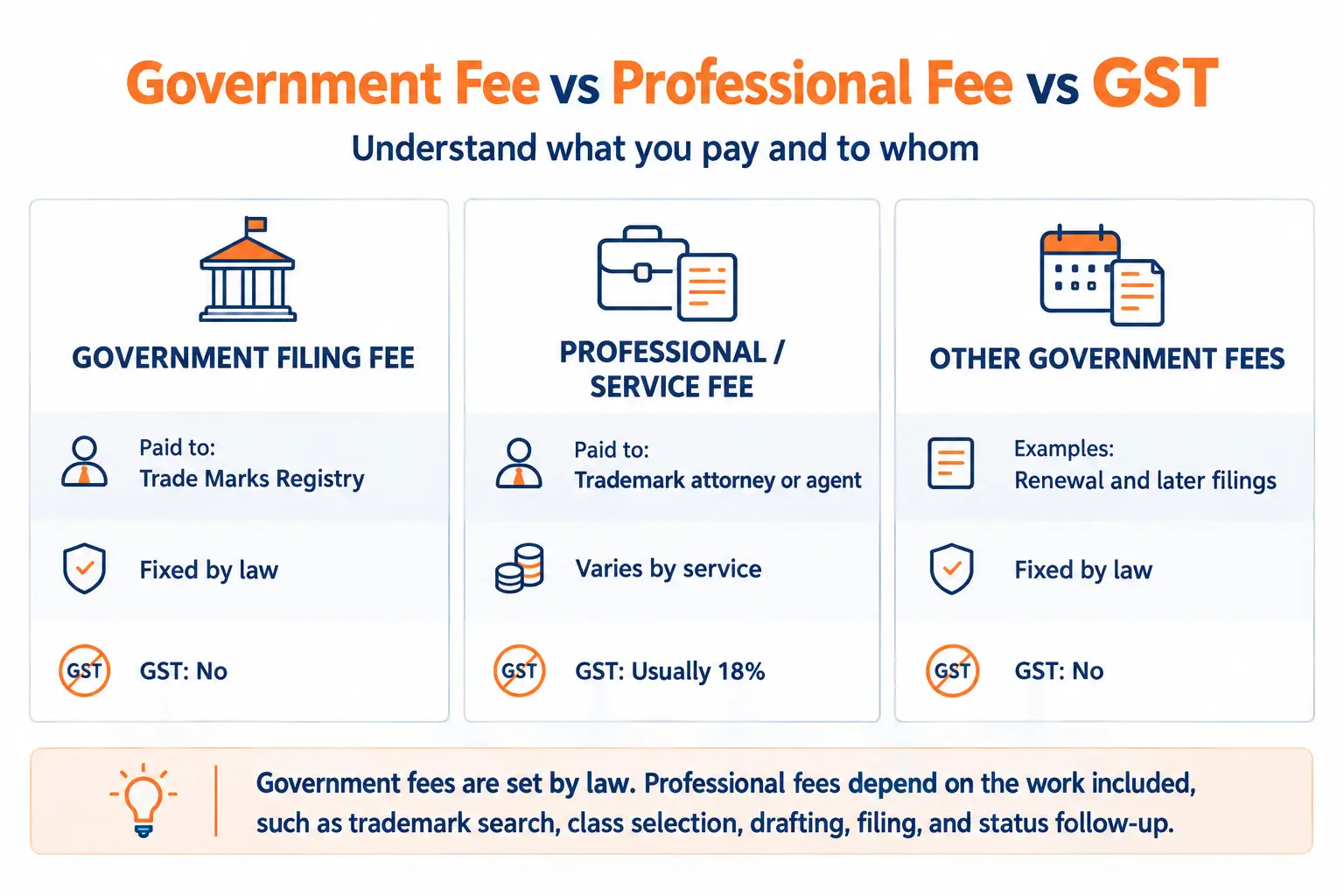
Government Fee vs Professional Fee vs GST
Many people compare prices and get confused because they mix these three things together.
Cost
Who you pay
Is it fixed?
GST applies?
Government filing fee
Trade Marks Registry
Yes, fixed by law
No
Professional / service fee
Your trademark attorney or agent
No, it varies
Yes, usually 18%
Other government fees later (renewal, etc.)
Trade Marks Registry
Yes, fixed by law
No
The government fee is the same for everyone. The professional fee depends on the work included: trademark search, class selection, drafting the goods and services description, filing, and status follow-up.
Let us put the numbers together. These examples use online filing.
Example 1: Solo founder, brand name only (1 class)
Item
Cost
Government fee (individual rate, 1 class)
₹4,500
Professional fee
₹[YOUR PRICE]
GST on professional fee (18%)
₹[CALCULATE]
Total
₹[TOTAL]
Example 2: DPIIT-recognised startup, name and logo (1 class, 2 marks)
Item
Cost
Government fee: name (1 class)
₹4,500
Government fee: logo (1 class)
₹4,500
Professional fee
₹[YOUR PRICE]
GST on professional fee (18%)
₹[CALCULATE]
Total
₹[TOTAL]
Example 3: Private Limited Company, brand name in 3 classes
Item
Cost
Government fee (3 classes × ₹9,000)
₹27,000
Professional fee
₹[YOUR PRICE]
GST on professional fee (18%)
₹[CALCULATE]
Total
₹[TOTAL]
The filing fee is non-refundable. Even if the Registry raises an objection or refuses your application, the government fee is not returned. That is why a proper search before filing is worth the small extra cost.
Other Costs You Should Plan For While Registering Trademark
The filing fee is just the start. Depending on what happens to your application, you may also need to budget for these.
Trademark objection reply. After you file, an examiner checks your application. If they raise an objection, you must reply within the time limit (30 days from the examination report). There is no separate government fee for replying, but drafting a strong reply usually needs professional help. An objection is not a rejection, and most can be solved with a proper reply. See our trademark objection service.
Trademark opposition. Once your mark is published in the Trade Marks Journal, anyone can oppose it within 4 months. If it happens, you will need to file a counter-statement (government fee of ₹2,700 per class online, Form TM-O), plus legal costs for evidence and hearings. See our trademark opposition service.
Renewal. A registered trademark is valid for 10 years from the date of application. Renewal costs ₹9,000 per class online (₹10,000 physical), and the lower startup or individual fee does not apply to renewals. If you miss the date, you get a grace period to renew with a late fee. After that, the mark can be removed from the register.
Other changes. Transferring ownership (assignment), recording a licence, or correcting the register each have their own government fee. Check the latest fee schedule on the IP India website for the exact form and amount.
How to Show Trademark Fees in Your Accounts
This is one of the most common questions from business owners, and most guides skip it. Here is the simple version.
Government fee: This is the fee paid to the Trade Marks Registry. It is not subject to GST.
Professional fee: This carries GST (usually 18%). If you are GST registered, you can claim the GST on the professional fee as input tax credit, provided you have a valid tax invoice and meet the usual conditions.
Recording the cost: Many businesses record the total trademark cost (government fee plus professional fee) as an intangible asset in their books, instead of charging it all to expenses in one year. Small businesses on simple accounting sometimes expense it directly. The right treatment depends on your accounting framework and your CA’s advice.
Depreciation: Under the Income Tax Act, trademarks are treated as intangible assets and are generally eligible for depreciation.
The exact treatment depends on your business, so confirm it with your CA. CoTaxo’s accounting and bookkeeping team can handle this for you.
6 Ways to Avoid Wasting Money During Filing and Maintaining Your Trademark
Search before you file. A trademark search shows whether a similar mark already exists. Finding a conflict before you pay saves the filing fee and months of waiting.
Pick the right class. Filing in the wrong class means filing again and paying again.
Do not file in classes you will never use. Each class costs money. Cover what you sell now and what you clearly plan to sell soon.
File online. It saves ₹500 to ₹1,000 per class.
Upload your startup or Udyam certificate at the time of filing. Otherwise you pay the full ₹9,000 rate.
Reply to objections on time. Missing the deadline can cause your application to be abandoned, and you will have to pay again to restart.
How to Pay Trademark Registration Fees Online (Step by Step)
Search your brand name on the IP India public search tool to check for similar marks.
Choose your class(es) based on your products or services.
Prepare your documents: applicant ID and address proof, logo (if filing a logo), Power of Attorney if a professional is filing for you, and your Udyam or DPIIT certificate if you are claiming the lower fee.
Fill Form TM-A on the IP India e-filing portal.
Pay the government fee online by net banking, card or UPI as offered on the portal.
Save your application number. You can use the ™ symbol as soon as you apply. The ® symbol is only for after your mark is registered.
Prefer not to do this yourself? Talk to a CoTaxo expert and we will handle the search, class selection and filing for you.
FAQs
Can I register a trademark myself?
Yes. Any applicant can file Form TM-A online on the IP India portal without a professional. Many people still hire an expert to run the search, choose the right class and handle objections.
Is the trademark fee refundable?
No. The government fee is non-refundable, even if your application is objected to, refused or withdrawn.
Can I use TM without registration?
Yes. You can use the ™ symbol with any brand name or logo you claim as your own, even before you apply. It gives notice of your claim but does not give the legal protection of a registered trademark.
Is GST required for trademarks?
No. You do not need a GST registration to register a trademark. GST at 18% applies only to the professional fee. The government fee has no GST.
Which is better, TM or ®?
® is stronger because it shows the mark is officially registered. Only use it after registration, because using ® on an unregistered mark is an offence. ™ can be used from the day you start using the brand.
What is the cheapest way to trademark?
Apply online as an individual, DPIIT startup or Udyam-registered small enterprise (₹4,500 per class), and file in only one class. Filing offline or as a company costs more.
Who is eligible for trademark registration?
Any individual, sole proprietor, partnership firm, LLP, company, trust or society can apply for a mark they use or plan to use. You do not need a minimum business age or turnover.
How many years to renew a trademark?
Every 10 years. A registered trademark is valid for 10 years from the application date and can be renewed again and again.
Final Thoughts
The government fee for trademark registration in India is simple: ₹4,500 or ₹9,000 per class, depending on who you are. What changes your total cost is the number of classes, the number of marks, and whether you face an objection or opposition later. Search first, choose your classes carefully, and file online.
Disclaimer: This article is for general information only and is not legal advice. Fees are as per the First Schedule of the Trade Marks Rules, 2017 and may change. Please check the official IP India website before filing.
Submit your Details to get an Instant All-inclusive Quote and a FREE Expert consultation