Copyright Registration in India (2026): Process, Fees, Documents & Timeline
To register a copyright in India, you file Form XIV online on the Copyright Office portal (copyright.gov.in), upload your work and documents, and pay the government fee (₹500 to ₹5,000, depending on the type of work). After a mandatory 30-day objection window and an examination, you receive your registration certificate. A straightforward application usually takes 2 to 6 months.
You do not have to register to own a copyright. But registration gives you official proof of ownership, and that proof is very useful when someone copies your work. This guide explains everything in simple steps: what copyright covers, who can apply, which documents you need, what it costs, how long it takes, and the mistakes that cause delays.
What Is Copyright Registration?
Copyright is the legal right a creator has over their original work. It is governed by the Copyright Act, 1957 and the Copyright Rules, 2013.
Copyright registration means entering your work in the Register of Copyrights, maintained by the Copyright Office under the Government of India. You get a registration certificate with a unique registration number.
Think of it this way:
Copyright: your right. It exists automatically the moment you create the work.
Copyright registration: your proof. It is an official, dated record that says this work belongs to you.
Copyright protects the expression of an idea, not the idea itself. You can protect your written story, but not the basic plot idea in your head.
So why register? Because of what happens when there is a dispute:
The registration entry is treated as prima facie evidence of your ownership (Section 48 of the Copyright Act). In simple words, the court starts by accepting your claim.
Without registration, you must prove you created the work first, which can take time and money.
It makes it easier to license, sell or assign your work, get takedowns on online platforms, and show ownership to investors or clients.
Quick check, should you register? Say yes to any of these:
You sell or plan to sell your work (books, courses, designs, music, software).
Others can easily copy it (online content, logos, templates).
You work with freelancers or a team and need clear ownership.
You are building a brand or company and the work is a business asset.
Benefits of Copyright Registration in India
Registering your creative work provides legal recognition and helps protect your intellectual property rights. Some key benefits of copyright registration include:
Legal Proof of Ownership
A copyright registration certificate serves as official evidence of ownership and can provide stronger legal support in case of copyright disputes or infringement matters.
Monetisation Opportunities
Registration makes it easier to license, assign, or commercially use your copyrighted work. It also helps creators establish greater value for their intellectual property when working with publishers, producers, or businesses.
Protection Against Unauthorised Use
A registered copyright creates public awareness of ownership and can strengthen your position while taking action against unauthorised copying, distribution, or online misuse of your work.
Maintains Creative Control
Copyright registration allows owners to control how their work is reproduced, adapted, distributed, or modified, helping protect the original creative vision.
International Protection of Copyright
India follows several international agreements that support copyright protection across different countries.
Berne Convention
The Berne Convention provides international copyright protection by ensuring that member countries recognise the rights of creators from other member nations.
Universal Copyright Convention (UCC)
The UCC provides an additional framework for international copyright recognition and protection.
TRIPS Agreement
The TRIPS Agreement establishes minimum standards for intellectual property protection among World Trade Organization member countries.
WIPO Copyright Treaty (WCT)
The WIPO Copyright Treaty provides additional protection for digital works and online content in the modern technological environment.
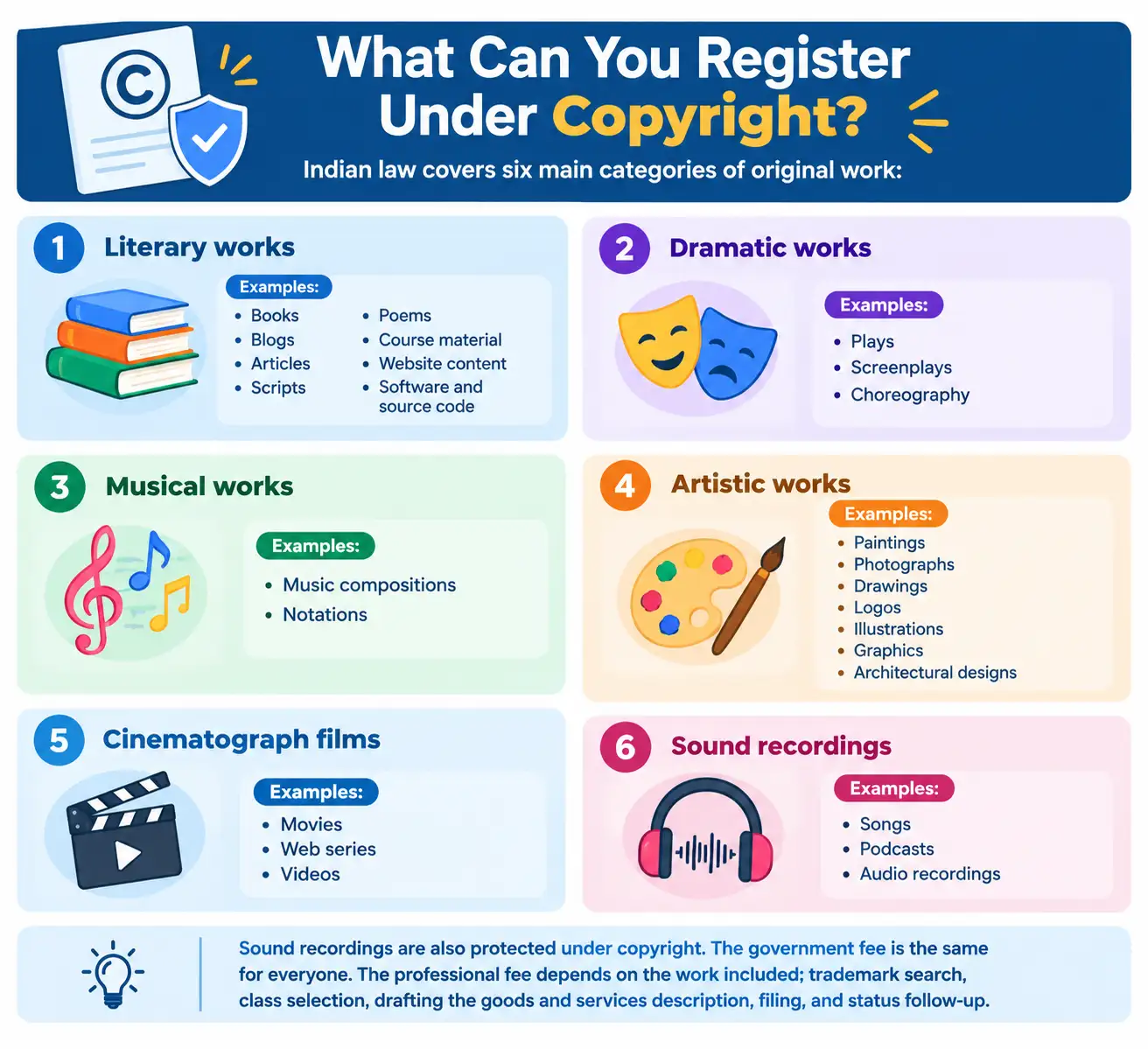
What Can You Register Under Copyright?
Indian law covers six main categories of original work:
Ideas, concepts and methods. Only the way you express them is protected.
Names, titles, slogans and short phrases. A brand name or tagline is protected by a trademark instead (see our trademark registration service).
Facts and data by themselves.
Works that are not original, such as a copy of someone else’s work.
Who Can Apply for Copyright Registration?
Under Section 45 of the Copyright Act, an application can be made by:
The author or creator of the work
The owner of the copyright, for example a person or company who got the rights through a written agreement (assignment)
A publisher
Any other person interested in the copyright
This means a company can register work created by its employees or freelancers, if the rights have been assigned to it in writing.
There is no age, income or business-type condition. Individuals, startups, companies, LLPs, trusts and creators can all apply. Each work needs its own separate application.
Documents Required for Copyright Registration
The basic documents are:
Form XIV (the application form), along with the Statement of Particulars and, where applicable, the Statement of Further Particulars
A copy of the work in the file format the portal accepts (PDF, JPG, MP3, MP4 and so on)
Applicant’s ID and address proof
No Objection Certificate (NOC), if the applicant is not the author, or if more than one person contributed to the work
Power of Attorney, if a professional files on your behalf
Fee payment (online)
Documents by Type of Work
Type of work
What to keep ready
Book, article, script
Soft copy of the manuscript or published book; publisher details if published; author NOC if the applicant is a different person
Software / app
Source code (usually the first and last 10 pages, with confidential parts blocked); details of the programming language and what the software does. Check the current portal instructions for the exact deposit rules
Logo / artwork
Image file; a certificate from the Trade Marks Registry may be required if the artwork is used on goods or services. Check the current requirements before filing
Music / song
Audio file; lyrics and composer details; NOC from the lyricist, composer or producer if they are different people
Film / video
Video file or extract; NOCs from the producer, director, writers, composers and others involved
Unpublished work
You may submit an extract instead of the full work, so your content stays confidential
Copyright Registration Fees in India
The government fee depends on the type of work. It is set in the Second Schedule of the Copyright Rules, 2013.
Type of work
Government fee (per work)
Literary, dramatic, musical or artistic work
₹500
Artistic work used on goods or services (such as a logo)
₹2,000
Sound recording
₹2,000
Cinematograph film
₹5,000
Software / computer programme
[VERIFY ON copyright.gov.in: ₹500 or ₹5,000, sources differ]
Fees are verified as of DATE. Please check the official Copyright Office fee schedule before filing, as fees can be revised.
The government fee is non-refundable, and each work needs its own application and fee. If you want to protect a book and its cover art, those are two works.
Our pricing: CoTaxo’s copyright registration service starts at ₹1,999 + government fee + GST (18% on our service fee). what is included: document review, Form XIV filing, objection handling, certificate delivery.
What Will You Actually Pay? 3 Examples
Situation
Government fee
CoTaxo fee
Total
Blogger registering 1 article series (literary work)
₹500
₹1,999
₹2,499
Startup registering its logo (artistic work used on goods/services)
₹2,000
₹1,999
₹3,999
Musician registering 1 song (musical work + sound recording)
₹500 + ₹2,000
₹1,999
₹4,499
Copyright Registration Process in India: Step by Step
Step 1: Check what you are registering. Decide the category of your work. Choosing the wrong category is the most common reason for delays.
Step 2: Create an account. Go to the Copyright Office portal (ipindia.gov.in), create a user account, and log in.
Step 3: Fill in Form XIV. Choose Online Copyright Registration, then enter details of the applicant, the author, the title, the language and whether the work is published or unpublished. Add the Statement of Particulars.
Step 4: Upload the work and documents. Upload your work and any NOCs or the Power of Attorney. Keep files clear and complete.
Step 5: Pay the fee online. Pay through the portal using the options available (net banking, card or UPI).
Step 6: Get your Diary Number. This acknowledges your application. Use it to track the status online.
Step 7: Wait through the 30-day objection period. For 30 days, anyone who disputes your claim can raise an objection. If nobody does, your application moves to examination.
Step 8: Examination. An examiner reviews the application. If there are errors or missing documents, you will receive a discrepancy letter and must reply within the given time.
Step 9: Hearing (only if needed). If there is an objection or an unresolved issue, a hearing may be held.
Step 10: Registration. Once everything is cleared, your work is entered in the Register of Copyrights and you receive your certificate.
Logo tip: A logo can be protected by copyright (as artwork) and by trademark (as your brand identity). If you want to stop others from using a similar brand in business, a trademark is the stronger option. Many businesses register both.
7 Common Mistakes That Delay Registration
Choosing the wrong category. Check the table above before filing.
Uploading incomplete work. Submit the full work or the proper extract.
Missing NOCs. Needed when the author and applicant differ, or for films and joint works.
Wrong author or owner details. Keep them consistent across all documents.
No written assignment. If you hired a freelancer to create the work, you need a signed agreement transferring the rights to you.
Ignoring discrepancy letters. Reply within the time given.
Registering many works in one application. Each work needs its own application.
How to Check a Copyright Registration or Application Status
Your own application: log in to the Copyright Office portal and use your Diary Number to track the status.
Existing registrations: you can search the Register of Copyrights through the Copyright Office website. If you want a search done before you file, contact CoTaxo.
Can You Register Copyright Without a Lawyer?
Yes. The process is designed so that creators can file on their own. A professional becomes useful when:
More than one person created the work
The work is a film, music or software with several contributors
Ownership was transferred by contract
You receive an objection or discrepancy letter
You want it done quickly and correctly the first time
Does Indian Copyright Protect Me in Other Countries?
India is a member of the Berne Convention, so your work is protected in other member countries without separate registration there. The level of protection and how you enforce it depends on each country’s laws.
FAQs
What is the cost of copyright registration in India?
The government fee for copyright registration in India ranges from ₹500 to ₹5,000 per work, depending on the type of work. Literary, musical and artistic works cost ₹500. Sound recordings are ₹2,000 and films are ₹5,000. Professional fees and GST are extra.
Is it mandatory to register copyright in India?
No. Copyright protection starts automatically when you create an original work. Registration is optional, but it gives you official proof of ownership, which makes it easier to enforce your rights if someone copies your work.
Can we get copyright for free?
Yes and no. Copyright protection is free and automatic as soon as you create an original work. Official copyright registration is not free, because the Copyright Office charges a government fee starting at ₹500 per work.
Who is the Registrar of Copyrights?
The Registrar of Copyrights heads the Copyright Office of India in New Delhi. The office works under the Department for Promotion of Industry and Internal Trade (DPIIT), Ministry of Commerce and Industry, and handles all copyright registrations in India.
Can I register my copyright online in India?
Yes. You can register your copyright online through the Copyright Office portal (copyright.gov.in). Create an account, fill in Form XIV, upload your work and documents, and pay the fee online. You will receive a Diary Number to track your application.
What are 5 things that can be copyrighted?
Five things you can copyright in India are:
Books, articles and blogs (literary works)
Songs and music compositions
Paintings, photographs and logos (artistic works)
Software and source code
Films, videos and sound recordings
How many years is copyright valid in India?
For literary, dramatic, musical and artistic works, copyright lasts for the author’s lifetime plus 60 years after death. For films, sound recordings, photographs and anonymous works, it lasts 60 years from the year of publication. Registration does not need to be renewed.
What is the golden rule of copyright?
There is no official “golden rule” in the law, but the main principle is that copyright protects the original expression of an idea, not the idea itself. In practice, never use someone else’s work without their permission or a valid legal exception.
Can I publish my book without copyright?
Yes. You own the copyright in your book automatically, so you can publish without registering it. Registration is optional but recommended before publishing, as it gives you proof of ownership. You cannot publish a book that copies someone else’s work without their permission.
Final Thoughts
Your copyright already belongs to you the moment you create something original. Registration turns that right into official, dated proof that is easy to show in a dispute, a licensing deal or a takedown request. The process is straightforward: choose the right category, file complete documents, pay the fee, and respond quickly to any query.
Disclaimer: This article is for general information only and is not legal advice. Fees, forms and procedures may change. Please check the official Copyright Office website (ipindia.gov.in) before filing.
Submit your Details to get an Instant All-inclusive Quote and a FREE Expert consultation