DPIIT Registration in 2026: Process, Eligibility, Benefits & Documents
Reviewed by FCS Yogesh Kumar
DPIIT registration means creating an account on the Startup India portal. DPIIT recognition is the separate approval from DPIIT that gives your startup its official certificate and benefits. Both stages are free of government fees.
Register on the Startup India portal (startupindia.gov.in).
Apply for DPIIT recognition with your documents and a clear description of your startup.
Download the recognition certificate after approval.
To claim startup benefits in India, a business first creates an account on the Startup India portal and then applies to DPIIT, the Department for Promotion of Industry and Internal Trade, to be recognised as a startup. People call this whole journey “DPIIT registration”. Strictly, it has two stages: registration on the portal, and recognition by DPIIT. Only the second stage gives you a certificate and the benefits.
This guide explains the registration stage first, then the recognition stage, with the eligibility rules, documents, steps, benefits and mistakes that matter at each point.
DPIIT Registration and DPIIT Recognition at a Glance
DPIIT registration means creating a user account on the Startup India portal. It does not give legal status, a certificate or any benefit.
DPIIT recognition is the formal approval that DPIIT grants after it reviews your application. It gives you the recognition certificate, a recognition number and access to startup benefits.
Order of steps: incorporate your business, register on the portal, apply for recognition, receive the certificate.
Cost: there is no government fee for either stage.
What Is DPIIT Registration?
DPIIT registration is the process of creating an account on the Startup India portal (startupindia.gov.in). The portal is run under the Startup India initiative of the Government of India. DPIIT stands for Department for Promotion of Industry and Internal Trade, which works under the Ministry of Commerce and Industry.
Registration on the portal identifies you as a user. It lets you log in, complete your profile and later submit an application for recognition. By itself, a portal account does not make your business a recognised startup, and it does not entitle you to tax exemptions, fee rebates or funding schemes.
In everyday use, many people say “DPIIT registration” when they mean the full journey, from creating the account to receiving the certificate. Search engines and many websites follow this usage. In this guide, “registration” means the account stage, and “recognition” means the approval stage, so that both are explained accurately.
Why DPIIT Registration Is the First Step
The Startup India portal is the only official channel through which a business applies for DPIIT recognition. You cannot apply for recognition without first creating an account and logging in. Registration therefore acts as the entry point to everything else: the recognition application, the dashboard where you track its status, and the later applications for schemes such as the Startup India Seed Fund Scheme.
Who Should Register on the Startup India Portal?
The portal is meant for the startup ecosystem. A founder or an authorised representative of a startup registers in order to apply for recognition. Other users, such as mentors and investors, may also create accounts for their own purposes. This guide is written for founders and business owners who want to obtain DPIIT recognition for their business.
Before you start, make sure your business already exists as a legal entity. Recognition can be granted only to an entity incorporated or registered in India. If you have not incorporated yet, complete that step first. CoTaxo can assist with Private Limited Company Registration, LLP Registration and Partnership Firm Registration.
Information to Keep Ready Before You Register
Creating the portal account is quick, but the details you enter should be accurate and consistent with your business records. Keep the following ready:
Name of the person who will operate the account (the founder, director, partner or authorised representative)
A working email address that the business will use for all future communication
A mobile number that can receive a one-time password (OTP)
Your business name exactly as it appears on the certificate of incorporation or registration
Your PAN and incorporation details, which you will need in the next stage
DPIIT Registration Process: Step-by-Step
The steps below describe the registration stage. Screen names and labels on the portal may change over time, so follow the current on-screen instructions.
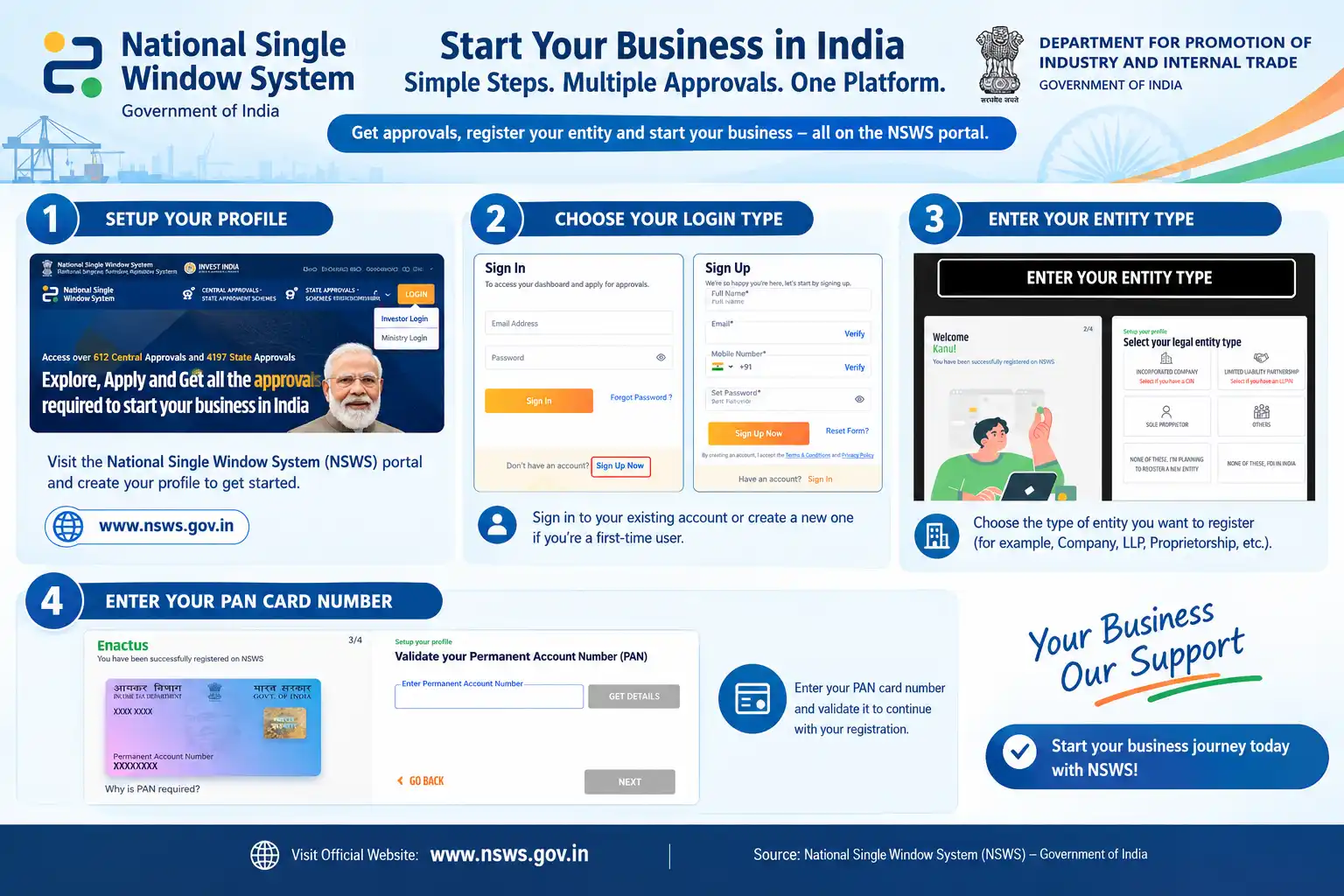
Step 1: Open the Startup India Portal
Go to startupindia.gov.in. This is the official government portal. Do not enter your details on any other website.
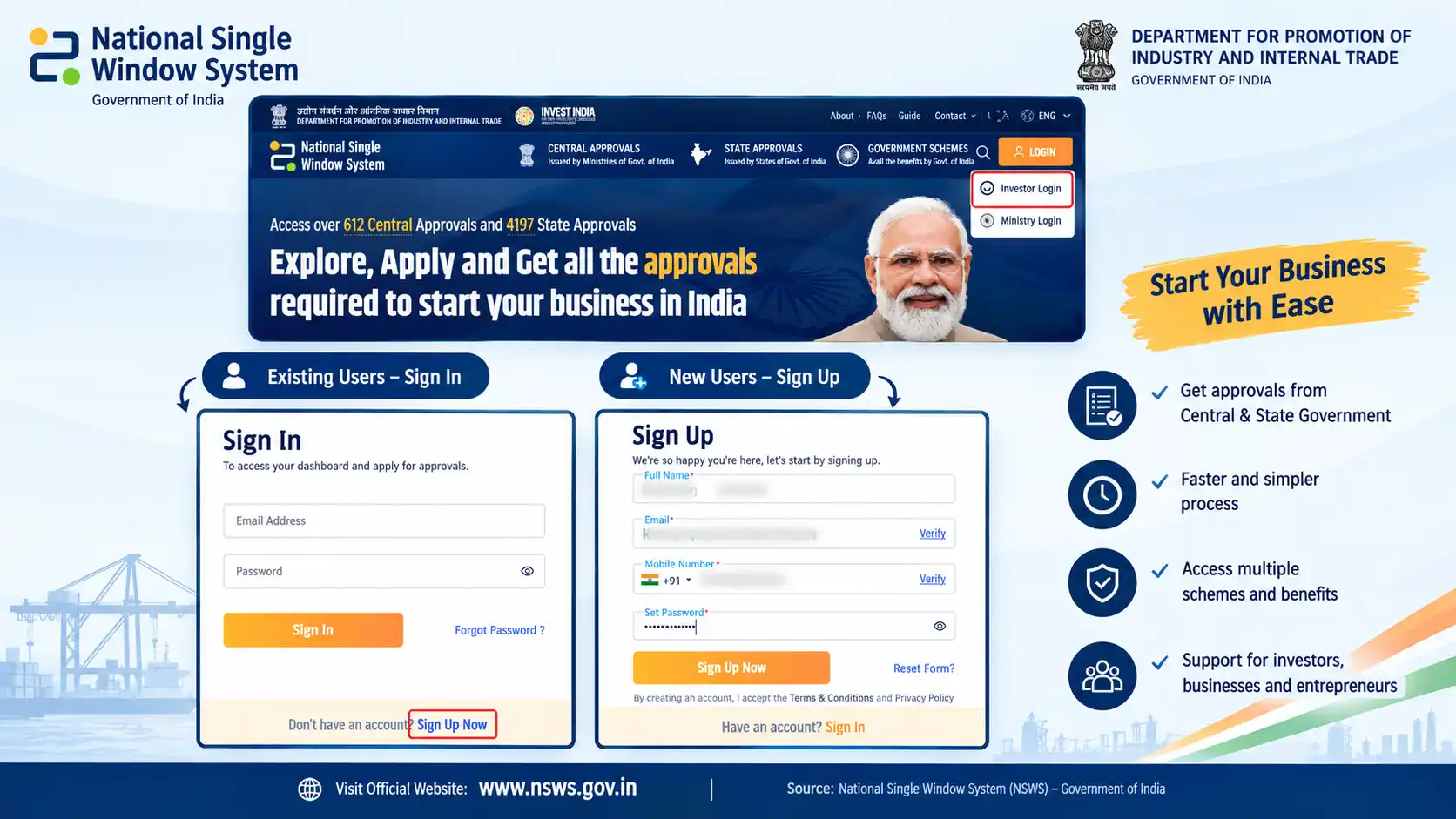
Step 2: Select Register
Click the register option and enter your name, email address, mobile number and a password. The person who registers should be a founder, director, partner or authorised representative, because the same account is used to file the recognition application.
Step 3: Verify With an OTP
Enter the one-time password sent to your mobile number and email. The account becomes active after this verification.
Step 4: Log In and Complete Your Profile
Log in and fill in the profile details that the portal asks for. These generally include the type of entity, date of incorporation, address and the stage of your startup. Completing the profile makes you ready to apply for recognition.
Step 5: Move to the Recognition Application
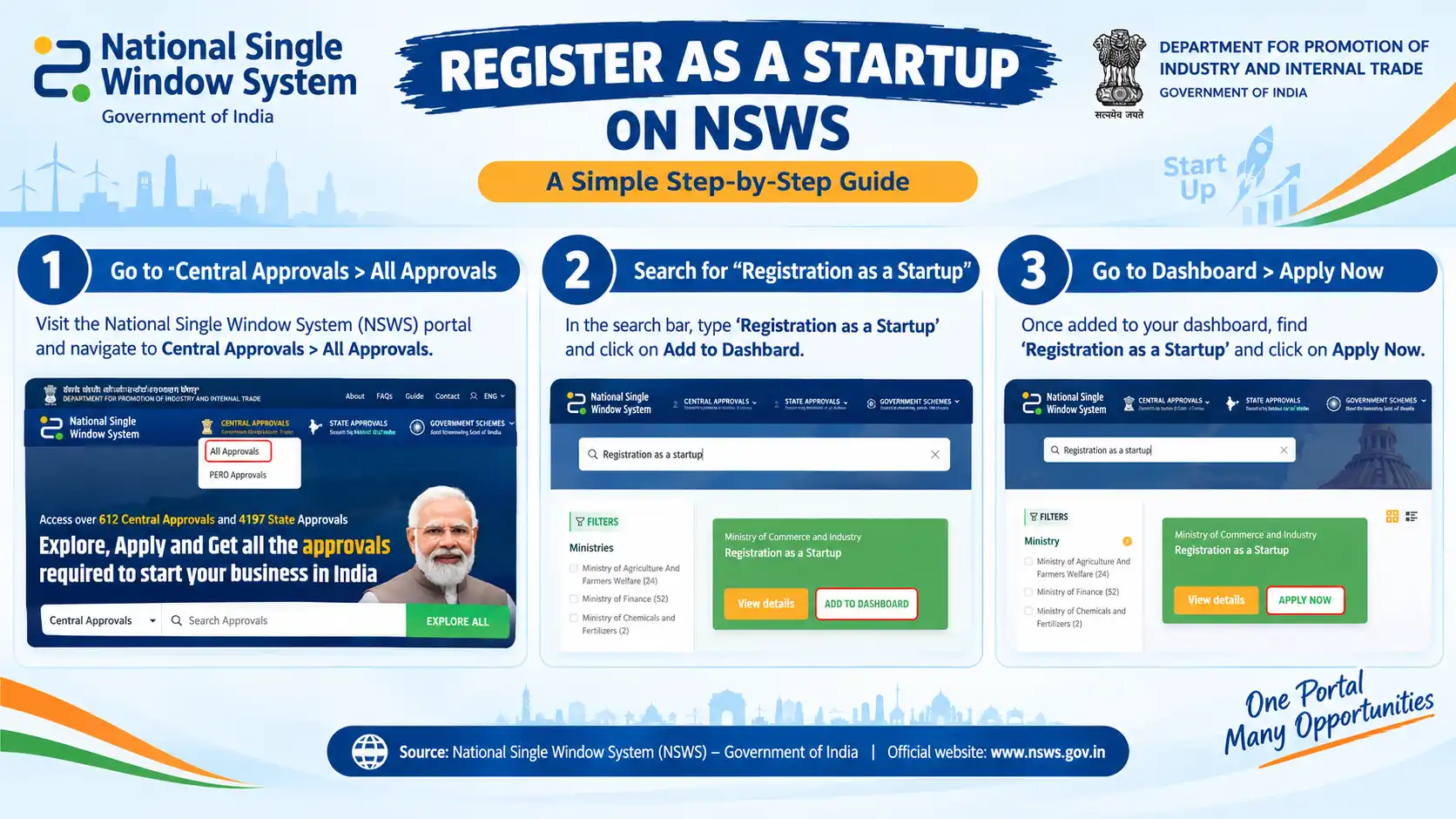
On the dashboard, open the recognition option and choose to apply for DPIIT recognition. As per current portal information, the application form is filed through the National Single Window System (NSWS) under the option for registration as a startup. This is where the registration stage ends and the recognition stage begins. The steps for it are explained later in this guide.
DPIIT Registration Fee and Time Required
You can get DPIIT startup recognition completely free on the Startup India website. If your paperwork is correct, approval usually takes just 2 to 7 days.If you take professional help, you pay only the professional service charges.
What You Get After DPIIT Registration, and What You Do Not
After registration, you get a login, a dashboard and the ability to submit the recognition application. You do not get a recognition certificate, a recognition number, income tax benefits, patent or trademark fee rebates, or eligibility for government funding schemes. These arise only after DPIIT approves your application for recognition.
Common Mistakes at the Registration Stage
Treating registration as the final step. An account on the portal does not make your business a recognised startup.
Using a personal or temporary email address. All updates and queries are sent to the registered email, so use an address that the business will keep.
Entering a business name that differs from the incorporation certificate. Even small differences in spelling or punctuation can cause queries later.
Registering before incorporating the business. Recognition requires an existing legal entity.
Using unofficial websites. Register only on the official government portal.
What Is DPIIT Recognition?
DPIIT recognition is the formal approval that the Department for Promotion of Industry and Internal Trade grants to an eligible business after reviewing its application and documents. Once approved, the business is officially recognised as a startup under the Startup India scheme. DPIIT issues a recognition certificate that carries a unique recognition number.
This is the stage that matters for benefits. The tax holiday under Section 80-IAC, rebates on patent and trademark fees, relaxations in government tenders and eligibility for funding schemes all depend on DPIIT recognition, not on the portal account alone.
The certificate is often called the DPIIT certificate, the Startup India certificate or the DPIIT recognition certificate. These names refer to the same document.
DPIIT Registration vs DPIIT Recognition: Key Differences
The table below separates the two stages.
Point
DPIIT Registration
DPIIT Recognition
Meaning
Creating an account on the Startup India portal
Official approval of your business as a startup
Where it is done
Startup India portal
Startup India portal, reviewed by DPIIT
Approval by DPIIT
Not required
Required
Documents
Basic account details
Incorporation certificate and business details
What you receive
Login and dashboard
Recognition certificate and recognition number
Startup benefits
None
Yes, subject to each scheme’s own conditions
Government fee
None
None
Order
First stage
Second stage
DPIIT Recognition vs Company Registration
Company registration is a third and different process. It creates your business as a legal entity with the Ministry of Corporate Affairs (MCA) or the LLP registrar. It is compulsory to run a company or LLP. DPIIT recognition is optional, and it is available only after the entity exists.
Point
Company Registration
DPIIT Recognition
Purpose
Creates the legal entity
Recognises the entity as a startup
Authority
MCA
DPIIT
Compulsory
Yes
No
Result
Certificate of Incorporation
Recognition certificate
Eligibility Criteria for DPIIT Recognition
A business must meet all of the following conditions. The limits below are based on the Startup India framework. Confirm the latest figures on the portal before you apply, because the government revises them from time to time.
Type of entity. The business must be a Private Limited Company, a Limited Liability Partnership (LLP) or a registered Partnership Firm. A sole proprietorship is not eligible.
Age of the entity. The entity must not be older than 10 years from the date of incorporation or registration. For recognised deep-tech startups, the government has allowed a longer period of 20 years.
Turnover. The annual turnover must not have exceeded ₹100 crore in any financial year since incorporation. For deep-tech startups, the limit is higher at ₹300 crore.
Original business. The entity must not be formed by splitting up or reconstructing an existing business.
Innovation or scalability. The business must work towards innovation, development or improvement of products, processes or services, or it must have a scalable business model with high potential for employment generation or wealth creation.
The fifth condition is assessed by the reviewer on the basis of your description. It is the point on which applications most often receive queries.
Documents Required for DPIIT Recognition
Keep the following ready before you begin the recognition application:
Certificate of Incorporation (company or LLP) or Registration Certificate and deed (partnership firm)
PAN of the entity
Names and contact details of directors or partners
Authorisation letter from the entity in favour of the person who files the application
A written description of the business: the problem, your solution, and why it is innovative or scalable
Supporting proof of your product, which is optional but helpful: website or app link, pitch deck, demo video, or details of patents, trademarks or copyrights
A recommendation from a DPIIT-recognised incubator or accelerator, only if you have one. It is not compulsory.
The application does not require income tax returns or financial statements. The portal asks you to self-declare that you meet the eligibility conditions.
DPIIT Recognition Process: Step-by-Step
The recognition application is made through the same portal account that you created during registration.
Step 1: Log In and Open the Recognition Application
Log in to your Startup India account, open the recognition tab and select the option to apply for DPIIT recognition.
Step 2: Open the Startup Recognition Form
The form is filed through the National Single Window System (NSWS) under registration as a startup. Portal screens can change, so follow the current on-screen instructions.
Step 3: Enter Entity Details
Enter the entity type, name, incorporation or registration number, date of incorporation, PAN, registered address, sector, and details of directors or partners. All details must match the certificate of incorporation or registration.
Step 4: Write the Description of Your Startup
This section decides the outcome of most applications. State the following in specific terms:
The problem: who faces it and why existing options fall short
Your solution: what the product or service does and what is new about it
Scalability: the market, the revenue model and the potential for employment or wealth creation
A statement such as “we are an innovative and disruptive platform” gives the reviewer nothing to assess.
Step 5: Upload Documents and Self-Declare
Upload the certificate of incorporation or registration, the authorisation letter and any supporting material. Then confirm the declarations that state you meet the eligibility conditions.
Step 6: Submit and Track the Application
Submit the form and keep the reference number. Track the status from your dashboard. If DPIIT asks for clarification, reply on the portal without delay.
Step 7: Receive the Recognition Certificate
On approval, the recognition certificate with your recognition number is issued. Download it and keep it safe, since it is needed for later applications such as the Section 80-IAC exemption, patent and trademark rebates, and government tenders.
How Long Does DPIIT Recognition Take?
Getting your DPIIT startup recognition usually takes 2 to 7 working days. In fact, according to the official NSWS portal, it often takes only 2 working days if your documents are complete and easy to read.
Timeline Breakdown
How long it takes in general: The usual processing time is 2 to 7 working days. However, if your application is completely error-free and clean, you will often get your certificate within 48 hours.
What could delay it: If the government (DPIIT) finds an issue and asks for clarification about your documents or your business idea, the process will take longer. The review time resets only after you submit your reply.
What it costs: The entire process is 100% free. The government does not charge any fees to apply for or download your recognition certificate.
I can guide you through the process if you want. Let me know:
How to Download the DPIIT Recognition Certificate
Log in to your Startup India account and open the recognition section of your dashboard to download the approved certificate. Recognised startups can also obtain the certificate through DigiLocker. The recognition number is printed on the certificate.
Benefits of DPIIT Recognition
The benefits below are available to recognised startups. Several of them require a separate application or approval after recognition, as noted in each case.
1. Income Tax Exemption Under Section 80-IAC
An eligible recognised startup can claim a deduction of 100% of its profits for three consecutive years, chosen from the first 10 years after incorporation. DPIIT recognition is not sufficient on its own. The startup must also obtain a certificate from the Inter-Ministerial Board, and it must satisfy the incorporation date limit prescribed in the law. Check the current rules before you plan.
2. Rebate on Patent and Trademark Fees
Recognised startups receive an 80% rebate on patent filing fees and a 50% rebate on trademark filing fees under the Startup India scheme. Patent applications of recognised startups are also eligible for faster examination. CoTaxo assists with Trademark Registration.
3. Relaxation in Government Tenders
Government departments may relax conditions on prior experience and prior turnover for recognised startups. Startups are also exempt from earnest money deposit (EMD) in many government tenders. This allows a new business to compete for public procurement.
4. Eligibility for Government Funding Schemes
DPIIT recognition is required to apply for schemes such as the Startup India Seed Fund Scheme, the Fund of Funds for Startups and the Credit Guarantee Scheme for Startups. Recognition makes you eligible to apply. It does not guarantee funding.
5. Self-Certification Under Certain Laws
Recognised startups can self-certify compliance with certain labour and environment laws for a limited period. This reduces routine inspections in the early years.
6. Credibility With Banks, Investors and Clients
The certificate is an official record that the Government of India recognises the business as a startup. This supports discussions with lenders, investors and corporate clients.
A Note on Angel Tax
Older articles state that DPIIT recognition exempts a startup from angel tax under Section 56(2)(viib) of the Income Tax Act. The Government abolished angel tax for all investors with effect from 1 April 2025. It is therefore no longer a specific advantage of DPIIT recognition. Always verify the current provisions with a tax professional before you plan a fundraise.
What to Do After You Receive the Recognition Certificate
Recognition is the starting point for claiming benefits. The following steps are commonly needed:
Apply to the Inter-Ministerial Board if you intend to claim the Section 80-IAC exemption
Mention your recognition status when you file patent and trademark applications so that you receive the fee rebate
Register on the Government e-Marketplace (GeM) if you plan to sell to government departments
Apply for funding schemes that suit your stage of growth
Common Mistakes That Delay or Block DPIIT Recognition
Confusing registration with recognition. A portal account does not make the business a recognised startup. The recognition application must be filed separately and approved.
A vague business description. General claims of innovation, without specific details, lead to queries and delay.
Mismatch in entity details. The name, incorporation number and addresses must match the incorporation documents exactly.
Applying with an ineligible entity. Sole proprietorships and entities beyond the age or turnover limits cannot be recognised.
Presenting an ordinary business as a startup. A conventional business without an innovative or scalable element may be rejected.
Delay in responding to queries. Unanswered queries keep the application pending.
Unclear or incomplete documents. Upload complete, legible files.
Is DPIIT Registration or Recognition Mandatory?
Neither is mandatory by law. A business can operate without DPIIT recognition. However, if you want any of the startup benefits described above, you must have DPIIT recognition, and you must first have a portal account to apply for it. For most early-stage startups that plan to raise funds, file patents or trademarks, or work with government departments, recognition is a practical necessity.
How CoTaxo Can Help
The government charges no fee for DPIIT registration or recognition, but an incomplete or unclear application can remain pending for a long time. CoTaxo assists with incorporation, portal registration, preparation of the startup description, document review and filing of the recognition application. Learn more about our Startup India Registration service, or book a free consultation with our experts.
Frequently Asked Questions
What is DPIIT registration?
DPIIT registration means creating an account on the Startup India portal. It is the first step towards applying for DPIIT recognition. It does not give startup status or benefits by itself.
What is DPIIT recognition?
DPIIT recognition is the approval that DPIIT grants to an eligible business after reviewing its application. On approval, the business receives a recognition certificate and a recognition number.
Is DPIIT registration the same as DPIIT recognition?
No. Registration is the creation of a portal account. Recognition is the formal approval of the business as a startup. Many people use “DPIIT registration” to describe the whole process, but they are two separate stages.
Does a Startup India portal account give me startup benefits?
No. Benefits such as the Section 80-IAC exemption, fee rebates and tender relaxations are available only after DPIIT recognition.
What is the full form of DPIIT?
DPIIT stands for Department for Promotion of Industry and Internal Trade. It works under the Ministry of Commerce and Industry.
Is there a fee for DPIIT registration or recognition?
There is no government fee for either. If you engage a professional, you pay their service charges.
Where can I find my DPIIT registration number?
The number that is commonly called the DPIIT registration number is the recognition number. It is printed on your DPIIT recognition certificate and is available on your Startup India dashboard.
Final Thoughts
DPIIT registration and DPIIT recognition are two connected but separate stages. Registration creates your account on the Startup India portal and has no benefits attached. Recognition is the approval from DPIIT that gives you the certificate, the recognition number and access to the startup benefits.
The correct sequence is to incorporate the business, register on the portal, file a complete recognition application with a specific description of your business, and then apply for the individual benefits that you need. A founder who follows this order, and who keeps the details accurate and consistent, can avoid most of the delays seen in practice.
Submit your Details to get an Instant All-inclusive Quote and a FREE Expert consultation