Missing a GST due date means late fees, interest and sometimes blocked filings. The tricky part is that GST return filing dates change depending on the return, your turnover and whether you file monthly or quarterly. This guide gives you every important due date in one place, a month-by-month calendar for FY 2026-27, and what to do if you miss a date.
For monthly filers, the GST return filing dates are the 11th for GSTR-1 and the 20th for GSTR-3B. Quarterly (QRMP) filers file GSTR-1 by the 13th and GSTR-3B by the 22nd or 24th of the month after the quarter. GSTR-9 is due on 31 December.
GST due dates in October 2026
13 October: GSTR-1 for QRMP filers (July-September quarter)
18 October: CMP-08 for composition taxpayers (July-September quarter)
20 October: GSTR-3B for monthly filers (September)
22 or 24 October: GSTR-3B for QRMP filers (July-September quarter)
GST Return Filing Dates at a Glance (FY 2026-27)
Return
Who files
Due date
GSTR-1 (monthly)
Regular taxpayers
11th of the next month
GSTR-1 (quarterly, QRMP)
Eligible taxpayers, turnover up to ₹5 crore
13th of the month after the quarter
GSTR-3B (monthly)
Regular taxpayers
20th of the next month
GSTR-3B (quarterly, QRMP)
QRMP taxpayers
22nd or 24th of the month after the quarter
GSTR-9 / GSTR-9C
Annual return
31 December after the financial year
GSTR-4
Composition taxpayers (annual)
30 April after the financial year
CMP-08
Composition taxpayers (quarterly)
18th of the month after the quarter
These are the standard dates. The government can extend them, so always confirm before the deadline (see the section on extensions below).
GST Return Filing Due Date for GSTR-1 and GSTR-3B
GSTR-1 and GSTR-3B are the two returns most businesses file, so most of your deadlines come from these.
GSTR-1 due date
GSTR-1 reports your outward supplies (sales). Monthly filers submit it by the 11th of the following month. Taxpayers under the QRMP scheme file it quarterly by the 13th of the month after the quarter ends.
GSTR-3B due date (monthly)
GSTR 3B is a summary return of sales, eligible Input Tax Credit (ITC) and tax payable. Monthly filers must file it and pay tax by the 20th of the following month.
GSTR-3B due date for quarterly return (QRMP)
Under the Quarterly Return Monthly Payment (QRMP) scheme, you file GSTR 3B once a quarter, but you still pay tax every month. The quarterly due date depends on your state:
22nd of the month after the quarter, for businesses in states such as Maharashtra, Gujarat, Karnataka, Tamil Nadu, Kerala, Telangana, Andhra Pradesh, Madhya Pradesh, Chhattisgarh and Goa, and some union territories.
24th of the month after the quarter, for other states such as Delhi, Uttar Pradesh, Rajasthan, Haryana and West Bengal.
Check the exact state list on the GST portal if you’re unsure which applies to you.
For the first two months of each quarter, QRMP taxpayers also pay tax through Form PMT-06 by the 25th of the following month.
Due Dates for Other GST Returns
Return
Applicable to
Due date
GSTR-5
Non-resident taxable persons
13th of the next month
GSTR-6
Input Service Distributors
13th of the next month
GSTR-7
TDS deductors
10th of the next month
GSTR-8
E-commerce operators
10th of the next month
GSTR-10
Final return after cancellation
Within 3 months of cancellation
GSTR-11
UIN holders (refund claims)
28th of the next month
GST Return Filing Dates for FY 2026-27: Monthly Calendar
Here are the standard due dates for monthly filers for the financial year 2026-27 (April 2026 to March 2027 return periods). They don’t include any extensions or holiday adjustments.
Return period
GSTR-1 due
GSTR-3B due
April 2026
11 May 2026
20 May 2026
May 2026
11 June 2026
20 June 2026
June 2026
11 July 2026
20 July 2026
July 2026
11 August 2026
20 August 2026
August 2026
11 September 2026
20 September 2026
September 2026
11 October 2026
20 October 2026
October 2026
11 November 2026
20 November 2026
November 2026
11 December 2026
20 December 2026
December 2026
11 January 2027
20 January 2027
January 2027
11 February 2027
20 February 2027
February 2027
11 March 2027
20 March 2027
March 2027
11 April 2027
20 April 2027
Quarterly (QRMP) filers:
Quarter
GSTR-1 due
GSTR-3B due
April–June 2026
13 July 2026
22 or 24 July 2026
July–September 2026
13 October 2026
22 or 24 October 2026
October–December 2026
13 January 2027
22 or 24 January 2027
January–March 2027
13 April 2027
22 or 24 April 2027
Annual returns: GSTR-9 and GSTR-9C for FY 2025-26 are due by 31 December 2026, unless extended.
Is the GST Return Filing Date Extended?
Sometimes. The government can extend GST due dates through notifications issued by the Central Board of Indirect Taxes and Customs (CBIC), usually for specific returns, tax periods or states, for example after a portal outage or a natural disaster. Extensions are not automatic and don’t apply to every return.
Don’t assume a deadline has moved. Check the CBIC website or the GST portal’s news section before relying on an extension, and file by the original date if you can’t confirm one.
How to Check GST Return Filing Status Online
Taxpayers can verify the status of their GST returns online through the official GST portal using multiple tracking options. Depending on the information available, you can check the status using the Application Reference Number (ARN), the return filing period, or the filing status.
Track GST Return Status Using ARN
The Application Reference Number (ARN) is a unique reference number generated after a GST return or application is successfully submitted. It can be used to check the current processing status.
Click Search to view the current status of the return.
Track GST Return Status by Return Filing Period
This option allows taxpayers to view the status of returns filed during a selected period.
Steps to check by filing period:
Log in to the GST portal.
Navigate to Services > Returns > Track Return Status.
Select Return Filing Period.
Choose the relevant start and end dates.
Click Search to view all returns filed during the selected period along with their status.
Track GST Return Status by Filing Status
Taxpayers can also search for returns based on their current filing status.
Steps to check by status:
Log in to the GST portal.
Go to Services > Returns > Track Return Status.
Select Status as the search option.
Choose the required filing status from the available options, such as:
Filed and Valid
Filed but Invalid
Validated but Not Filed
Click Search to display all returns matching the selected status.
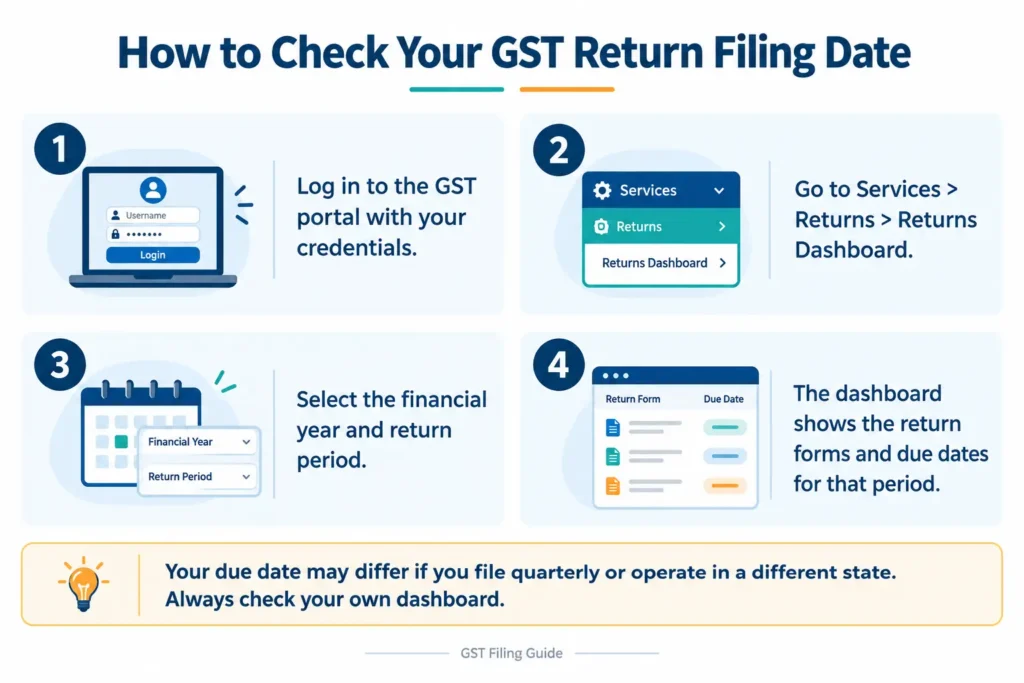
Your due date can differ from a friend’s business if you file quarterly or are in a different state, so check your own dashboard.
GST Return Filing Last Date: Late Fee and Interest If You Miss It
If you miss the GST return filing last date, you pay a late fee plus 18% yearly interest on any unpaid tax. The late fee is charged per day, up to a cap based on your turnover. Check the GST return filing due date for your own return and filing frequency, so you don’t pay it at all.
Late Fee for GSTR-3B Per Day
The late fee for GSTR 3B per day is ₹50 (₹25 CGST + ₹25 SGST), or ₹20 for a nil return. The same per-day amount applies to GSTR-1. Not sure of your GSTR 3B due date? It’s the 20th of the next month for monthly filers. See the full list in the due dates table above.
Type of return
Late fee per day
Regular return
₹50 (₹25 CGST + ₹25 SGST)
Nil return
₹20 (₹10 CGST + ₹10 SGST)
Maximum Late Fee by Turnover
Aggregate turnover (previous financial year)
Maximum late fee per return
Nil return
₹500
Up to ₹1.5 crore
₹2,000
₹1.5 crore to ₹5 crore
₹5,000
Above ₹5 crore
₹10,000
Late Fee Example
A business with ₹1 crore turnover files its GSTR-3B 10 days late. The late fee is 10 days × ₹50 = ₹500 (₹250 CGST + ₹250 SGST), which is below the ₹2,000 cap. If there was unpaid tax, 18% yearly interest is added on top.
Late fees and interest must be paid in cash, not through Input Tax Credit. The GST portal calculates both automatically when you file.
Missed a date? Our team can clear pending returns and calculate the exact late fee for you. See our GST return filing services.
Rates and caps are changed by notification, so confirm the current figures on the GST portal.
What to Do If You Miss the Due Date
If you realize you have missed the last date to file your GST return:
File as soon as you can. The late fee grows daily until the cap, so delay costs you.
Pay the tax due with interest along with the return.
Pay the late fee in cash. The portal calculates it automatically.
Clear any other pending returns. Unfiled GSTR-3B returns can block you from filing later GSTR-1 returns.
Don’t ignore it for months. Continued non-filing can lead to notices and cancellation of your GST registration.
Tips to Never Miss a GST Due Date
Set calendar reminders for the 8th, 18th and the quarterly dates.
Reconcile your purchases with GSTR-2B before the filing date, so ITC problems don’t delay you.
Keep invoices and bank records organized every month, not at the last minute.
Consider handing GST filing to a professional if you miss dates regularly.
FAQs
What is the GST return filing date for GSTR-3B?
The 20th of the following month for monthly filers. For quarterly (QRMP) filers it is the 22nd or 24th of the month after the quarter, depending on the state.
What is the last date to file a GST return?
It depends on the return and your filing frequency. GSTR-1 is the 11th (monthly) or 13th (quarterly), GSTR-3B is the 20th (monthly) or 22nd/24th (quarterly), and GSTR-9 is 31 December.
Is the GST return filing date extended?
Only if the government notifies an extension, and extensions are usually for specific returns, periods or states. Check CBIC notifications and the GST portal before relying on one.
How can I file a GST return after the due date?
File it on the GST portal as normal. The portal adds the late fee, and you pay interest on any unpaid tax.
How do I check my GST return filing date?
Log in to the GST portal, open the Returns Dashboard, and select your financial year and period.
Need Help Filing On Time?
Missing dates is expensive and stressful. Our experts handle GSTR-1, GSTR-3B and annual filing for you, with reconciliation and reminders included. See our GST return filing services or talk to a CoTaxo expert for a free consultation.
Submit your Details to get an Instant All-inclusive Quote and a FREE Expert consultation