GST • Income Tax • Registration • Payroll • Advisory • FSSAI • Virtual CFO

One Employee, Three Payslips: What the ₹25,000 PF Wage Ceiling and the 50% Wage Rule Mean for Your Payroll

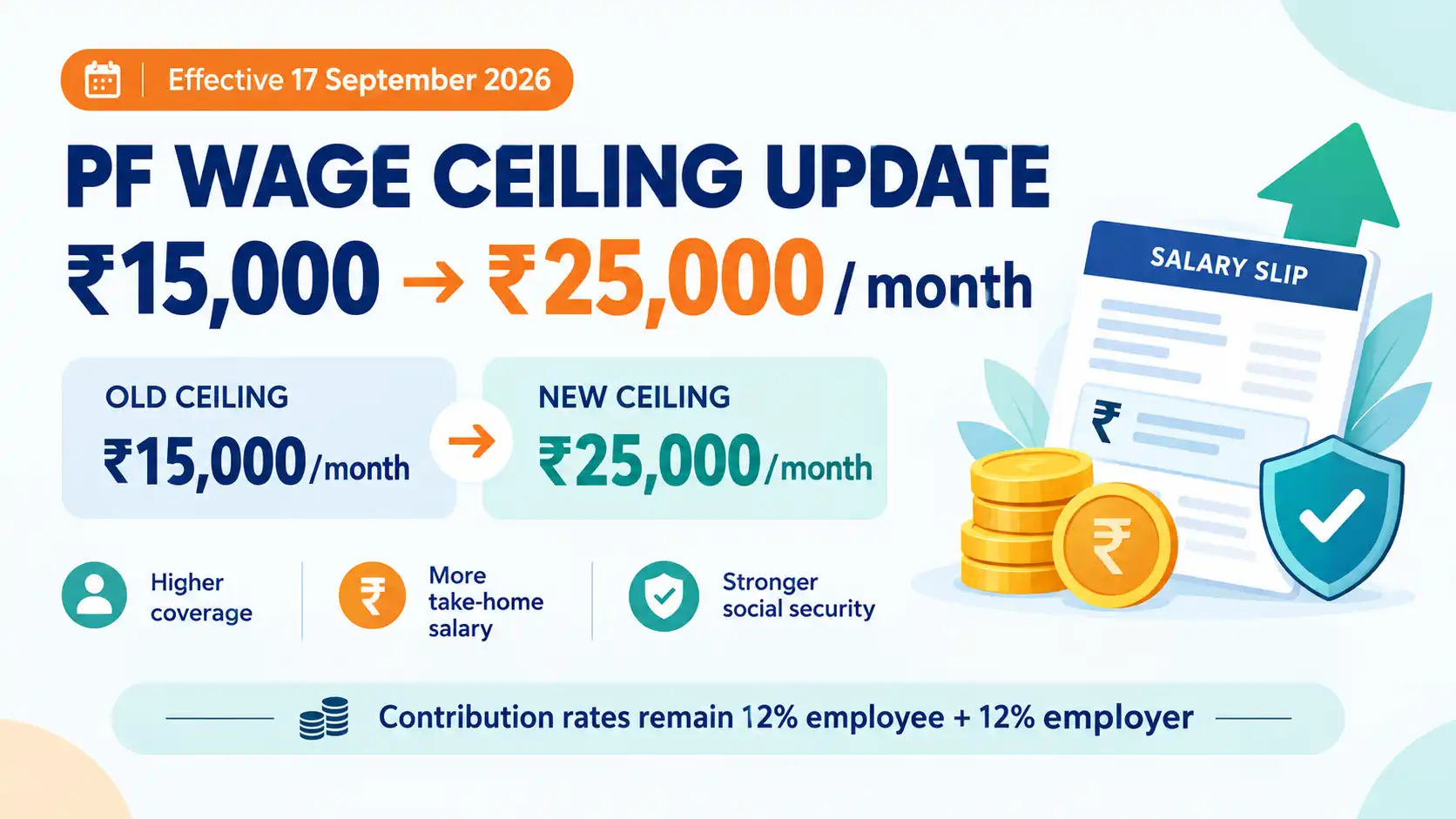
The PF wage ceiling rose from ₹15,000 to ₹25,000 per month on 17 September 2026, and October 2026 is the first full wage month under it. The 12% employee and employer rates are unchanged, so an employee with a ₹20,000 PF wage now contributes ₹2,400 a month instead of ₹1,800. Separately, under the Code on Wages, 2019, exclusions from “wages” cannot exceed 50% of total remuneration; any excess is added back to wages.

The EPFO wage ceiling for 2026 is ₹25,000 per month, up from ₹15,000.

Why did your payroll change in September 2026?

If your accountant has said something like “the PF numbers look different this month,” you are not imagining it. The Employees’ Provident Fund Organisation (EPFO) has raised the statutory wage ceiling for PF, pension and deposit-linked insurance from ₹15,000 to ₹25,000 per month, effective 17 September 2026. It is the first revision in more than a decade.

At the same time, the Labour Codes, in force since 21 November 2025, have given India one common definition of “wages” with a rule that surprises many employers: the 50% wage rule.

These two changes work together. This guide follows one fictional employee, Riya, through three payslips so you can see exactly what changes, and then gives you a checklist for your business.

What is the new PF wage ceiling?

The PF wage ceiling is the limit used to decide who must be covered under mandatory EPF and to cap the wage on which contributions are calculated. Here is what has changed:

  • Old ceiling: ₹15,000 per month
  • New ceiling: ₹25,000 per month
  • Effective from: 17 September 2026
  • Wider coverage: EPFO’s FAQs say the change brings over 51 lakh additional employees under mandatory coverage
  • Contribution rate: unchanged at 12% for the employee and 12% for the employer. Only the base on which it is calculated has moved.

Of the employer’s 12%, 8.33% goes to the Employees’ Pension Scheme (EPS, capped at the wage ceiling) and 3.67% goes to EPF.

Meet Riya: three payslips, one salary

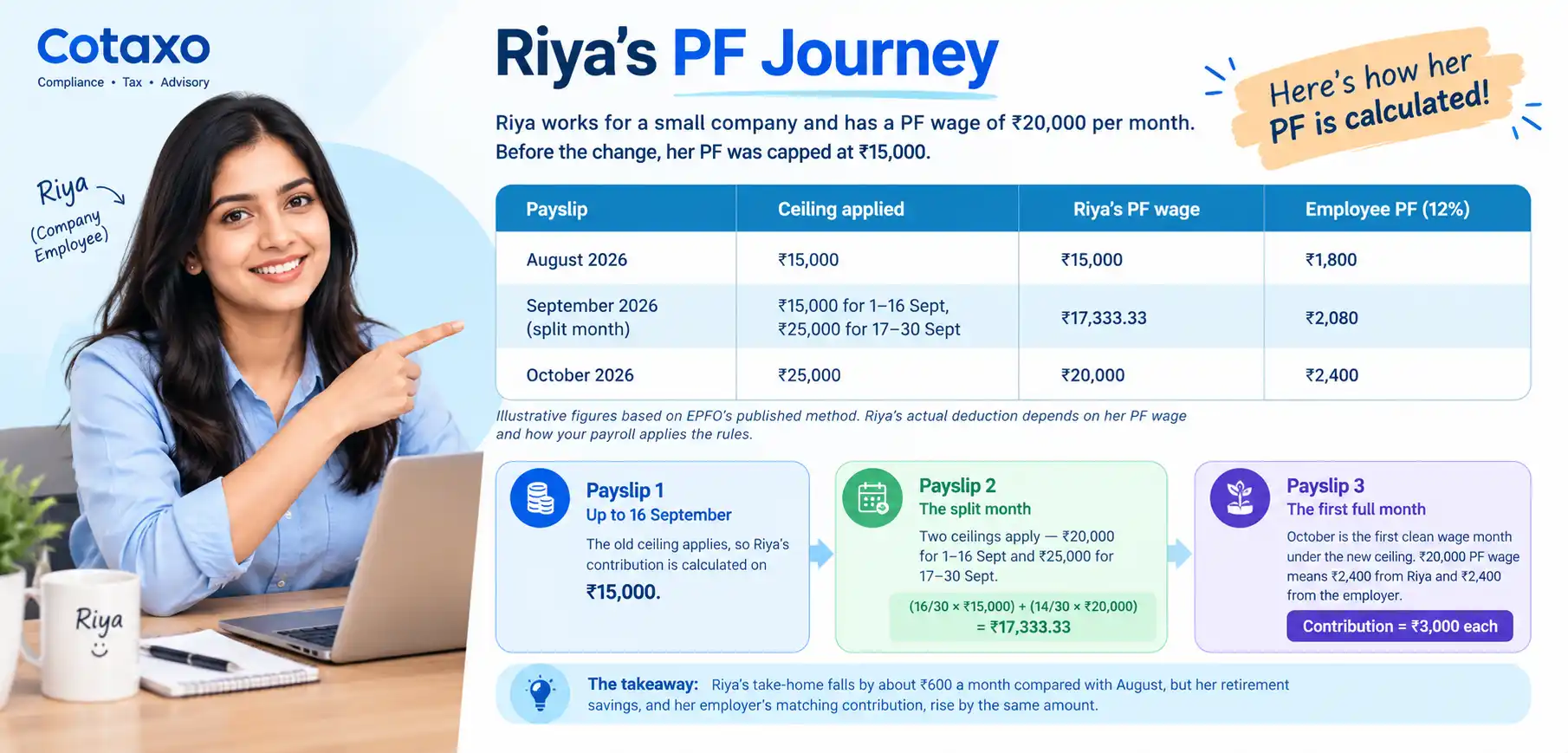
Riya works for a small company and has a PF wage of ₹20,000 per month. Before the change, her PF was capped at ₹15,000.

Payslip

Ceiling applied

Riya’s PF wage

Employee PF (12%)

August 2026

₹15,000

₹15,000

₹1,800

September 2026 (split month)

₹15,000 for 1–16 Sept, ₹25,000 for 17–30 Sept

₹17,333.33

₹2,080

October 2026

₹25,000

₹20,000

₹2,400

Illustrative figures based on EPFO’s published method. Riya’s actual deduction depends on her PF wage and how your payroll applies the rules.

Payslip 1: up to 16 September

The old ceiling applies, so Riya’s contribution is calculated on ₹15,000.

Payslip 2: the split month

September is the tricky one because two ceilings apply in one month. For an existing member moving to an actual ₹20,000 wage from 17 September, EPFO calculates September EPF wages at ₹17,333.33. You can check it yourself: (16/30 × ₹15,000) + (14/30 × ₹20,000) = ₹17,333.33.

Payslip 3: the first full month

October is the first clean wage month under the new ceiling. A ₹20,000 PF wage means ₹2,400 from Riya and ₹2,400 from the employer. If her PF wage were ₹25,000 or more, the contribution would be capped at ₹3,000 each.

The takeaway: Riya’s take-home falls by about ₹600 a month compared with August, but her retirement savings, and her employer’s matching contribution, rise by the same amount.

What Is the 50% Wage Rule? Understanding the New Wage Rules Under the Code on Wages

Under the new wage rules, the Code on Wages, 2019 gives India one common meaning of “wages” for all four Labour Codes. These codes have been in effect since 21 November 2025.

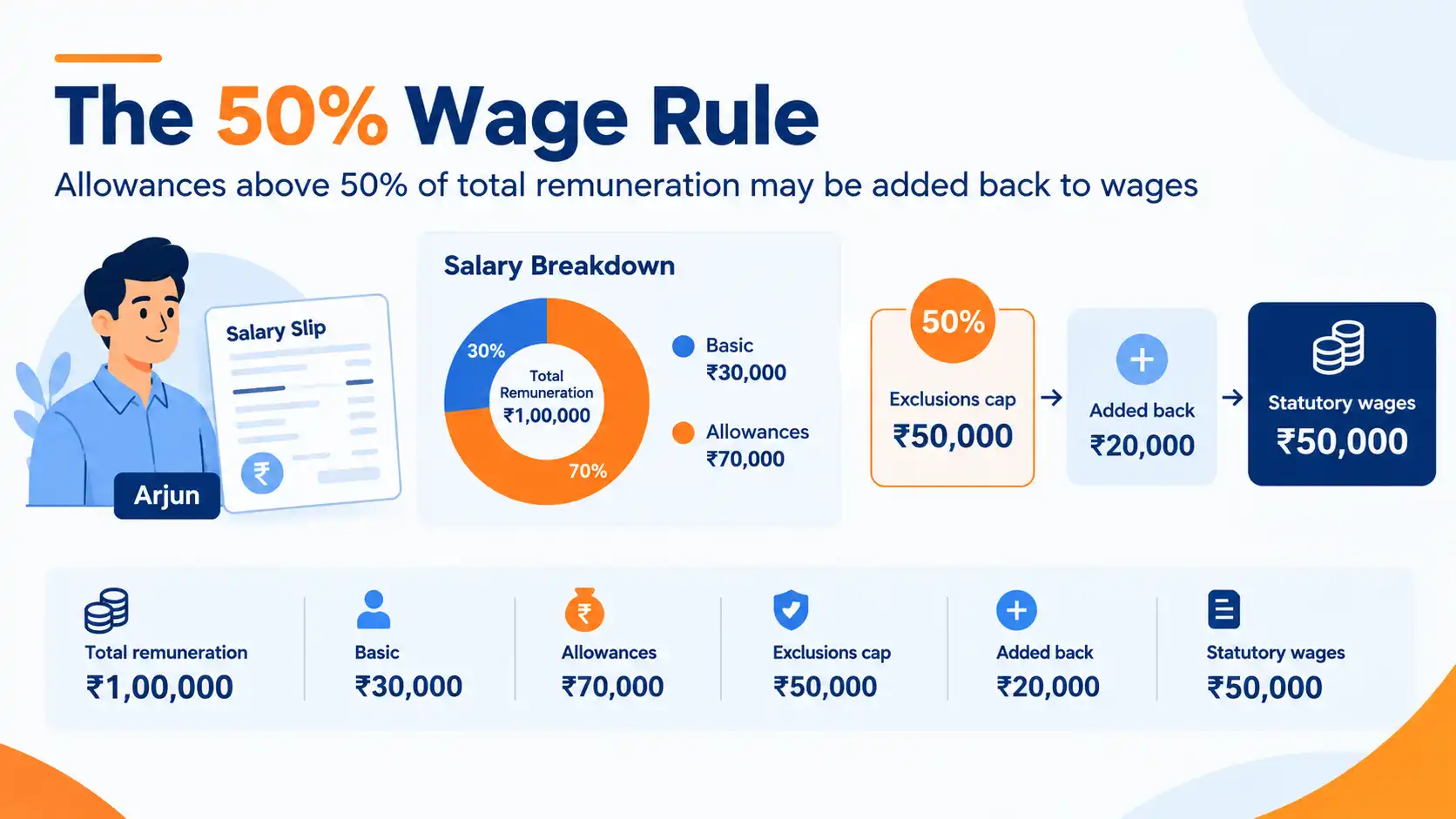
Some payments, such as certain allowances, are left out of “wages.” But the Code on Wages rules set a limit: the items left out cannot be more than 50% of the total remuneration. If they are, the extra amount is added back to wages.

Why does this matter? PF, gratuity and other benefits are calculated on “wages.” So your wages for these benefits can be higher than the basic pay on your payslip.

Simple example: Arjun earns ₹1,00,000 a month: ₹30,000 basic and ₹70,000 allowances. Only ₹50,000 can stay outside wages, so ₹20,000 is added back. His wages for PF and gratuity are ₹50,000, not ₹30,000.

In one line: the 50% wage rule is a cap on what can be excluded from wages. It does not say your basic pay must be 50% of CTC.

Myth: “Basic must be 50% of CTC”

This is the most common misreading. The law does not say your basic salary must equal 50% of CTC. It says that no more than 50% of total remuneration can sit outside the definition of wages. Think of it as a cap on exclusions, not a ceiling on wages.

How the two rules interact

  1. The 50% rule decides what counts as wages.
  2. The ₹25,000 ceiling decides how much of those wages is subject to PF.

An employer who only updates the ceiling but ignores the wage definition may still under-calculate PF. An employer who only restructures salaries may miss the new ceiling. You need both checks.

Employer checklist: what to do now

  1. Update your payroll master to the ₹25,000 ceiling for the October wage month onward.
  2. Handle September correctly: use ₹15,000 for 1-16 September and ₹25,000 for 17-30 September. The September ECR (Electronic Challan-cum-Return) was due by 15 October 2026.
  3. Recover any shortfall. If the extra employee share could not be recovered from September pay, it can be recovered in the October payroll cycle. The full amount must still be reported and remitted with the September ECR.
  4. Review new coverage: employees earning up to ₹25,000 who were previously outside mandatory PF may now need to be enrolled.
  5. Run the 50% test on every salary structure: total your exclusions and compare them with 50% of total remuneration.
  6. Update offer letters and CTC structures so new hires see the correct deductions from day one.
  7. Tell your team early. Take-home pay will drop for some employees, and a short note avoids confusion.

FAQs,

What is the new PF wage ceiling in 2026?

The PF wage ceiling is ₹25,000 per month, effective 17 September 2026. It replaces the earlier ₹15,000 ceiling.

No. It depends on each employee’s PF wage, existing membership and how the employer applies the rules. Employees whose PF wage is already at or below ₹15,000 may see no change.

Use ₹15,000 for 1–16 September and ₹25,000 for 17–30 September, then calculate the blended PF wage for the month.

No. It limits exclusions from wages to 50% of total remuneration. Any excess is added back to wages.

Yes. The uniform wage definition applies across the Labour Codes, and gratuity is calculated on it from 21 November 2025.

PF applicability depends on headcount and wage levels. Speak to a compliance professional when you set up your company so your payroll is correct from the first hire.

The Labour Codes, in force since 21 November 2025, give one common definition of wages. Under the Code on Wages, exclusions from wages cannot exceed 50% of total remuneration.

Final thoughts

The ₹25,000 PF wage ceiling and the 50% wage rule are small numbers with big payroll consequences. Get the September split right, run the 50% test on your salary structures, and tell your employees what to expect.

Setting up a new company or hiring your first employees? Cotaxo can help you register your company and build a compliant payroll from day one. Contact us for a free consultation.

Submit your Details to get an Instant All-inclusive Quote and a FREE Expert consultation

Call Us WhatsApp