GST • Income Tax • Registration • Payroll • Advisory • FSSAI • Virtual CFO

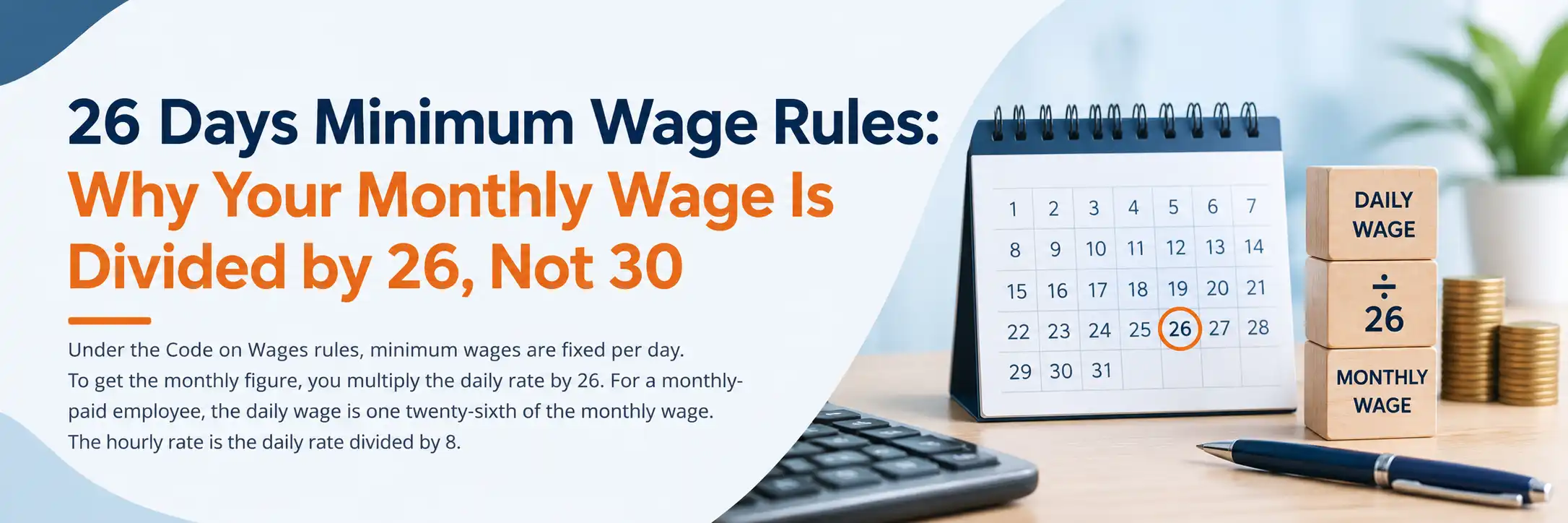
26 Days Minimum Wage Rules: Why Your Monthly Wage Is Divided by 26, Not 30

The 26 days minimum wage rule is simple: minimum wages are fixed per day, and the monthly figure is the daily rate multiplied by 26. To get the monthly figure, you multiply the daily rate by 26. For a monthly-paid employee, the daily wage is one twenty-sixth of the monthly wage. The hourly rate is the daily rate divided by 8.

26 Days Minimum Wage Rules: Wait, Why 26 and Not 30?

If you run payroll, you have probably asked this at least once. A month has 30 days, so why does everyone divide by 26?

It is simpler than it sounds. Most workers get a weekly day off. Take about four rest days out of a 30-day month and you are left with roughly 26 working days. For years, this was a common practice in payroll. Under the new wage rules, it is spelled out clearly.

What the 26 Days Minimum Wage Rules actually say

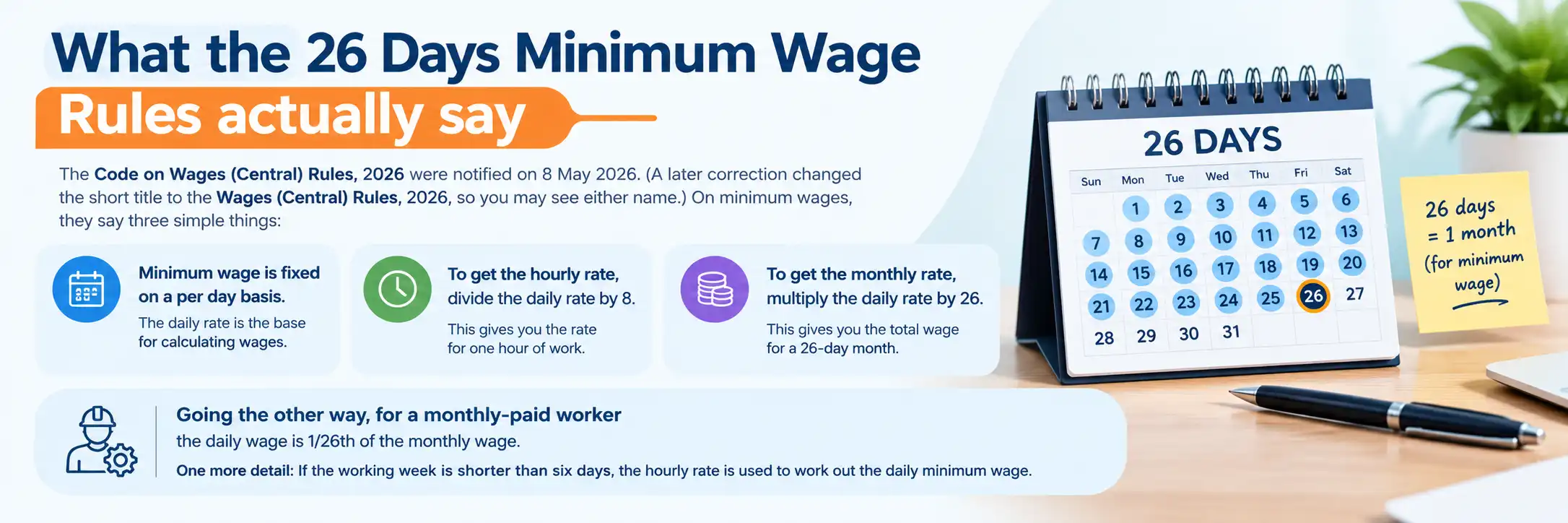
The Code on Wages (Central) Rules, 2026 were notified on 8 May 2026. (A later correction changed the short title to the Wages (Central) Rules, 2026, so you may see either name.) On minimum wages, they say three simple things:

  • Minimum wage is fixed on a per day basis.
  • To get the hourly rate, divide the daily rate by 8.
  • To get the monthly rate, multiply the daily rate by 26.

Going the other way, for a monthly-paid worker the daily wage is 1/26th of the monthly wage.

One more detail. If the working week is shorter than six days, the hourly rate is used to work out the daily minimum wage.

Official source: Code on Wages, 2019 – Ministry of Labour and Employment

A quick example

Let us say a minimum wage of ₹600 a day. These are made-up numbers to show the method, not real notified rates.


Amount

Daily wage

₹600

Hourly wage (₹600 ÷ 8)

₹75

Monthly wage (₹600 × 26)

₹15,600

Now the other direction. Suppose someone is paid ₹18,000 a month. Their daily wage works out to ₹18,000 ÷ 26 = about ₹692. If the minimum daily wage for their job is ₹600, they are above it. If it were ₹750, they would be short, and the employer would have to make up the difference.

Does this apply to my business?

This is the part people miss, so read it slowly.

The Central Rules apply to establishments where the Central Government is the “appropriate government.” Most private businesses follow their state’s minimum wage notification instead. The Code also says a state cannot fix minimum wages below the floor wage set by the Centre.

The 26-day method is widely used in payroll, but the actual rate depends on your state, industry and the skill level of the worker. So before you run the numbers, look up the notified rate that applies to you.

What the 26-day rule does not mean

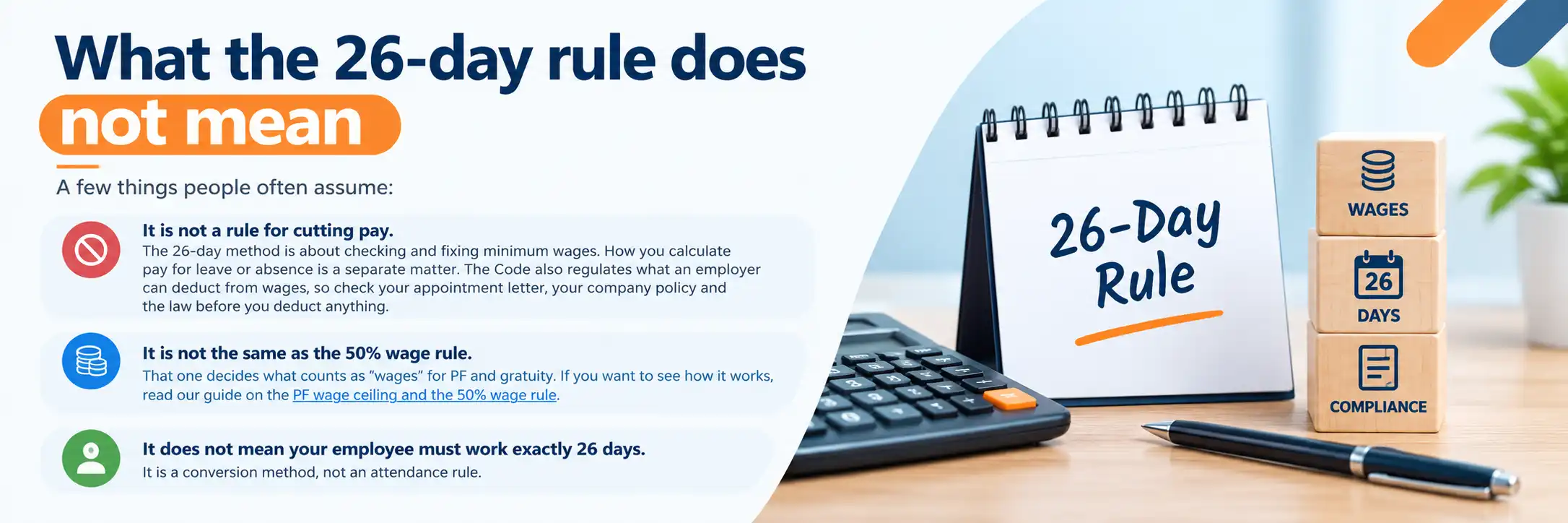
A few things people often assume:

  • It is not a rule for cutting pay. The 26-day method is about checking and fixing minimum wages. How you calculate pay for leave or absence is a separate matter. The Code also regulates what an employer can deduct from wages, so check your appointment letter, your company policy and the law before you deduct anything.
  • It is not the same as the 50% wage rule. That one decides what counts as “wages” for PF and gratuity. If you want to see how it works, read our guide on the PF wage ceiling and the 50% wage rule.
  • It does not mean your employee must work exactly 26 days. It is a conversion method, not an attendance rule.

A simple checklist for employers

  1. Find the notified minimum wage for your state, industry and skill category.
  2. Convert it: divide the monthly figure by 26 for the daily rate, then by 8 for the hourly rate.
  3. Compare it with what you actually pay. Include daily-wage and contract workers, not just your regular staff.
  4. Pay on time. Monthly wages should be paid before the 7th day of the following month, and wages of an employee who leaves must be paid within two working days.
  5. Keep your records ready. If anyone asks, you should be able to show how you reached each figure.

Frequently asked questions

What is the 26 days minimum wage rule?

It is the method used to convert between daily and monthly minimum wages. The monthly wage is the daily wage multiplied by 26, and the daily wage of a monthly-paid worker is the monthly wage divided by 26.

Because workers usually get a weekly rest day. A month has about four of them, so there are roughly 26 working days.

Divide the monthly wage by 26. For example, ₹15,600 ÷ 26 = ₹600 a day.

Divide the daily wage by 8. For example, ₹600 ÷ 8 = ₹75 an hour.

The Central Rules set the method for central-sphere establishments. States notify their own minimum wage rates, so check your state’s notification for the rate that applies to your business.

Final thoughts

The 26-day rule looks like a small detail, but it decides whether a monthly salary actually meets the legal minimum. Do the quick division, check it against your state’s rate, and you are covered on this one.

If you are hiring your first employees or want your payroll checked, Cotaxo can help with payroll services. Talk to us for a free consultation.

This article is for general information only and is not legal, tax or professional advice. Rules and state notifications can change, so please confirm with a qualified professional before acting.

Sources: Ministry of Labour and Employment, FAQs on Labour Codes; PRS Legislative Research, Code on Wages (Central) Rules, 2026

Submit your Details to get an Instant All-inclusive Quote and a FREE Expert consultation

Call Us WhatsApp