How to register sole proprietorship in India: Step-by-Step Guide (2026)
Reviewed by FCS Yogesh Kumar
Want to know how to register sole proprietorship in India? Good news: it is one of the easiest ways to start a business in India. There is no company to set up and no big forms to file with the government. In this guide, we explain the sole proprietorship registration process step by step, in simple words, along with the documents you need, the time it takes and the mistakes to avoid.
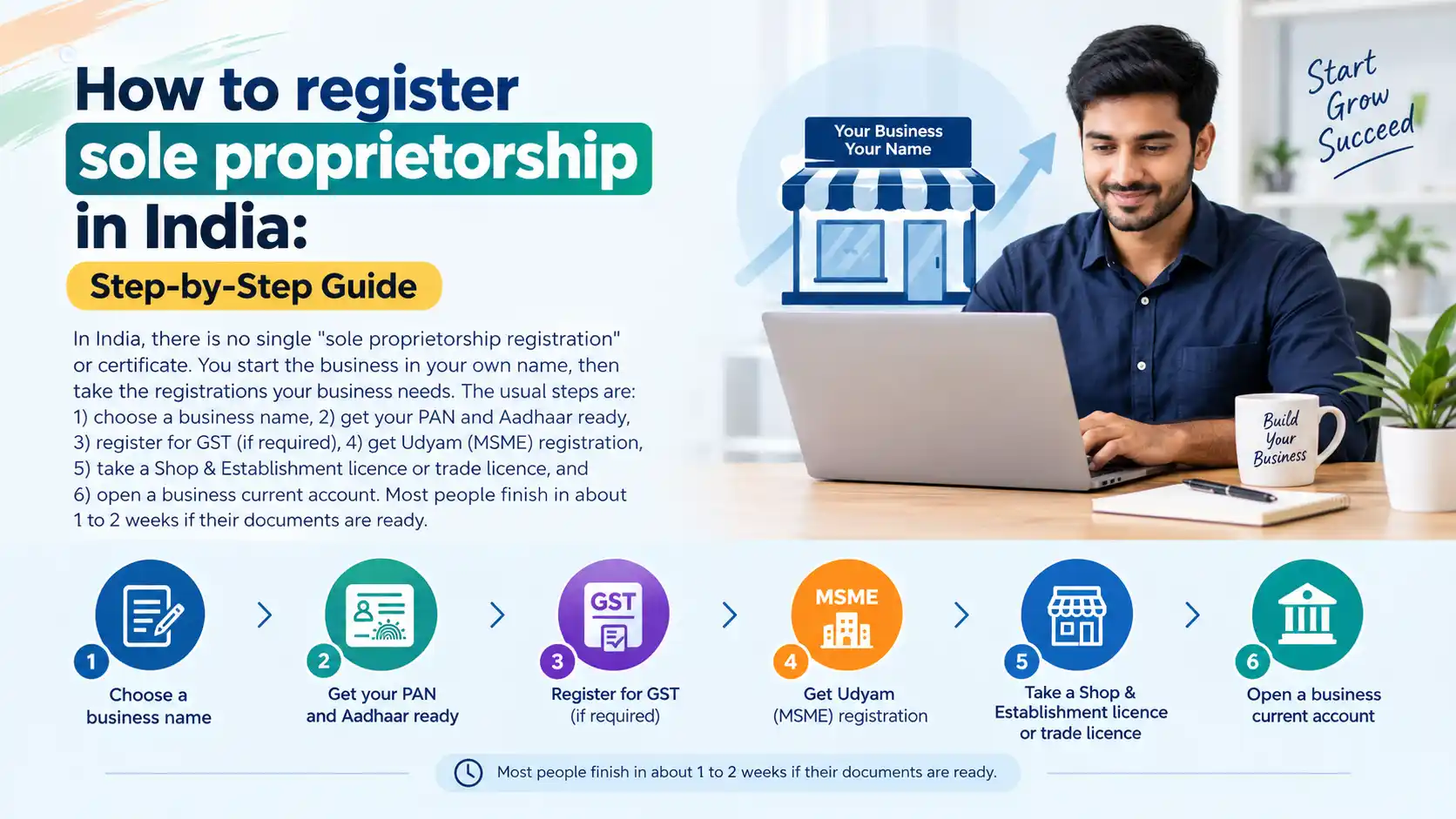
In India, there is no single “sole proprietorship registration” or certificate. You start the business in your own name, then take the registrations your business needs. The usual steps are: 1) choose a business name, 2) get your PAN and Aadhaar ready, 3) register for GST (if required), 4) get Udyam (MSME) registration, 5) take a Shop & Establishment licence or trade licence, and 6) open a business current account. Most people finish in about 1 to 2 weeks if their documents are ready.
What Is a Sole Proprietorship?
A sole proprietorship is a business that is owned and run by one individual. In the eyes of the government, you and the business are the same. You keep all the profit, and you are also personally responsible for all the losses. It is the simplest and most common business type in India, popular with freelancers, traders, shop owners and consultants.
Is Sole Proprietorshipregistration mandatory? No law forces you to “register” a sole proprietorship. But to run it properly, banks, buyers and the government expect at least one business registration, such as GST, Udyam or a Shop & Establishment licence. That is why the steps below matter.
What You Need to Know First About Sole Proprietorship
Before you start, keep these basics in mind:
A sole proprietorship is not a separate legal entity. You and your business are the same in law. That means you are personally responsible for business debts.
There is no incorporation certificate. Banks and marketplaces usually accept your GST certificate, Udyam certificate or shop licence as proof of your business.
Your personal PAN is your business PAN. A sole proprietorship does not receive a separate PAN.
Which registrations you need depends on your business. A freelancer and a food seller will need different things.
If you are still deciding between structures, read our guide on one person company vs sole proprietorship.
Who Can Register as a Sole Proprietor?
You can, if you:
Are an individual (companies, firms and groups cannot be sole proprietors)
Are at least 18 years old
Have a PAN card and an Aadhaar card
Have an address to run the business from (owned, rented or even your home, where local rules allow)
That’s it. There is no minimum capital and no approval needed to begin.
Can foreigners or NRIs register a sole proprietorship? Generally no. A sole proprietorship is meant for resident Indian citizens. Foreign nationals usually enter India through a private limited company or LLP, and NRIs, OCIs and PIOs face extra rules under FEMA. Take professional advice before you start.
How to register sole proprietorship in India
Sole proprietorship registration process explained step by step.
Step 1: Decide your business activity and name
First, be clear about what you want to sell or offer. This decides which registrations you need.
Then choose a business name. A sole proprietorship does not need name approval, but you should still check that nobody else uses a similar name. Search the Trademark Registry and Google, and check if the domain and social media handles are free. This saves you from branding trouble later.
Step 2: Keep your personal documents ready
You will need your PAN, Aadhaar, a passport-size photo, your mobile number linked to Aadhaar, and an email address. Make sure the name on your PAN and Aadhaar match exactly. Mismatches are one of the most common reasons for delays.
Step 3: Fix your business address
Choose the address from where the business will operate. If it is your own property, keep a recent electricity bill or property tax receipt. If it is rented, you will need a rent agreement and a No Objection Certificate (NOC) from the owner. For a home-based business, a utility bill in your name is usually enough.
Step 4: Register for GST (if you need it)
Not every sole proprietor needs GST. You usually need it if:
Your yearly turnover crosses the limit (generally ₹40 lakh for goods and ₹20 lakh for services, and lower in some states), or
You sell goods to other states, or
You sell through e-commerce platforms such as Amazon or Flipkart, or
A client or marketplace asks for a GST number.
You can also take GST voluntarily, which helps if you sell to businesses that want to claim tax credit.
How it works: apply on the official GST portal (gst.gov.in) using your PAN, Aadhaar, address proof and bank details. You get an Application Reference Number (ARN) to track the status. Approval usually takes a few working days if your documents are correct, but an officer can ask questions, which adds time.
Udyam registration is optional but very useful. It gives you an official MSME certificate, helps with bank loans and government schemes, and builds trust with buyers. You can apply online on the Udyam portal, you need your Aadhaar and PAN, and there is no government fee. The certificate is usually issued within a day.
Fees and rules differ from state to state, so check with your local authority.
Step 7: Open a business current account
A separate bank account keeps your business and personal money apart, and it makes tax filing much easier. Most banks ask for your PAN, Aadhaar, address proof, photos and one business proof, such as your GST, Udyam or shop licence certificate. Rules differ by bank, so ask your bank for its exact list.
Step 8: Set up your accounts and tax filing
Your registration is only the beginning. From day one:
Keep invoices, bills and bank statements
Track your income and expenses every month
File GST returns on time, if you are registered
File your income tax return every year. Your business income goes in your personal return.
Documents Checklist for Sole Proprietorship Registration
Document
Why you need it
Needed for
PAN card
Identity and tax
Everything
Aadhaar card
Identity and verification
GST, Udyam, bank
Passport-size photo
Application forms
GST, bank
Business address proof (bill, rent agreement, NOC)
Proves where you operate
GST, licences, bank
Bank account details or cancelled cheque
Links your account
GST, Udyam
Email ID and mobile number
OTPs and updates
Everything
Business name proof or letterhead (if asked)
Shows the trade name
Bank, GST
FSSAI, trade or professional certificates
Needed for specific businesses
Food, regulated trades
Your exact list can change by state, bank and business type, so confirm before you apply.
How Long Does It Take?
Registration
Typical time
Udyam (MSME)
Same day
GST
2 to 5 working days
Shop & Establishment / trade licence
3 to 7 working days (Depends on the state)
Current account
A few days, depending on the bank
If all your documents are ready and correct, you can be set up within one to two weeks. Delays almost always come from mismatched names, missing address proof or unanswered queries.
Typical processing times by registration: Shop & Establishment licence 3 to 7 working days (depends on the state), GST 2 to 5 working days if your documents are valid, Udyam on the same day, professional tax 5 to 10 days, and FSSAI or Import Export Code 7 to 15 days. These are rough ranges and can change.
Taxes and Yearly Compliance After Registration
Registration is only the start. Here is what you need to do every year:
Income tax: your business profit is added to your personal income and taxed at slab rates. File your income tax return every year (ITR-3, or ITR-4 if you use presumptive tax).
Presumptive tax: small businesses can declare profit as a fixed share of turnover (6% of digital receipts and 8% of other receipts) instead of keeping detailed books. This used to be Section 44AD. Since 1 April 2026, it sits in Section 58 of the Income-tax Act, 2025.
Books: keep proper books of accounts if you do not opt for presumptive tax.
Advance tax: pay it in instalments during the year if your tax for the year is expected to be above ₹10,000.
Audit: needed only above set turnover limits. For business turnover this is generally ₹1 crore, with a higher limit if most receipts are digital.
The new Income-tax Act changed section numbers, and limits can change, so confirm the current rules with your CA.
What Does It Cost?
The government charges no fee for GST or Udyam registration. Your main costs are local licences, any extra licence your business needs, and professional help. Here is a simple view:
Mismatched names. Your name should be written exactly the same on PAN, Aadhaar and bank records.
Weak address proof. An old or unclear bill can lead to rejection or queries.
Skipping GST when you need it. Selling online or to other states without it can bring penalties.
Mixing personal and business money. It makes tax filing messy.
Not keeping records. Even a small business should track invoices and expenses.
Forgetting renewals and returns. Licences expire and GST returns have due dates.
Staying a sole proprietor too long. When your risk or income grows, think about moving to an OPC, LLP or private limited company.
Should You Do It Yourself or Take Help?
You can do all of this yourself, and many people do. It works well if you have one simple registration and some free time. Help is worth it if you need several registrations together, your state’s process is confusing, your application got stuck or rejected, or you simply want to start your business instead of chasing paperwork.
Frequently Asked Questions
Is it mandatory to register a sole proprietorship?
No. No law requires it. You only need registrations like GST or a shop licence if your business falls under those rules.
Is a sole proprietor 100% owner?
Yes. You own the whole business and keep all the profit, but you are also fully responsible for all its debts.
How do I start as a sole proprietor?
Choose a business name, keep your PAN and Aadhaar ready, take the registrations you need (GST, Udyam, shop licence), then open a current account.
How much does it cost to register a sole proprietorship in India?
GST and Udyam registration are free on the government portal. Local licences vary by state, and professional help costs extra.
How much turnover can a sole proprietor have?
There is no limit. Turnover only decides which rules apply, such as GST registration (generally above ₹40 lakh for goods or ₹20 lakh for services) and tax audit limits.
Can I convert my sole proprietorship to a Pvt Ltd company?
Yes. You set up a new private limited company and transfer your business, assets and licences to it.
Need Help Registering Your Sole Proprietorship?
Cotaxo can handle your GST, Udyam, licences and bank documents from start to finish, so you can focus on your business.
This article is for general information only and is not legal or tax advice. Rules, limits and fees change, so please confirm the latest position on the official portals or with a qualified professional.
Submit your Details to get an Instant All-inclusive Quote and a FREE Expert consultation