Penalty for Late Filing of Income Tax Return: Fees, Interest & Last Date (AY 2026-27)
Reviwed by FCS Yogesh Kumar
Missed the ITR deadline? It feels stressful, but it’s fixable. The penalty for late filing of an income tax return is a Section 234F fee plus interest on any unpaid tax, and the total only gets bigger the longer you wait. For AY 2026-27 you can still file a belated return until 31 December 2026. The late fee is a flat ₹5,000, or ₹1,000 if your total income is up to ₹5 lakh, and interest applies only to tax you still owe. This guide walks you through exactly what you’ll pay, what else can go wrong, and how to fix it.
Even if your final tax liability is ₹0, the Section 234F late fee still applies. If your income before deductions is above the basic exemption limit, you were required to file, so a belated return costs ₹1,000 (total income up to ₹5 lakh) or ₹5,000 (above ₹5 lakh). The e-filing portal calculates the fee automatically, and you need to pay it before you can submit the return.
What Is the Penalty for Late Filing of Income Tax Return?
Your total income
Late filing fee (Section 234F)
Above ₹5 lakh
₹5,000
Up to ₹5 lakh
₹1,000
Below the basic exemption limit
Nil
On top of the fee, you pay interest under Section 234A at 1% per month (or part of a month) on the tax still unpaid after TDS and advance tax. If you owe nothing, there’s no 234A interest, but the fee still applies.
Technically the 234F amount is a “fee”, not a penalty. People search for it as a penalty, so that’s the word you’ll see most places, but it’s a fixed charge that applies automatically once you file after the due date.
ITR Filing Last Date for AY 2026-27 (Due Dates)
You’re late the moment you miss the last date that applies to you. Here’s the calendar for this year:
Who
Original due date
Individuals and HUFs filing ITR-1 or ITR-2
31 July 2026
Individuals and HUFs filing ITR-3 or ITR-4 (no audit)
31 August 2026
Cases requiring audit
31 October 2026, extended to 21 November 2026 for the category covered by CBDT Circular No. 07/2026
Transfer pricing cases
30 November 2026
Belated return (Section 139(4))
31 December 2026
Revised return
31 March 2027 (a fee applies after 31 December 2026)
Updated return (ITR-U)
31 March 2031
The audit-case extension was announced by the Income Tax Department on 29 September 2026 through CBDT Circular No. 07/2026. It applies to the persons mentioned at Sl. No. 2 in the table under Explanation 2 to Section 139(1), and the related audit report date moved from 30 September to 21 October 2026. If you’re an audit case, read the circular on the e-filing portal to confirm which bucket you fall in.
One thing worth knowing: a new Income-tax Act, 2025 came into force on 1 April 2026, but your AY 2026-27 return is still filed under the old 1961 Act. That means the section numbers you’ll see (234A, 234F, 139(4)) are still the ones that apply to this filing.
ITR Filing Statistics: When Taxpayers Actually File
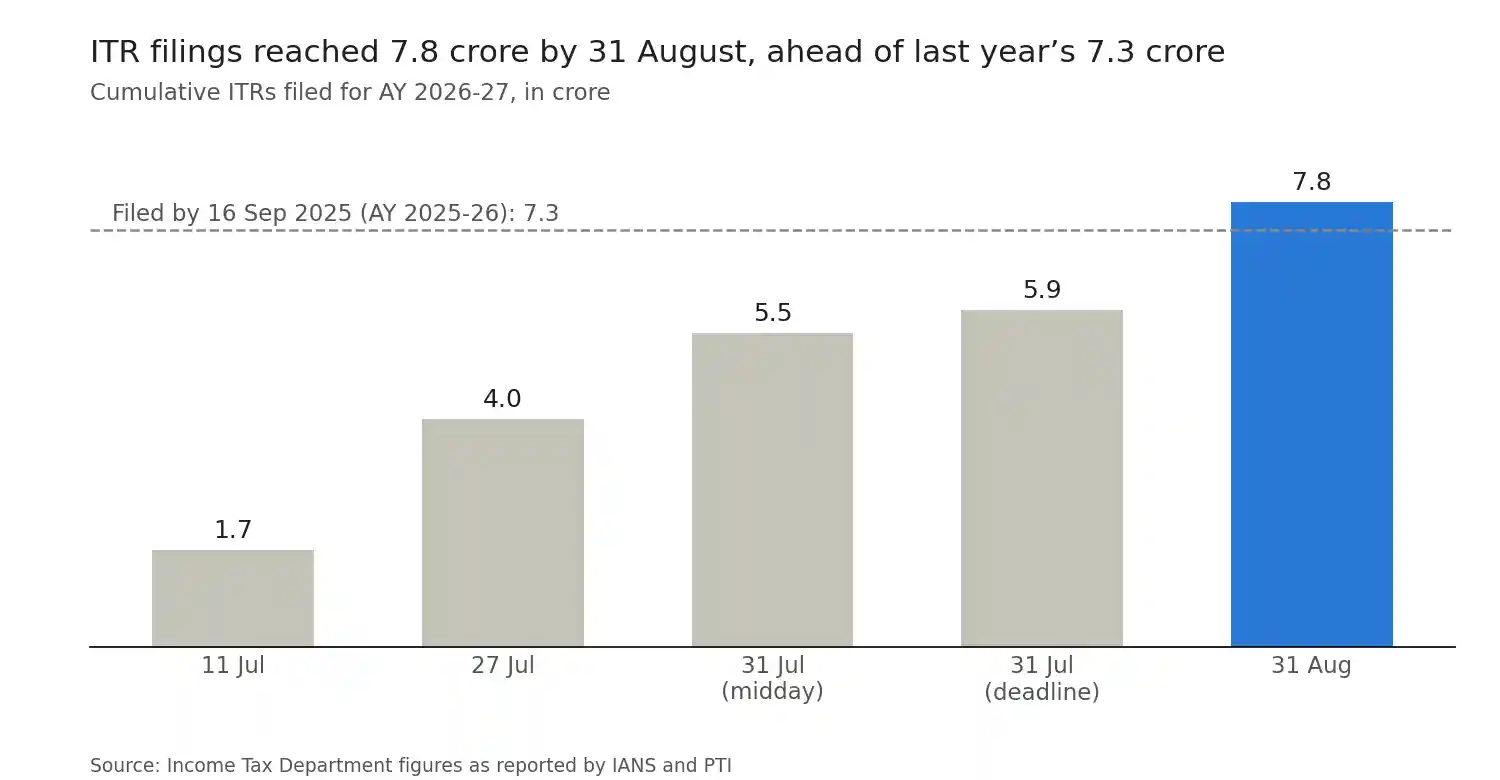
Most people file at the last minute: the department reported over 42 lakh returns on 30 July alone, the day before the deadline (IANS). Total filings keep rising too. The e-filing portal showed 9.19 crore returns in FY2024-25, up from 8.52 crore in FY2023-24 and 7.78 crore in FY2022-23 (IANS). Note that these are returns filed, not the number of people who pay tax.
What Counts as a "Late" Return?
A return filed after your original due date is called a belated return and is filed under Section 139(4). It’s the same ITR form you’d have used on time, you just tick the box saying it’s being filed after the due date. Filing a belated return is always better than not filing at all.
Under the Income Tax Act, the penalty for late filing of return has two direct costs: the 234F fee and 234A interest. It can also affect carry-forward of losses and refunds, which we cover below.
Section 234F: Late Filing Fee for Income Tax Return in Detail
Section 234F is a flat fee. It doesn’t depend on how much tax you owe or how late you are. Whether you file one day or three months after the deadline, the amount is the same.
Total income more than ₹5 lakh: ₹5,000
Total income up to ₹5 lakh: ₹1,000
Income below the basic exemption limit: no fee
“Total income” here means income after deductions, not your gross salary. Also note that the fee is payable even if your tax liability is nil. For example, if your total income is ₹4.5 lakh and your tax comes to zero because of the rebate, you can still owe the ₹1,000 fee, because your income is above the exemption limit. Check the exemption limit for the regime you’re filing under before assuming you owe nothing.
The fee has to be paid before the return can be filed, so factor it into your filing day.
Interest You May Pay on Top for Late Filing of Income Tax Return
The fee is the visible cost. Interest is the one people underestimate.
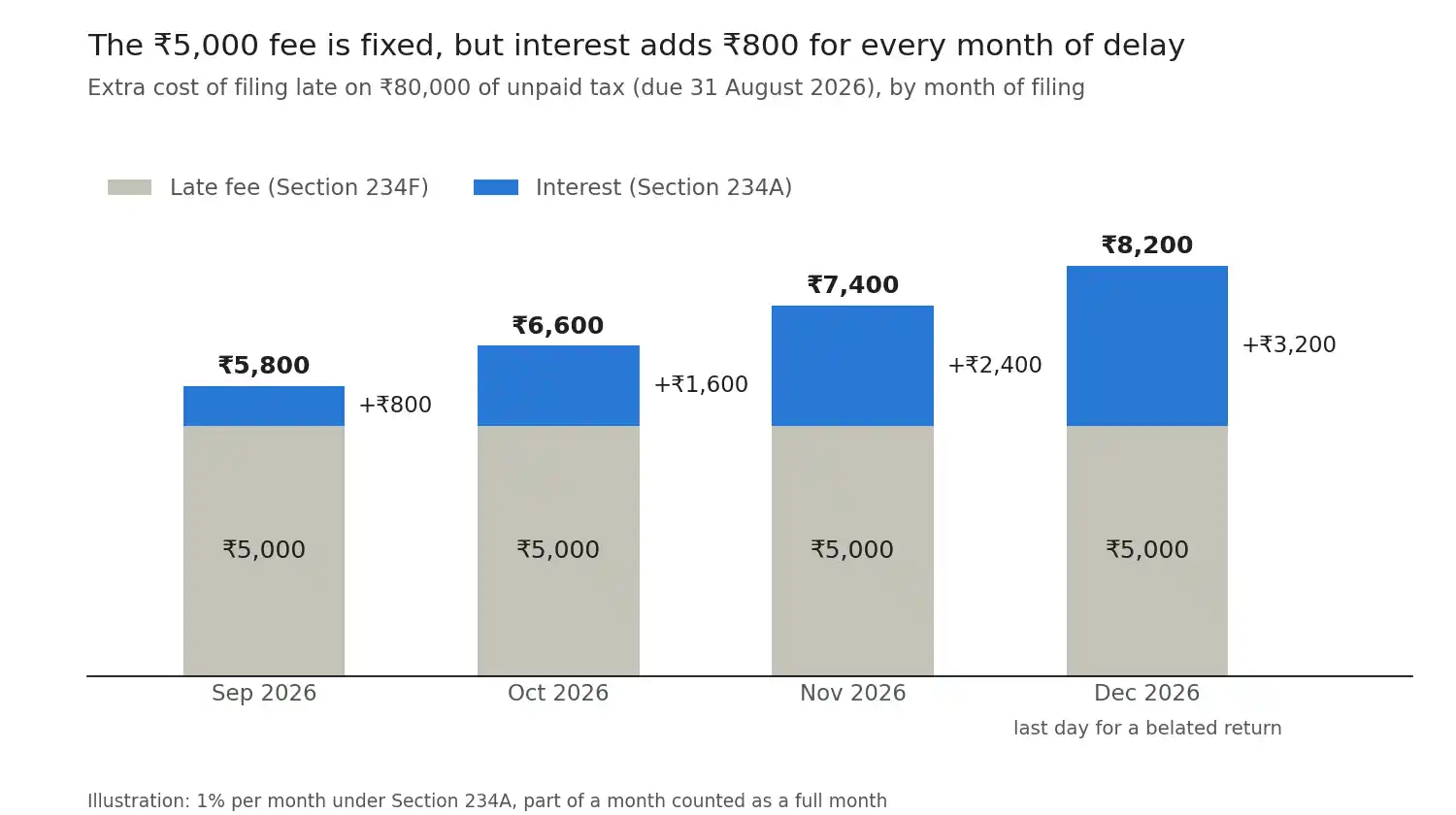
Section 234A (late filing). If you owe tax when you file late, you pay 1% per month on the unpaid amount, counted from the due date to the date you file. A part of a month is treated as a full month.
Section 234B (advance tax shortfall). If you were supposed to pay advance tax and paid less than 90% of your assessed tax during the year, interest is charged at 1% per month from 1 April of the assessment year until you pay.
Section 234C (late advance tax instalments). If individual instalments were paid late or fell short, 234C interest applies to each missed instalment.
Salaried people whose employer deducted the full tax usually don’t face 234B or 234C. Freelancers, professionals, landlords and traders with taxable income outside salary are the ones who get caught by all three.
Worked Examples
Numbers make this clearer. These are simple illustrations for the current year.
Example 1: Salaried employee, no tax due. Total income ₹9 lakh, TDS covers the full tax. Files ITR-1 on 20 August.
234F fee: ₹5,000
234A interest: nil, since no tax is unpaid
Total cost: ₹5,000
Example 2: Freelancer with tax due. Total income ₹12 lakh, ITR-3 due 31 August. Self-assessment tax of ₹80,000 is unpaid, and the return is filed on 15 November.
234F fee: ₹5,000
234A interest: ₹80,000 × 1% × 3 months (September, October, and part of November) = ₹2,400
Extra cost: ₹7,400, plus the ₹80,000 tax itself
Example 3: Low income. Total income ₹4.5 lakh, tax nil after rebate, filed in December.
234F fee: ₹1,000
Total cost: ₹1,000
These examples don’t include 234B and 234C, which depend on your advance tax history. Use the Income & Tax Calculator on the e-filing portal for your exact figure.
The fee stays flat, so the real cost of waiting is interest: in this example, filing in December instead of September costs ₹2,400 more.
Other Consequences Beyond the Fee
The money you pay is often the smaller problem. Late filing can cause these headaches too:
Loss carry-forward. On a belated return you generally can’t carry forward most losses (house property loss is the usual exception). If you had capital losses or business losses, this can cost you far more than ₹5,000 in future tax savings.
Slower refunds. Refund processing waits until your return is filed and verified, so every extra week of delay pushes your money back.
Notice risk. Non-filers with high-value transactions or large TDS credits are more likely to get a communication from the department.
Loans and visas. Banks, lenders and embassies often ask for filed returns as income proof. A gap in your filing history can slow these down.
Prosecution (rare). Wilful failure to file can, in serious cases, lead to prosecution under Section 276CC. This generally isn’t a worry for an ordinary taxpayer who files before the assessment year ends, but it’s a reason not to ignore the deadline entirely.
Penalty for Late Filing of Income Tax Return for Individuals, Companies and Others
Individuals and HUFs. The penalty for late filing of income tax return for an individual is ₹5,000, or ₹1,000 if total income is up to ₹5 lakh.
Companies, firms and LLPs. The penalty for late filing of income tax return for a company follows the same Section 234F structure, so a company with total income above ₹5 lakh pays ₹5,000. Interest under 234A, 234B and 234C works the same way. Non-filing can also bring other compliance trouble, so companies should treat the date seriously.
Senior citizens and NRIs. There’s no special discount on the fee. Senior citizens fall under the same income-based slabs, and non-residents follow the same belated return route.
TDS/TCS returns. If you’re a deductor, late filing of a TDS statement is a different matter: it attracts a fee of ₹200 per day under Section 234E (capped at the TDS amount), and a further penalty can apply under Section 271H. Need help with pending TDS returns? See our TDS return filing service.
GST returns. Running a business? Late GST returns have their own late fees and caps, separate from the ITR fee in this guide. See our GST return filing dates guide for the due dates and late fee rules.
How to File a Belated Income Tax Return, Step by Step
Go to e-File → Income Tax Returns → File Income Tax Return, and choose AY 2026-27.
Pick “Original/Belated” as the filing type and tick the section as 139(4) (filed after the due date).
Select the correct form (ITR-1 to ITR-7) and fill in or verify the pre-filled details against Form 26AS and AIS.
Pay any tax, 234F fee and interest using the e-Pay Tax service. The portal now has one payment module that handles dues under both the 1961 Act and the 2025 Act.
Submit and e-verify using Aadhaar OTP, net banking or another option. An unverified return is treated as not filed, so don’t skip this.
Save the acknowledgement for your records.
Prefer not to do it yourself? Our team can file the belated return, work out the fee and interest, and e-verify it for you: see our income tax return filing service.
Can You Revise a Belated Return?
Yes. A return filed under Section 139(4) can still be revised under Section 139(5). Following the Finance Act 2026, the deadline for revising your AY 2026-27 return is 31 March 2027. Revisions up to 31 December 2026 are free; revisions between 1 January and 31 March 2027 attract a fee under the new Section 234I, reported as ₹1,000 for income up to ₹5 lakh and ₹5,000 otherwise.
That’s a real improvement over the old rules, where a belated return filed in late December left you almost no time to correct a mistake.
What If You Miss 31 December 2026?
After 31 December, the regular belated route closes. You still have options:
Updated return (ITR-U) under Section 139(8A). You can file this up to 31 March 2031 for AY 2026-27, but it carries additional tax of 25% to 70% on the tax and interest due, and it can’t be used to claim a refund. It’s an expensive last resort, so file belated before the deadline if you can.
Condonation request. In genuine hardship cases, particularly refund-related ones, you can apply to the Income Tax Department to condone the delay. It isn’t automatic, and it isn’t a way around the late fee.
Waiver applications. The department recently notified a revised Form 161 for applications for waiver of penalty under section 440(2) of the Income-tax Act, 2025. That applies to penalties under the new Act, so check your situation with a professional.
How to Avoid the Penalty for Late Filing of Income Tax Return
Put your ITR due date in your calendar in June, not July.
Collect Form 16, Form 26AS, AIS, interest certificates and capital gains statements early.
Pay advance tax on time if you have income beyond salary.
If you can’t pay the full tax, still file. The late fee and interest grow if you don’t, and you can pay the balance with the return.
Check the pre-filled details in AIS and fix mismatches before submitting.
Keep a reminder for the revised-return window, so a small error doesn’t turn into a notice.
Frequently Asked Questions(FAQs)
What is the penalty for late filing of income tax return?
It’s a Section 234F fee of ₹5,000 (₹1,000 if total income is up to ₹5 lakh), plus 1% per month interest under Section 234A on any unpaid tax.
What is the last date to file a belated ITR for AY 2026-27?
31 December 2026, under Section 139(4).
Is the late fee applicable if I have no tax to pay?
234F fee applies to any return filed after the due date, even if your tax liability is nil. It doesn’t apply if your income is below the basic exemption limit.
Can the Section 234F fee be waived?
routine. It’s an automatic statutory fee, and relief is only possible in limited cases through a formal application.
Can I carry forward losses if I file late?
Generally no, apart from house property loss. That’s one of the biggest hidden costs of filing late.
Can I file after 31 December 2026?
Only through an updated return (ITR-U), which carries additional tax and doesn’t allow a refund claim.
Is the penalty different for companies?
The Section 234F structure is the same. Most companies have income above ₹5 lakh, so ₹5,000 is the usual figure.
Does the new Income-tax Act 2025 change the penalty for AY 2026-27?
No. Your AY 2026-27 return is still governed by the 1961 Act, so sections like 234A and 234F continue to apply.
Final Thoughts
The income tax return penalty for filing late is ₹1,000 to ₹5,000 plus interest, which is much less than the trouble of not filing at all. If you’ve missed the date, file the belated return before 31 December 2026, pay what’s due, and e-verify. If your situation is complicated (business income, audit, capital losses, foreign assets), speak to a tax professional before you file.
Need help filing on time? Missing dates is expensive and stressful. Our experts can file your belated return, calculate the exact 234F fee and interest, and e-verify it for you. See our income tax return filing service or talk to a Cotaxo expert for a free consultation.
FCS Yogesh Kumar is an experienced Company Secretary and corporate law professional with expertise in Corporate Law, Company Secretarial Practices, FEMA Regulations, Stamp Duty Matters, Corporate Governance, and Statutory Compliance.
He possesses practical knowledge of corporate legal frameworks, regulatory requirements, and business compliance procedures in India. His areas of expertise include Private Limited Company Registration, LLP Incorporation, MCA & ROC Compliance, Annual Filings, and Corporate Regulatory Matters.
With a solution-oriented approach, he focuses on simplifying complex legal and compliance requirements, providing valuable insights to entrepreneurs, startups, and business owners. His professional knowledge helps readers better understand corporate regulations, statutory obligations, and compliance best practices in India.
Submit your Details to get an Instant All-inclusive Quote and a FREE Expert consultation