GST • Income Tax • Registration • Payroll • Advisory • FSSAI • Virtual CFO

Sole Proprietorship vs LLC: Complete Guide and Best Alternatives for LLC in India

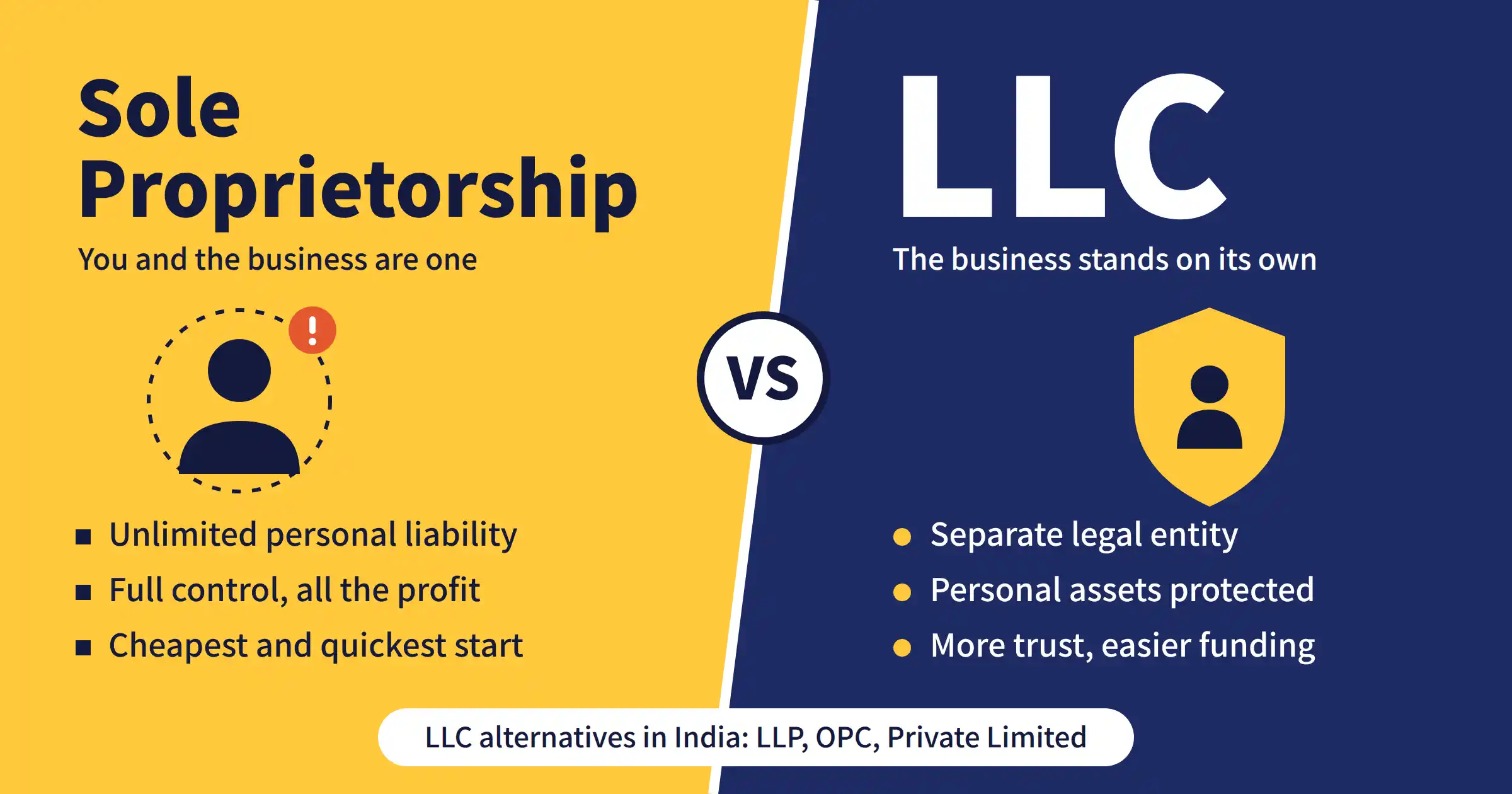
A Limited Liability Company (LLC) is a US business structure created under US state law. While India doesn’t have a US-style LLC, it offers four similar (not exact) options. sole proprietorship is an unincorporated business owned by one person. The proprietor controls the business and remains responsible for its debts. An LLC (limited liability company) is a separate legal entity that protects your personal assets from business debts. But the LLC is a US structure, so in India the real choice is between a sole proprietorship and its Indian alternatives: OPC, LLP, Partnership Firm and Private Limited Company.

The key difference between an LLC and a sole proprietorship mainly lies in taxation, legal identity, liability, ownership and compliance.

NOTE: Keep in mind that there is no exact alternatives to a LLC in India. The closest alternative to LLCs in India in terms of solo entrepreneurship is a one person company (OPC), but the difference is, it requires a nominee director, and if you want to add a partner then it will convert to a standard company it is no longer called a one person company (OPC). If your approach is Operational and Partnership Flexibility then the closest to an LLC is a Limited Liability Partnership (LLP), but for an LLP you need two partners, you cannot have a single person LLP in India.

Key Takeaways

  • US LLCs provide a separate legal identity and generally protect owners or partners from paying for business debts and losses out of their own pockets.
  • Sole proprietorships provide direct control over the business, but the owner also remains vulnerable to business debts & any obligations related to the business
  • India has no LLC structure, but OPC, LLP, and PVT LTD provide features similar to LLC for different requirements.
  • Tax structure differs between sole proprietorships, LLCs and Indian alternatives.
  • The right structure for your business depends on ownership, taxation, liability, funding, management and compliance requirements.

Sole Proprietorship vs LLC: Side-by-Side Comparison

Feature

Sole Proprietorship

LLC (US)

Owners

One person

One or more members

Legal identity

Same as the owner in the eyes of law

Separate from the owners

Liability

Unlimited, personal assets at risk

Limited, personal assets mostly protected

Setup

Very easy: No special registration for the structure

Filing with a US state, plus fees

Tax

Added to the owner’s personal income

Pass-through by default, or taxed like a corporation by choice

Compliance

Very low

Moderate, with yearly state filings in most states

Raising money

Hard, no shares, no investors, no partners

Easier, can add members and investors

Credibility

Basic

Higher with banks and clients

If the owner leaves or die

Business usually ends

Business can continue

Best for

Freelancers, small shops, trial businesses

Solo founders and small teams who want protection from business debt.

What they share: both are easy to start, both give the owner strong control, and in the US both can pass profit straight to the owner’s tax return. The big gap is legal separation and liability.

Sole Proprietorship vs Indian Alternatives

Structure

Owners

Liability

Separate legal entity

Compliance

Best for

Sole Proprietorship

1

Unlimited

No

Very low

Freelancers, small shops

Partnership Firm

2 or more

Unlimited

No

Low

Small family or friend businesses

LLP

2 or more

Limited

Yes

Medium

Professionals, agencies, small partnerships

OPC

1 (plus a nominee)

Limited

Yes

High

Solo founders wanting protection

Private Limited

2 to 200 shareholders

Limited

Yes

Highest

Startups and businesses raising funds

Sole Proprietorship vs LLC: Key Differences Explained

The differences between an a sole proprietorship and an LLC affect ownership, taxation, liability, compliance, and business growth: 

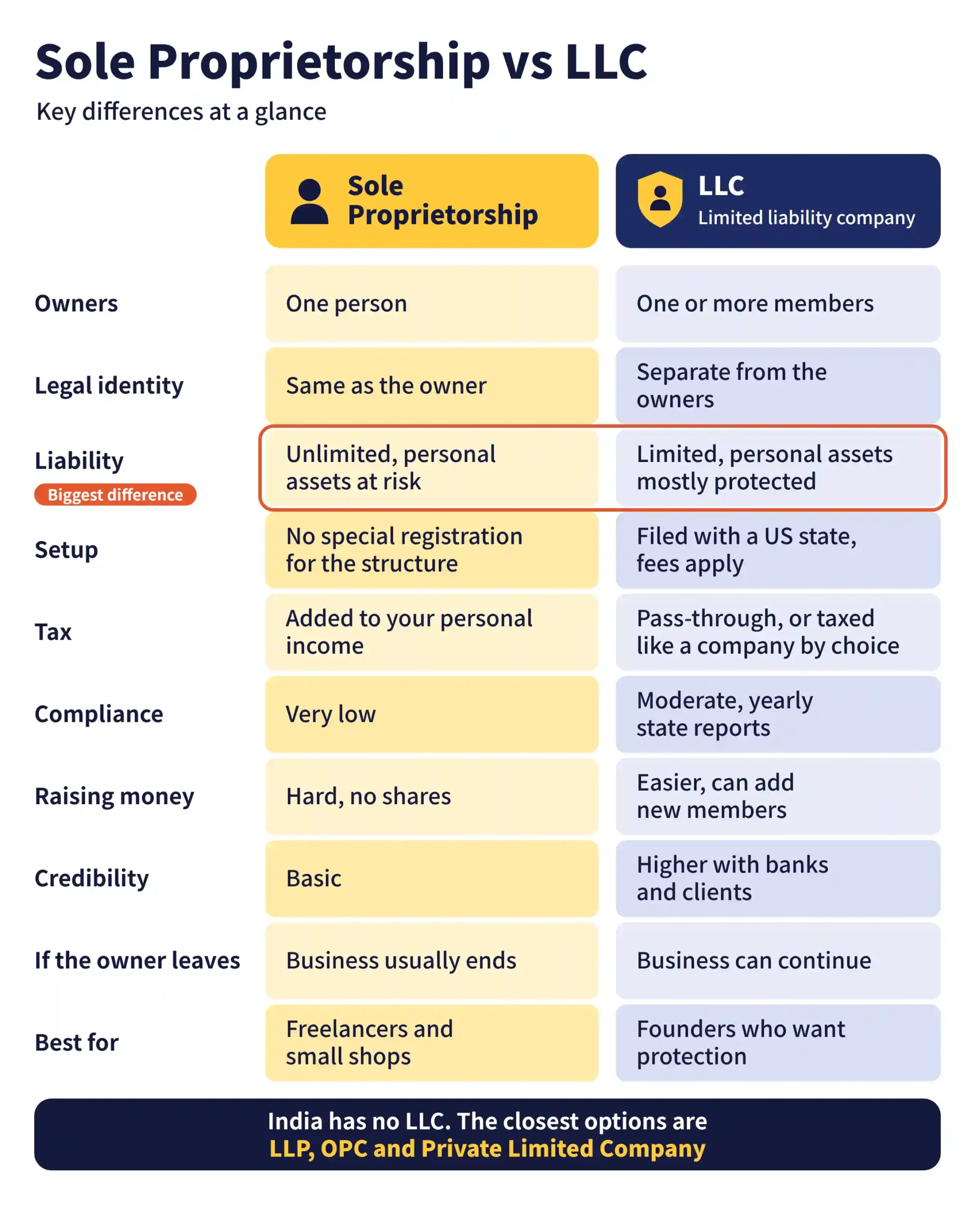
Sole proprietorship vs LLC key differences chart covering liability, tax, compliance and setup

Ownership

Sole proprietorship: only one person can own it. If you include a partner, it becomes a partnership.

LLC: one or many members can own it; there is no limit, and other companies can also become members.

In India: a sole proprietorship has one owner. An OPC also has one owner. An LLP needs two or more partners, and a Private Limited needs two or more shareholders.

Sole proprietorship: you and the business are the same person in the eyes of law. Contracts, loans, and bank accounts are in your name.

LLC: the business is its own legal person. It can own assets, sign contracts, and be sued in its own name.

In India: LLP, OPC, and Private Limited all have a separate identity. A sole proprietorship and a partnership firm do not.

Liability

Sole proprietorship: liability is unlimited, and the owner is responsible for all liabilities. A business debt can be recovered from the owner’s personal savings, property, or vehicle.

LLC: liability is limited. Creditors can usually claim only what the business owns, and members risk only the money they invested.

In India: LLP partners, OPC owners, and company shareholders get limited liability protection, but this disappears if you commit fraud or sign a personal guarantee.

Setup and Registration

Sole proprietorship: Easiest way to start a business; there is no special registration for the structure itself. You start working and then take the licenses your business needs.

LLC: it must be formed by filing with a US state, and a name and agreement are usually needed.

In India: Registering an OPC, LLP, or company means doing official government paperwork with the MCA (Ministry of Corporate Affairs). This process takes more time and requires a lot more documents than starting a sole proprietorship.

Cost

Sole proprietorship: the lowest cost to start and run. You mostly pay for licenses and your own tax return.

LLC: it costs more because of state filing fees, yearly fees, and often professional help.

In India: An LLP is less costly to run than a company, while a Private Limited Company costs more to operate because it requires annual audits and yearly government filings.

Taxation: Sole Proprietorship vs LLC Taxes

Sole proprietorship: profit is added to your personal income and taxed at your slab rate.

LLC: by default profit passes through to the owners’ personal tax returns. An LLC can also choose to be taxed like a corporation.

In India: a sole proprietor pays slab rates and can use presumptive taxation. An LLP pays a flat rate, and a company pays corporate tax.

Compliance and Paperwork

Sole proprietorship: very little paperwork. You file your income tax return and GST returns if you are registered.

LLC: moderate. Most US states need a yearly report and a fee.

In India: an LLP files two annual forms, while a company also needs board meetings, a statutory audit, and ROC filings. Missing deadlines leads to daily penalties.

Raising Money

Sole proprietorship: hard. You cannot sell shares, and you depend on your own savings and bank loans.

LLC: easier. You can bring in new members who invest money for a share of the business.

In India: investors prefer a Private Limited Company because they can hold shares. An LLP and an OPC have limits here, and an OPC must convert before it takes outside equity.

Credibility and Trust

Sole proprietorship: fine for small clients and local customers, but banks and big companies may ask for more proof.

LLC: looks more professional, which helps with banks, vendors, and tenders.

In India: a registered LLP or company is often needed for large contracts, government tenders, and larger loans.

Continuity

Sole proprietorship: the business depends fully on its owner. If you die or stop working, it ends.

LLC: the business continues even if a member leaves, as long as the agreement allows it.

In India: LLPs and companies have perpetual existence. An OPC names a nominee to take over.

Control and Flexibility

Sole proprietorship: you have complete control and can change direction whenever you want.

LLC: control is shared by the members as per the agreement, so decisions can take longer.

In India: in an LLP the partners follow the LLP agreement. In a company, directors run the business and shareholders have rights, so decisions follow more rules.

Sole Proprietorship vs LLC: Pros and Cons Compared

Deciding between a sole proprietorship vs LLC (or its Indian equivalents like an OPC or LLP) comes down to balancing risk against operational cost. While one structure offers ultimate simplicity, the other provides critical asset protection. Let’s break down the advantages and disadvantages of each business type so you can make an informed choice.

FeatureSole ProprietorshipLLC (US) / Indian Alternatives
Setup CostVery Low / FreeModerate to High
Personal RiskHigh (Unlimited Liability)Low (Limited Liability)
TaxesFiled on personal returnFlexible choices / Flat rates
CredibilityLow (Harder to get loans)High (Attracts investors)


The Pros and Cons of a Sole Proprietorship

Advantages

  • Lowest cost and easy to start
  • Full control and quick decisions
  • Less paperwork and compliance
  • Simple tax filing, with presumptive tax options for small businesses

Disadvantages

  • Personal assets are at risk
  • Banks, investors, and big clients may see it as less credible to provide loan or invest money
  • Hard to raise money, because you cannot sell shares
  • Business depends on one person

Example: Neha runs a home bakery in Delhi. She is the only owner, uses her own PAN, keeps a current account in the bakery’s name, and files her income tax return every year. Her setup is easy, but if a supplier sues her for a large unpaid bill, her personal assets can be claimed.

The Pros and Cons of an LLC (and Indian Alternatives)

Advantages

  • Limited liability and Protects personal assets
  • Less paperwork than a corporation
  • Tax choices
  • Looks more professional
  • Banks and investors trust easily

Disadvantages

  • Costs more to set up than a sole proprietorship
  • Yearly filings and fees in most US states
  • Liability protection can be lost if you mix personal and business money
  • If its multi member LLC, decision must be mutual you can’t just decide and execute it even if it is in best interest of business structure

Single-member LLC: the best of both worlds? A single-member LLC has one owner, like a sole proprietorship, but still gets limited liability. That is why solo founders in the US often prefer it. India does not have this exact structure. The closest match is an OPC (One Person Company), explained below.

How to Choose the Right Structure

Ask yourself three questions: how much could I lose, how fast do I want to grow, and how much paperwork can I handle? Then match your answers below.

If this sounds like you

Choose

Testing an idea, working alone, low risk and low cost

Sole Proprietorship

Starting with a friend or family member, with a clear deed

Partnership Firm, or better, an LLP

Offering professional services with a partner and want personal protection

LLP

Working alone but want limited liability and a company name

OPC

Planning to raise investment, hire a large team, or sell to big corporates

Private Limited Company

Real-life examples

  • A freelance photographer in Noida starts as a sole proprietor. The risk is low and the setup is quick.
  • Two chartered accountants in Gurugram open a practice together. An LLP gives them protection with lower compliance.
  • A founder in Bengaluru builds an app and wants angel funding. A Private Limited Company is the only practical route.

What Is an LLC (Limited Liability Company)?

An LLC is a business structure, mostly used in the United States, that blends the simplicity of a sole proprietorship with the protection of a company. The business is a separate legal entity, so its debts belong to the LLC, not to you.

The owners of an LLC are called members. An LLC is created by filing with a US state, and each state has its own rules and fees.

Key features of US LLC

  • Limited liability. Members are generally not personally responsible for business debts or lawsuits. They can lose what they invested, but usually not their personal assets.
  • Separate legal entity. The LLC can own property, open bank accounts, sign contracts, and sue or be sued in its own name.
  • One or many owners. An LLC can have a single member or several. Companies can also be members.
  • Flexible taxation. By default, profits pass through to the owners and are taxed on their personal returns. An LLC can also choose to be taxed like a corporation.
  • Flexible management. There are no strict board meetings or rules like a corporation has.
  • Credibility. Banks, partners, and customers often trust an LLC more than an individual trader.

What Is a Sole Proprietorship? and its Features

A sole proprietorship is a business owned and run by one person. There is no separate company. The owner and the business are the same in the eyes of the law.

If you sell clothes from a shop, take freelance design work, run a tiffin service, or give tuitions, and you have not set up a company or partnership, you are most likely a sole proprietor.

Key features of a sole proprietorship

  • One owner. You take every decision and keep every rupee of profit.
  • No separate legal identity. The business cannot own property, sign contracts, or be sued apart from you.
  • Easy and cheap to start. There is no special law or certificate that creates a sole proprietorship. You start trading and then get the registrations your work needs, such as GST or Udyam.
  • Taxed as you. Business profit is added to your personal income and taxed at your slab rate.
  • Unlimited liability. If the business cannot pay its debts, your personal savings, gold, vehicle, or even your house can be used to pay them.
  • Ends with you. The business has no life of its own. If the owner dies or leaves, it stops.

How to Register for Sole Proprietorship and LLCs Alternatives in India

Sole Proprietorship

  1. Keep Your (owner’s) PAN, Aadhaar and address proof ready.
  2. Choose your business name and set up a business address.
  3. Get Udyam registration online. It is free.
  4. Apply for GST if your turnover or type of sale requires it.
  5. Take the local licences your work needs, such as Shop and Establishment registration, a trade licence, or FSSAI for food.
  6. Open a current account in the business name, using proof such as GST, Udyam, or a shop licence.

If you want help setting this up properly, see our sole proprietorship registration service.

LLP

  1. Get digital signatures and DIN numbers for the designated partners.
  2. Reserve the LLP name on the MCA portal.
  3. File the incorporation form and the LLP agreement online.
  4. Receive the certificate of incorporation, then get PAN and TAN, open a bank account, and apply for GST if needed.

OPC and Private Limited Company

  1. Get digital signatures and DIN numbers for all directors.
  2. Reserve the company name on the MCA portal.
  3. File the incorporation application with the company’s Memorandum and Articles of Association. For an OPC, include the nominee’s consent.
  4. Receive the certificate of incorporation with PAN and TAN, then open a bank account and register for GST if needed.

Notes for Delhi Businesses

  • Company and LLP filings are done online through the MCA portal and are handled by the Registrar of Companies (ROC) for your region.
  • Shop and Establishment registration with the Delhi government and MCD trade licences depend on your type of business and location, so check what applies before you open.
  • Rules and fees change, so confirm current requirements with a professional or the official portals.

Frequently Asked Questions

Which is best, sole proprietorship or LLC?

Neither is best for everyone. A sole proprietorship is best if you want to start fast, spend little, and keep paperwork light. An LLC is best if you want to protect your personal assets and look more credible. If your risk is low, start as a sole proprietor. If real money, debt, or big clients are involved, choose a limited liability structure. In India, that means an LLP, OPC, or Private Limited Company.

The biggest disadvantage is higher cost and more paperwork than a sole proprietorship. You pay setup and yearly fees, and you must follow filing rules. Also, your liability protection can weaken if you mix personal and business money or sign a personal guarantee. India has no LLC, but an LLP or company has the same trade-off.

The main disadvantage is unlimited liability: your savings and property can be used to pay business debts. Other drawbacks include difficulty raising money, less trust from banks and large clients, and a business that ends when you step away. All the risk and workload also stay with one person.

The difference is legal separation. In a sole proprietorship, you and the business are one, so you carry unlimited liability. In a limited liability company, the business is a separate legal entity, so your personal assets are mostly protected. An LLC costs more to set up and run. In India, the nearest options are an LLP, OPC, and Private Limited Company.

For most small businesses, a sole proprietorship is the better starting point because it is cheap, simple, and quick. Switch to an LLP, OPC, or Private Limited Company when your income, loans, or client contracts grow. If you start with a partner or significant debt, choose a limited liability structure from day one.

It depends on your goals. Choose a sole proprietorship if you work alone, have low risk, and want low costs. Choose a Private Limited Company if you want limited liability, plan to raise funds, or want bigger clients to trust you. Remember that a Private Limited Company needs at least two directors, an audit, and yearly filings with the ROC.

No. LLC is a US structure. The closest Indian options are an LLP, an OPC, and a Private Limited Company.

Final Thoughts

There is no single best structure. A sole proprietorship is perfect for starting small and staying in control. An LLP, OPC, or Private Limited Company gives you safety, trust, and room to grow, at the price of more compliance.

Think about how much risk you carry, how fast you want to grow, and how much paperwork you can manage. Your answers will point you to the right choice.

Not sure which structure fits? The team at CoTaxo can look at your situation and guide you. Talk to our experts today.

Submit your Details to get an Instant All-inclusive Quote and a FREE Expert consultation

Call Us WhatsApp